
How to Choose Nail Tools for Shared Bathrooms
A shared bathroom should not mean a shared nail kit. Clippers, files, brushes, and cuticle implements contact nails, surrounding skin, and sometimes blood, so individual ownership and unmistakable labeling are the simplest hygiene controls.
Choose tools for each person’s nail needs, then build separate clean storage, a used-tool holding area, and open drying space. Compare washable materials, protective caps, color coding, slot security, corrosion resistance, and whether sharp items remain inaccessible to children.
Household framework
Assign ownership before arranging storage
Every implement needs one owner, one protected home, and an understood route through use, cleaning, drying, and return.
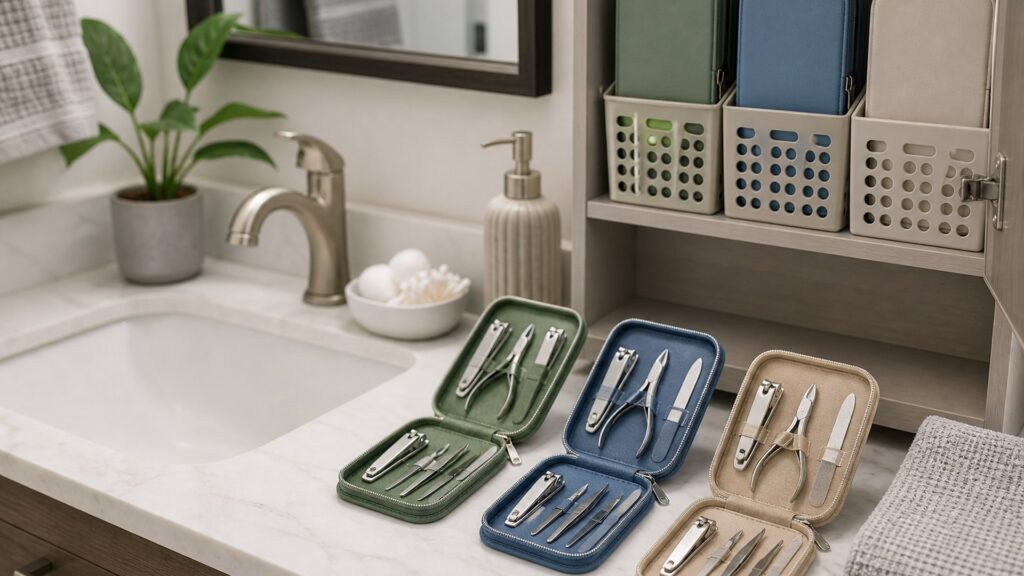
Label the tools: Use different case colors, names, or durable handle identifiers. Do not depend on remembering which identical clipper belongs to which household member.
Separate clean and used: Place recently used equipment in a washable holding tray until it is cleaned. Never return it directly beside prepared tools.
Secure hazards: Store nippers, blades, pointed cleaners, and powered attachments where children and casual bathroom users cannot reach them.
Shared-space profiles
Fit the system to the people using the room
Roommates, couples, families, and guests create different identification, access, and supervision needs.
The roommate household: Give each person a closed labeled case and assigned shelf or drawer area. Personal boundaries should remain obvious during rushed mornings.
The family bathroom: Use child-resistant placement for sharp pieces and keep adult specialty tools separate from simple supervised grooming equipment.
The frequent host: Maintain a clean guest file or inexpensive personal kit rather than offering a household member’s used implements. Dispose of single-use pieces appropriately.
Shared-space details
Inspect identification, retention, and cleanability
The best household tools remain recognizable and protected through frequent handling and bathroom humidity.
What a busy morning reveals
Peak traffic exposes mistaken ownership, open cases, unsafe counter placement, and whether users bypass the cleaning-status system to save time.
What one month reveals
Repeated washing shows fading labels, rust-prone joints, file wear, residue inside organizers, and whether each person replaces damaged tools responsibly.
Visible ownership: Color differences should remain clear after washing and normal wear. Labels belong on cases or handles without covering contact areas that require cleaning.
Protected contact surfaces: Cases must prevent blades, abrasive files, and pointed ends from touching neighboring items or fingers searching in a drawer.
Moisture management: Choose corrosion-resistant construction and storage that permits fully dried tools to remain clean without trapping sink splash or condensation.
Household mistakes
Do not confuse proximity with permission to share
A familiar household does not eliminate contamination or make damaged skin safe for communal tools.
Sharing a clipper casually: Use personal implements. Never share an item contaminated with blood or used around a suspected fungal, bacterial, or inflammatory nail condition.
Mixing damp tools: Metal pieces and brushes should dry completely before enclosed storage. Wet items touching clean equipment undermine careful separation.
Leaving sharp tools open: Countertop cups and unlatched cases expose blades to hands, towels, and falls. Close each personal kit after tools are dry.
Buying decision
Buy separate cores before shared extras
Individual essential kits are easier to identify, maintain, and replace than one large communal assortment.
Give each person essentials: A personal clipper and suitable file cover common maintenance. Add a brush or specialist according to that owner’s actual routine.
Standardize storage, not tools: Matching case formats can simplify the cabinet, but choose distinct colors or labels and never merge the contents.
Avoid communal bundles: A large kit with one of each implement encourages passing tools between users and makes cleaning responsibility unclear.
Household upkeep
Make sanitation status visible
Everyone should know whether a tool is clean, drying, damaged, or awaiting disposal without opening another person’s case.
Clean by material: Each owner follows the manufacturer’s directions for metal, files, brushes, and attachments, with special attention to joints and trapped debris.
Dry in assigned places: Use separate washable mats or racks with airflow, positioned away from toilet spray, sink splash, cosmetics, and toothbrushes.
Replace personally: Owners retire worn files, misaligned clippers, rusted metal, bent tips, or contaminated implements instead of passing them to someone else.
FAQ
Shared-bathroom nail-tool questions
These answers emphasize ownership, identification, protected storage, and contamination boundaries.
Can family members safely share nail clippers?
How should nail tools be labeled in a shared bathroom?
Where should clean nail tools dry in a shared bathroom?
Final check
Make personal boundaries effortless to follow
A successful shared bathroom keeps every nail implement identifiable, protected, clean, and under its owner’s control.
Confirm identity: No household member must handle or closely inspect a tool to determine who owns it or whether it is ready.
Confirm separation: Clean, used, and drying equipment occupy distinct places, and personal cases never become mixed communal storage.
Confirm safety: Sharp tools remain secured, children cannot reach them, and contaminated or damaged implements leave the bathroom rather than changing owners.
Reading Shortcuts
Move directly to the shared use decision stage you need.
Decision Reminders
Keep the evidence for shared use visible while comparing.
- Role: The nail tool serves the named task.
- Proof: The trial observes clean cuts, controlled filing, comfortable leverage, and intact surrounding skin.
- Care: Remove filings, disinfect compatible surfaces, and dry metal hinges before storage.
Glossary Snippets
Useful language for comparing nail tools.
When a Top 10 List Helps
Use rankings to discover credible nail tools, then screen them for shared use.
- The format is undecided: A broad list reveals plausible forms and price levels.
- A shortlist is needed: Rankings narrow discovery but do not replace fit testing.
Have finalists already? Open the comparison section.
When a Direct Comparison Helps
Compare finalists after establishing their suitability for shared use.
- Two candidates remain: Side-by-side evidence exposes meaningful tradeoffs.
- An upgrade is uncertain: Compare whether added cost corrects the original weakness.
Still exploring? Start with the Top 10 section.