
How to Choose Niche Fragrance for Travel Sizes
Travel fragrance is a packaging decision as much as a scent decision. The useful size must survive transport, comply with the journey’s rules, and provide enough wears without making leakage an acceptable risk.
Count planned applications, trip length, climate, and opportunities to replace the scent. Then compare factory minis, refillable atomizers, rollerballs, and solid formats by seal quality, labeling, spray behavior, and cleaning demands.
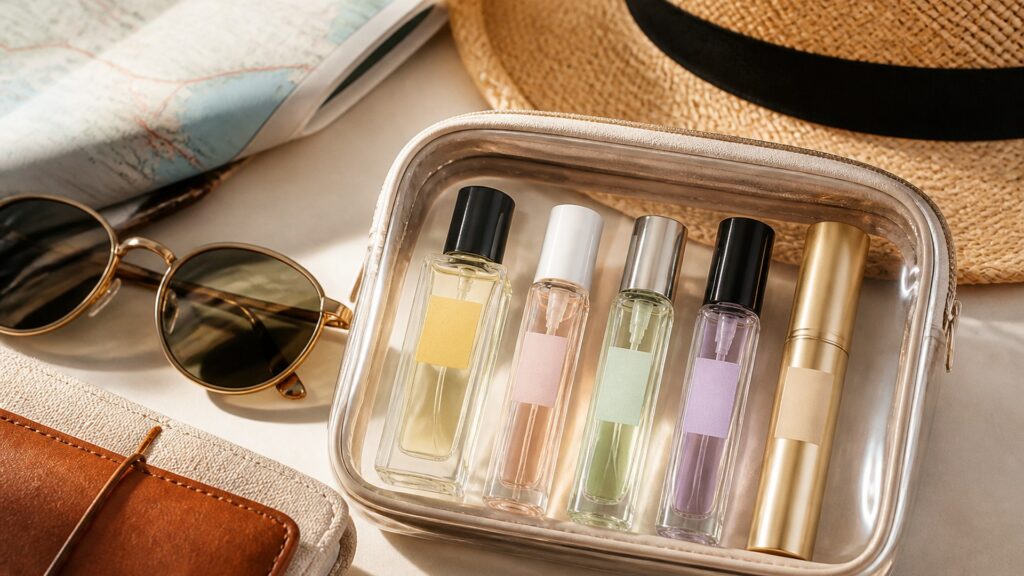
Buying framework
Define the portable fragrance job before comparing niche fragrances
Estimate trip volume from actual sprays per wear instead of assuming the smallest bottle will automatically last long enough.
Recreate the setting: A factory travel spray reduces decanting errors, while a refillable atomizer offers flexibility only when its valve seals reliably.
Write a pass condition: Test the container upside down inside a sealed pouch before allowing it near clothing, electronics, documents, or cosmetics.
Set the rejection line: Cabin pressure and heat amplify weak closures, so leave expansion room and avoid filling a reservoir to its absolute limit.
Use profiles
Match the niche fragrance to the person and frequency
Choose an opaque protective case when light exposure or breakage is plausible during repeated movement between accommodations.
The low-maintenance buyer: Label every decant with fragrance name and fill date; an anonymous vial becomes difficult to replace or evaluate later.
The careful experimenter: Compare spray output because a forceful travel nozzle may consume more liquid and project farther than the original bottle.
The targeted upgrader: Rollerballs conserve space but alter application and can collect skin oils, making them unsuitable for people who prefer touch-free spraying.
Specifications
Read niche fragrance specifications through real use
Solid perfume avoids liquid leakage yet may wear closer and behave differently from the familiar alcohol-based composition.
Evidence from the first trial
Clean reusable atomizers only by the maker’s method; trapped rinse water or residual scent can distort the next refill.
Evidence after repetition
Buy a larger format only when cost per milliliter matters more than portability, replacement ease, and loss exposure.
Working behavior: Retire a travel vessel that weeps around the collar, produces rusty droplets, cracks, or develops an unexplained odor.
Contact and comfort: Estimate trip volume from actual sprays per wear instead of assuming the smallest bottle will automatically last long enough.
Package and control: A factory travel spray reduces decanting errors, while a refillable atomizer offers flexibility only when its valve seals reliably.
Common mistakes
Avoid shortcuts that distort the portable fragrance decision
Test the container upside down inside a sealed pouch before allowing it near clothing, electronics, documents, or cosmetics.
Rewarding the loudest claim: Cabin pressure and heat amplify weak closures, so leave expansion room and avoid filling a reservoir to its absolute limit.
Testing under ideal conditions: Choose an opaque protective case when light exposure or breakage is plausible during repeated movement between accommodations.
Ignoring the boundary: Label every decant with fragrance name and fill date; an anonymous vial becomes difficult to replace or evaluate later.
Decision guidance
Decide when basic, premium, or no purchase makes sense
Compare spray output because a forceful travel nozzle may consume more liquid and project farther than the original bottle.
Choose a basic option: Rollerballs conserve space but alter application and can collect skin oils, making them unsuitable for people who prefer touch-free spraying.
Upgrade for evidence: Solid perfume avoids liquid leakage yet may wear closer and behave differently from the familiar alcohol-based composition.
Wait when uncertainty remains: Clean reusable atomizers only by the maker’s method; trapped rinse water or residual scent can distort the next refill.
Ownership & compatibility
Keep the niche fragrance reliable after purchase
Buy a larger format only when cost per milliliter matters more than portability, replacement ease, and loss exposure.
Build the reset step: Retire a travel vessel that weeps around the collar, produces rusty droplets, cracks, or develops an unexplained odor.
Watch compatibility: Estimate trip volume from actual sprays per wear instead of assuming the smallest bottle will automatically last long enough.
Know the retirement signal: A factory travel spray reduces decanting errors, while a refillable atomizer offers flexibility only when its valve seals reliably.
FAQ
Questions about niche fragrances for portable fragrance
Test the container upside down inside a sealed pouch before allowing it near clothing, electronics, documents, or cosmetics.
What should I check first when choosing a niche fragrance for portable fragrance?
How long should I test the niche fragrance?
When is a more expensive niche fragrance worthwhile?
Bottom line
Finish the portable fragrance choice with observable proof
Cabin pressure and heat amplify weak closures, so leave expansion room and avoid filling a reservoir to its absolute limit.
Restate the actual role: Choose an opaque protective case when light exposure or breakage is plausible during repeated movement between accommodations.
Rehearse an ordinary day: Label every decant with fragrance name and fill date; an anonymous vial becomes difficult to replace or evaluate later.
Write the purchase reason: Compare spray output because a forceful travel nozzle may consume more liquid and project farther than the original bottle.
Reading Shortcuts
Move directly to the portable fragrance decision stage you need.
Decision Reminders
Keep the evidence for portable fragrance visible while comparing.
- Role: The niche fragrance serves the named task.
- Proof: The trial observes distinctive development, personal wearability, credible craftsmanship, and repeat interest.
- Care: Retain the cap, limit heat and light exposure, and document the opening date.
Glossary Snippets
Useful language for comparing niche fragrances.
When a Top 10 List Helps
Use rankings to discover credible niche fragrances, then screen them for portable fragrance.
- The format is undecided: A broad list reveals plausible forms and price levels.
- A shortlist is needed: Rankings narrow discovery but do not replace fit testing.
Have finalists already? Open the comparison section.
When a Direct Comparison Helps
Compare finalists after establishing their suitability for portable fragrance.
- Two candidates remain: Side-by-side evidence exposes meaningful tradeoffs.
- An upgrade is uncertain: Compare whether added cost corrects the original weakness.
Still exploring? Start with the Top 10 section.