
How to Choose Off-Road & Overlanding for Overlanding Trip Setups
Overlanding equipment is used in a sequence, not as a catalog. Travelers stop, secure the vehicle, deploy weather protection, retrieve food and water, sleep, then reverse the process—sometimes in rain, darkness, wind, or a hurried departure.
Sketch that daily sequence before choosing tents, drawers, kitchens, batteries, or water tanks. Travel camps reward fast deployment and clean pack-down; base camps can justify more living space. Place emergency and recovery gear outside the camp puzzle, separate wet and food zones, and weigh the complete setup by axle. The best arrangement reduces repeated handling while remaining modular enough for shorter trips, repairs, and ordinary vehicle use.
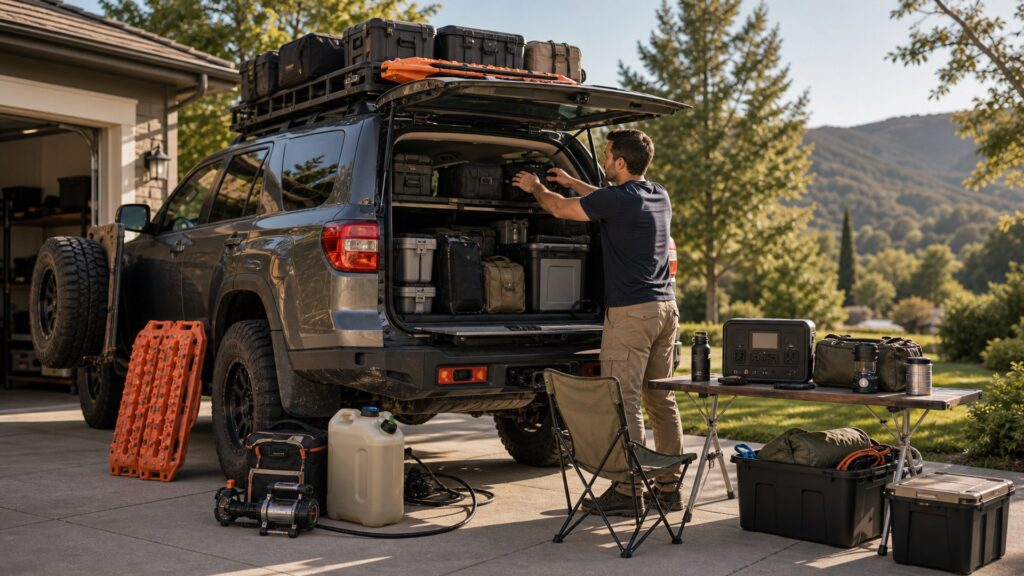
Buying framework
Design the trip as a sequence of transitions
Map arrival through departure, then assign each system a location, access order, and deployment envelope.
Write the daily rhythm: Record drive hours, arrival light, camp frequency, cooking pattern, sleep needs, rest days, and how often the vehicle leaves camp.
Draw deployment envelopes: Measure tent, awning, hatch, drawer, ladder, doors, and kitchen clearances so one open system does not trap another.
Separate critical access: Recovery, first aid, fire extinguisher, communication, rain gear, and departure tools must remain reachable without building camp.
Test the reverse sequence: Pack wet shelter, dirty shoes, hot cookware, bedding, waste, and cables in a realistic departure drill before fixing storage positions.
Who this is for
Match the setup to how the trip moves
A moving camp, stationary base, family trip, and shoulder-season route place different demands on space and repetition.
Daily movers: Prioritize fast sleep and kitchen deployment, minimal loose items, simple leveling, and weatherproof pack-down.
Base-camp travelers: More sheltered living area and removable day-trip modules can justify added setup when camp remains established.
Families and pets: Provide safe seating, private changing, nighttime exits, low-step access, temperature control, and separate food or animal supplies.
Cold or wet travelers: Favor interior access to dry layers, protected cooking alternatives where safe and permitted, condensation management, and a deliberate wet-gear zone.
What to pay attention to
Trip-setup specifications measured in minutes and movements
Capacity matters, but repeated handling, blocked access, and weather exposure determine daily usability.
Camp Workflow
Deployment time, access order, living zones, exits, lighting, privacy, and pack-down.
Vehicle Integration
Payload, axle balance, securement, roof limits, ventilation, electrical use, water mass, and service access.
True deployment time: Time the complete process including leveling, stakes, bedding, kitchen, lighting, and safe storage—not only the product's opening motion.
Packed and deployed dimensions: Check door swing, ladder angle, guy lines, hatch height, campsite footprint, garage clearance, and whether adjacent systems remain usable.
Resource turnover: Calculate daily water, food, refrigeration, battery, fuel, and waste volume with realistic recharge or resupply.
Securement and load placement: Count container and mounting mass, keep dense items low, protect occupants, and verify access after every strap is tensioned.
Weather recovery: Plan how wet canvas, muddy boards, frozen hoses, condensation, and wind-exposed components are handled without contaminating bedding or food.
Avoid these traps
Trip setups that create work at every stop
Small workflow penalties compound across a multi-day route and become safety problems in bad weather.
Buying for campsite photos: Large living systems can demand level ground, clearance, stakes, and pack time unavailable on frequent travel nights.
Burying departure equipment: A jack, recovery point, rain layer, or compressor under bedding and kitchen boxes delays urgent roadside or trail action.
Making every system permanent: Fixed drawers, tanks, batteries, and kitchens consume payload year-round and can block repairs or alternative trip layouts.
Ignoring wet pack-down: A setup tested only in dry weather may trap moisture, soil bedding, damage electronics, and require impossible drying during consecutive storms.
Decision guidance
Choose the layout that removes the most repeated handling
Spend payload and money where a system improves every arrival or departure, not one imagined campsite.
If camp moves daily: Choose compact modular shelter, sleep, cooking, and power that deploy independently and packs in a fixed order.
If camp stays put: Use a base shelter with removable vehicle modules so navigation, recovery, food, water, and communication can travel during day trips.
If interior space is scarce: Prioritize occupant safety and sleep first, then move durable weather-tolerant cargo outside within roof, hitch, or bed limits.
If weather drives complexity: Buy ventilation, drainage, covered access, robust anchors, and wet storage before adding decorative camp furniture or redundant appliances.
Ownership & compatibility
Shakedown the setup through complete camp cycles
Real transitions reveal pinch points, forgotten tools, condensation, battery deficits, and loads that migrate.
Run a driveway overnight: Use only packed gear, operate water and power, cook, sleep, handle waste, and depart on a timer without entering the house.
Inspect after rough travel: Check mounts, straps, drawers, tanks, wiring, roof hardware, abrasion, leaks, and shifted dense items before the next camp.
Revise the manifest: Record unused gear, repeated searches, scarce consumables, slow tasks, and weather failures; change placement before purchasing another organizer.
FAQ
Overlanding trip-setup questions
These answers cover camp styles, shelter, storage, water, power, and shakedowns.
Is a rooftop tent best for a moving overland trip?
How should I choose between drawers and removable totes?
Where should emergency gear be stored?
How much setup time is reasonable?
Should water storage be fixed or portable?
Do I need a refrigerator for every trip?
How should wet gear be packed?
What makes a good camp-lighting plan?
What is the best way to test a new setup?
Bottom line
The right trip setup makes movement easier
Design for the repeated transition, preserve critical access, and let the route—not a permanent equipment identity—decide what earns payload.
Map the sequence: Follow arrival, shelter, food, sleep, weather, and departure in order.
Protect access: Keep emergency and recovery equipment outside the camp unpacking chain.
Test and simplify: Run full cycles, weigh the vehicle, and remove systems that add more handling than value.
Reading Shortcuts
Move from the overlanding trip setup problem to a vehicle-compatible plan that can be installed and verified.
Decision Reminders
Keep the complete overlanding trip setup system in view while comparing parts.
- Rhythm: Moving camp or base camp.
- Envelope: Measure every open component.
- Access: Keep emergency gear independent.
- Weather: Plan wet pack-down.
- Resources: Match reliable resupply intervals.
- Modularity: Avoid permanent unused mass.
Glossary Snippets
Terms that separate useful performance from apparent compatibility.
When to Use a Top 10 Review
Use a overlanding trip setup roundup only after the required function, vehicle interface, and operating limits are known.
- Problem defined: The visibility or mobility failure is specific.
- Vehicle mapped: Interfaces and limits are documented.
- Format chosen: The correct product family is settled.
- Evidence available: Finalists can be compared on relevant tests.
Have finalists already? Open a Comparison for a closer tradeoff.
When to Use a Comparison
Compare overlanding trip setup finalists that solve the same defined problem on the same vehicle configuration.
- Application: Both match the exact vehicle and function.
- Performance: Evidence addresses the operating problem.
- Integration: Mounting and system effects are understood.
- Ownership: Inspection and service demands are acceptable.
Need a broader field? Use a Top 10 to form a shortlist.