
How to Choose Off-Road & Overlanding for Remote Camping Gear Lists
A remote camping list should answer failures, not product categories. What keeps the group safe if the route closes, a water container leaks, the vehicle will not start, a traveler is injured, or the cellular network disappears? The useful list connects each consequence to a capability.
For every critical item, record quantity, packed location, owner, inspection date, and backup. Calculate water, food, fuel, medication, and energy from actual people, pets, climate, duration, and delay reserve. Keep first response equipment accessible before camp is unpacked. Weigh the finished vehicle and remove low-consequence duplication. A shorter manifest with independent backups and practiced procedures is stronger than a huge checklist nobody can find or maintain.
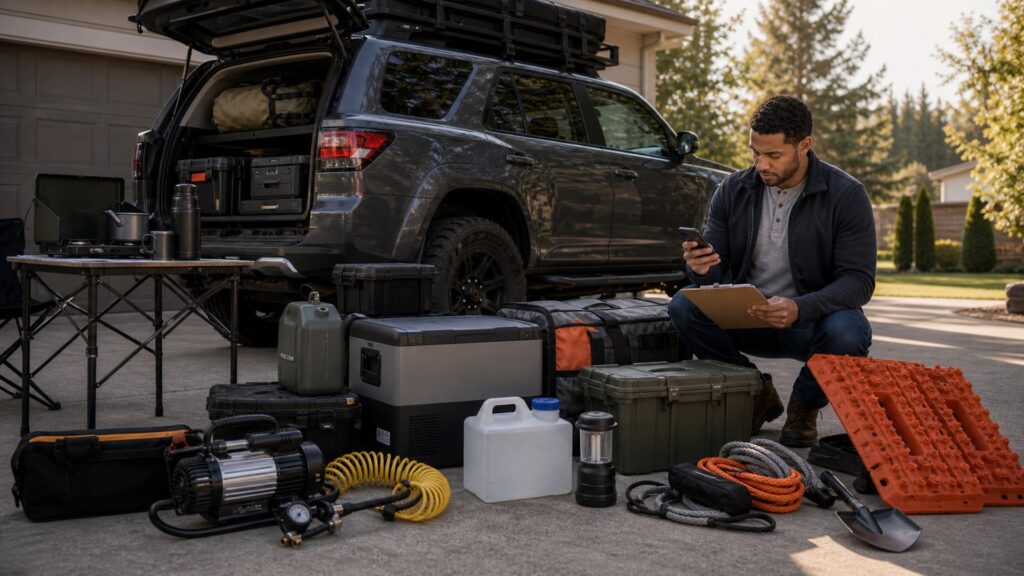
Buying framework
Build the manifest from consequences backward
Identify what can harm people or stop the trip, then assign a capability, quantity, backup, location, and owner.
List credible failures: Cover exposure, dehydration, illness, injury, fire, lost navigation, failed communication, puncture, no-start, immobilization, contamination, and delayed return.
Assign capability tiers: Mark life safety and mobility items critical, trip-continuity items important, and comfort items optional so payload decisions remain explicit.
Calculate and locate: Set quantities and delay reserves, then pack critical response gear where the failure leaves it reachable.
Create stop-trip rules: Define minimum water, communication, tire, brake, medication, weather, route, and mechanical conditions required to continue.
Who this is for
Scale the list to remoteness and group needs
A supported campground, remote solo route, family trip, and extreme climate require different reserves and redundancy.
Remote solo travelers: Prioritize independent communication, conservative check-ins, self-recovery, medical limitations, simple systems, and backups operable with one injured hand.
Families and groups: Add participant medications, child or elder needs, head counts, role assignments, sanitation capacity, food allergies, and communication between separated vehicles.
Hot or cold climate users: Increase condition-specific water, electrolytes, insulation, shade, heating, fuel, battery, sun, freeze, and fire planning without relying on one powered system.
Multi-vehicle convoys: Distribute shared tools without assuming the vehicles remain together; each vehicle retains minimum water, shelter, navigation, communication, medical, and mobility capability.
What to pay attention to
Gear-list fields that make equipment auditable
A product name is insufficient; the manifest needs quantity, condition, compatibility, storage, and independent backup.
Human Continuity
Water, food, shelter, temperature, medical care, sanitation, fire safety, and signaling.
Vehicle Continuity
Fuel, tires, repair, recovery, power, navigation, communication, tools, spares, and documentation.
Consumption and reserve: Calculate daily water, food, medication, fuel, and energy, then add scenario-based delay rather than an unexplained percentage.
Compatibility and competence: Record sizes, fluids, connectors, battery chemistry, tire repair method, recovery points, medical training, and who can operate each system.
Storage environment: Protect medication, batteries, water, food, textiles, fuel, and electronics from heat, freezing, crushing, moisture, contamination, and animals.
Inspection status: Track expiration, charge, seal, corrosion, calibration, recalls, firmware, missing pieces, and practice dates before loading.
Location and retrieval: Use a stable packing map and labels; test retrieval in darkness, rain, with seats occupied, and before deploying shelter.
Avoid these traps
Remote gear lists that look complete but fail as systems
Quantity without independence, location, inspection, and practice creates false confidence.
Duplicating one failure mode: Two phones on one network, two pumps on one battery, or all water in one tank do not provide independent resilience.
Packing to container capacity: Filling every drawer or box ignores axle load, tire capacity, securement, emergency access, and space for wet or damaged gear.
Treating first aid as a purchased kit: Contents must match travelers, training, prescriptions, allergies, climate, remoteness, and an escalation or evacuation plan.
Skipping consumable rotation: Expired medication, discharged communicators, stale fuel, contaminated water containers, damaged food packaging, and corroded batteries fail silently.
Decision guidance
Buy capability gaps before checklist upgrades
Add equipment only when it closes a high-consequence failure with acceptable mass and maintenance.
If water is a single point: Split storage, add a suitable treatment or collection option, protect containers, and practice sanitation without assuming every source is available.
If communication depends on cellular service: Choose an appropriate independent method, subscription, power backup, contact plan, and trained message procedure for the route.
If mobility depends on one tire solution: Carry tools and spares matched to tire construction, wheel hardware, inflation needs, vehicle lifting points, and damage beyond a simple tread puncture.
If payload is exhausted: Remove optional furniture, duplicate cookware, excess clothing, decorative accessories, and redundant organizers before reducing critical water or recovery margins.
Ownership & compatibility
Maintain the manifest like safety equipment
A list is current only when contents, travelers, route, subscriptions, and vehicle configuration still match.
Run a pre-trip audit: Verify identities, medical needs, route permissions, weather, contacts, subscriptions, quantities, dates, charges, seals, tools, and packed locations.
Practice critical retrieval: Time water isolation, first-aid access, fire response, communication, tire repair, navigation backup, shelter, and recovery setup without unpacking unrelated gear.
Close the loop after travel: Record consumption, damage, shortages, unused mass, failed assumptions, and new participant needs before cleaning, drying, charging, and restocking.
FAQ
Remote camping gear-list questions
These answers cover quantities, redundancy, medical care, communication, and payload.
How much emergency water should I carry?
Is a water filter enough for any remote source?
Do I need both cellular and satellite communication?
What belongs in a remote first-aid kit?
How should shared convoy gear be divided?
What vehicle spares are worth carrying?
How do I avoid overpacking remote camping gear?
Where should fire-safety equipment be stored?
What should trigger canceling or turning back?
Bottom line
A remote gear list is a maintained risk-control system
Equip high-consequence capabilities, separate common failure modes, keep critical items reachable, and let measured consumption remove unnecessary mass.
Start with failure: Map exposure, water, medical, communication, navigation, mobility, and fire consequences.
Make it auditable: Record quantity, location, owner, condition, backup, and stop-trip threshold.
Practice and revise: Retrieve critical gear, measure use, rotate supplies, and remove items that never justify their load.
Reading Shortcuts
Move from the remote camping manifest problem to a vehicle-compatible plan that can be installed and verified.
Decision Reminders
Keep the complete remote camping manifest system in view while comparing parts.
- Consequence: Life safety before comfort.
- Quantity: People, climate, duration, delay.
- Independence: Avoid shared failure modes.
- Access: Retrieve before unpacking camp.
- Inspection: Dates, charge, seals, condition.
- Threshold: Know when to stop or turn back.
Glossary Snippets
Terms that separate useful performance from apparent compatibility.
When to Use a Top 10 Review
Use a remote camping manifest roundup only after the required function, vehicle interface, and operating limits are known.
- Problem defined: The visibility or mobility failure is specific.
- Vehicle mapped: Interfaces and limits are documented.
- Format chosen: The correct product family is settled.
- Evidence available: Finalists can be compared on relevant tests.
Have finalists already? Open a Comparison for a closer tradeoff.
When to Use a Comparison
Compare remote camping manifest finalists that solve the same defined problem on the same vehicle configuration.
- Application: Both match the exact vehicle and function.
- Performance: Evidence addresses the operating problem.
- Integration: Mounting and system effects are understood.
- Ownership: Inspection and service demands are acceptable.
Need a broader field? Use a Top 10 to form a shortlist.