
How to Choose Oral Care Products for Gum Health
Products for gum health should make plaque easier to disrupt where it collects: along the gum margin and between teeth. That is chiefly an access-and-control problem. A compact soft brush that reaches the back molars and an interdental method suited to the actual spaces can matter more than aggressive bristles or a dramatic mouthwash sensation.
Build the routine around surfaces, not promises. Consider head geometry, pressure feedback, floss handling, interdental-brush diameter, and the cleanup required by a water flosser. These tools support daily hygiene; they do not diagnose or treat gum disease. Persistent bleeding, swelling, pain, or recession deserves professional evaluation.
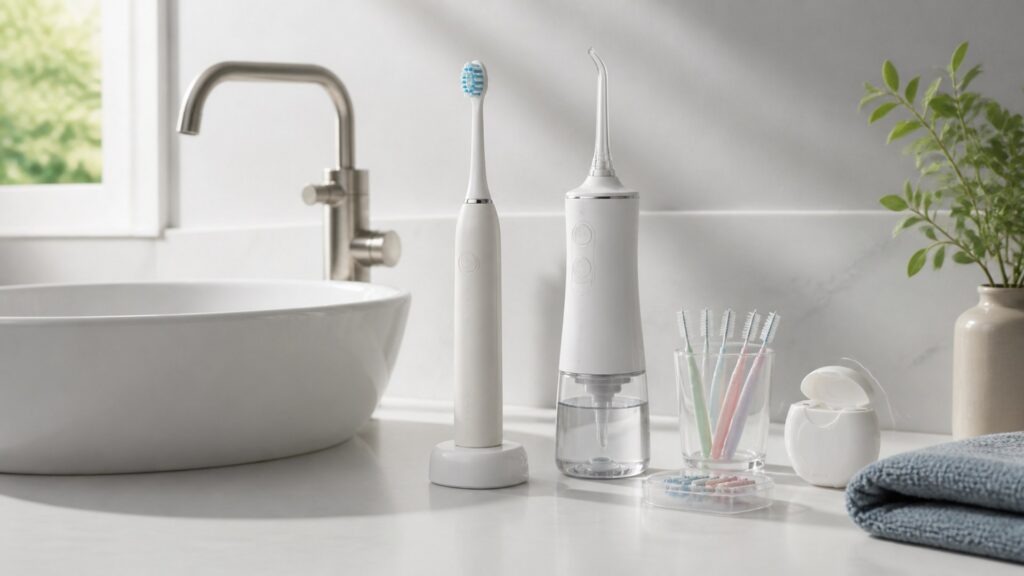
Buying framework
Map the surfaces before choosing the tool
A gum-focused routine needs controlled contact at the margin plus a credible way to reach between teeth. Choose those two functions first and add accessories only for a specific access problem.
Cover the gum margin: Select a soft-bristled head small enough to follow the line around front and back teeth without forcing the handle into an awkward angle.
Choose an interdental route: String floss, holders, interdental brushes, and water flossers solve different handling and space problems. Pick the route that can enter the relevant areas without being forced.
Control force: A comfortable light grip and, where useful, pressure feedback make technique easier to repeat. Scrubbing harder is not a substitute for positioning filaments correctly.
Fit the mouth, not the package: Tight contacts, open spaces, braces, bridges, and dexterity limitations change the useful format. One diameter or tip should not be assumed to fit every site.
Plan replacement: Splayed bristles, bent interdental wires, frayed floss, and unavailable proprietary heads undermine otherwise sound choices. Check refill cost and access before committing.
Who this is for
Different mouths create different access problems
The best pairing depends on hand control and what occupies the spaces between teeth. These profiles change the mechanics, not merely the product size.
The tight-contact flosser: Floss must pass through close contacts without shredding, then wrap against each tooth surface. Texture and handling matter more than a thick interdental brush that cannot enter safely.
The open-space cleaner: Larger embrasures may suit a correctly sized interdental brush that contacts tooth sides without force. Several diameters may be needed across one mouth.
The powered-brush pressure reducer: You tend to scrub or flatten bristles. A handle with clear pressure feedback and a small compatible head can redirect attention toward placement and time.
The braces or bridge wearer: Hardware and connected restorations create unusual paths. Threaders, specialized floss, interdental brushes, or water-flosser tips may help, but product selection should follow dental guidance for the specific appliance.
The limited-dexterity user: Fine floss wrapping is difficult. A holder with adequate reach or a powered water flosser may reduce finger demands, provided the device is simple to position, fill, and clean.
What to pay attention to
Specifications determine where contact lands
Oral-care labels often emphasize modes and sensations. For gumline care, geometry, force, and replacement condition produce more useful comparisons.
Contact geometry and access
Compare the part that reaches the tooth margin or interdental surface.
Force control and repeatability
Consider grip, feedback, dexterity, mess, upkeep, and refill supply.
Brush-head footprint: A shorter, narrower head can reach behind last molars and track curved margins more easily than a long head that collides with cheeks.
Bristle softness and end condition: Choose soft filaments and inspect them over time. Flaring or crushed tufts alter contact and may reveal that pressure is excessive.
Powered pressure feedback: Sensors may slow, stop, light, or vibrate at a threshold. The useful design gives feedback you notice without disrupting placement.
Floss construction: Monofilament, multifilament, coated, and tape-like flosses differ in glide, spread, and shredding. Select the texture you can pass and curve around tooth sides consistently.
Interdental-brush diameter: The brush should contact surfaces without buckling the wire or requiring force. Size can vary by site, so multipacks or professional sizing guidance can be useful.
Wire and handle geometry: A coated wire, angled neck, and secure grip change access around posterior teeth or appliances. Replace a brush whose wire kinks or filaments collapse.
Water-flosser controls: Reservoir capacity, pressure range, tip angle, pause button, and sink-side footprint affect use. Start and operate according to directions rather than treating maximum pressure as the goal.
Avoid these traps
Intensity can disguise poor access
Strong sensation and visible force can feel productive while leaving difficult surfaces untouched. Correct the route before increasing pressure.
Choosing medium or hard bristles for power: Stiffer filaments do not fix an oversized head or poor angle. A soft brush used with controlled placement is the more appropriate starting point for routine gumline cleaning.
Forcing one interdental size everywhere: A brush that bends in a tight contact or barely touches an open space is mismatched. Use appropriately sized formats and seek sizing guidance when uncertain.
Snapping floss into the gums: Forcing floss past a contact sacrifices control. Choose a construction that glides through, then guide it along tooth surfaces rather than driving it into tissue.
Using rinse as the mechanical step: A mouth rinse does not physically wipe every gum margin or interdental surface. Treat any rinse as an adjunct chosen for its labeled purpose, not a replacement for brushing and between-teeth cleaning.
Ignoring persistent bleeding: Bleeding is not a score for an effective product. If it persists, recurs, or comes with swelling, pain, or recession, arrange professional evaluation instead of escalating force.
Decision guidance
Choose the route that reaches the missed surface
Start with the location your current routine cannot clean predictably. Then choose the least forceful format that reaches it.
If brushing misses back margins: Try a smaller soft head and a handle that supports precise angles. A powered brush may help with timing or motion, but head access remains the first filter.
If contacts are tight: Choose floss that passes without shredding and can curve along both adjacent tooth surfaces. A slim holder can help only if it still reaches the back teeth accurately.
If spaces are open: Use an interdental brush sized to make gentle filament contact without bending the wire. Different areas may need different diameters.
If braces or bridges block the route: Consider threaders, specialized floss, angled interdental brushes, or a directed water jet. Confirm the technique with a dental professional familiar with the appliance.
If hand control is limited: Favor large grips, reachable controls, or a water flosser that is easy to fill and aim. Reject any device whose reservoir or cleaning process becomes a barrier.
If symptoms continue: Products are not a substitute for assessment of persistent bleeding, swelling, pain, bad taste, or visible recession. Seek dental care rather than rotating through harsher tools.
Ownership & compatibility
Keep contact surfaces clean and intact
The working ends of gum-care tools wear quickly and touch personal oral surfaces. Condition and hygiene matter as much as the original specification.
Replace by condition and directions: Change brush heads when bristles flare or according to maker guidance. Discard interdental brushes when filaments collapse or the wire bends, not after forcing extra uses.
Rinse and air-dry: Remove visible debris, rinse tools as directed, and let them dry openly. Store personal brush heads so they do not contact one another.
Maintain water-flosser parts: Empty, clean, and descale reservoirs, lines, and tips according to the manufacturer. A large tank is only convenient if its corners and lid are accessible.
Confirm refill continuity: Before buying a powered handle or specialized holder, check that compatible heads and tips are available at a tolerable recurring cost.
FAQ
Questions about gum-focused tools
These answers clarify force, access, and product boundaries.
Are soft toothbrush bristles effective for gumline cleaning?
Is an electric toothbrush better for gums?
Should floss make my gums bleed at first?
How do I size an interdental brush?
Can a water flosser replace string floss?
Does mouthwash improve gum health by itself?
How often should toothbrush heads be replaced?
Are rubber interdental picks the same as brushes?
When should gum symptoms be checked professionally?
Bottom line
Gentle contact only works when it reaches
Build gum-focused oral care around a soft brush that follows the margin and an interdental method fitted to the actual spaces. Pressure, accessories, and rinses cannot compensate for inaccessible surfaces.
Map the surfaces: Separate gumline brushing from between-teeth cleaning.
Fit the contact: Match head size, floss texture, or brush diameter to the route.
Limit force: Use feedback and controllable handles instead of harsher bristles.
Escalate symptoms, not intensity: Persistent bleeding or swelling belongs in dental assessment.
Reading Shortcuts
Navigate the decisions that shape gum-focused cleaning.
Decision Reminders
Keep the shortlist focused on gum-focused cleaning.
- Margin: Use a soft head that reaches the back teeth.
- Between teeth: Select floss, brushes, or jets by access.
- Force: Control placement instead of scrubbing harder.
- Diameter: Never force an interdental brush into a tight site.
- Refills: Check compatible heads and tips before purchase.
- Symptoms: Persistent bleeding or swelling needs assessment.
Glossary Snippets
Useful oral-care terms for this purchase.
When to Use a Top 10 Review
Use rankings after the product role for gum-focused cleaning is settled.
- Method chosen: Keep candidates suited to gum-focused cleaning.
- Access known: Remove formats that cannot reach the intended surfaces.
- Technique realistic: Favor tools you can control at the stated frequency.
- Finalists needed: Compare concrete design and label differences.
Already down to two choices? A Comparison can isolate the decisive difference.
When to Use a Comparison
Compare finalists by how they handle gum-focused cleaning, not by accessory count.
- Contact differs: Compare bristle, filament, tray, or applicator geometry.
- Directions differ: Check frequency, duration, and use sequence.
- Tolerance differs: Weigh irritation or sensitivity tradeoffs.
- Upkeep differs: Count refills, cleaning, and replacement.
Still exploring? Begin with a Top 10 after defining the exact product type.