
How to Choose Oral Care Products for Plaque Removal
Plaque removal is not one identical task across the mouth. A toothbrush can disturb biofilm on exposed outer, inner, and chewing surfaces, but its bristles do not predictably clean every contact between teeth. A useful shopping plan therefore pairs a controllable brush with an interdental method suited to the spaces, dental work, and hand skills involved.
Compare products by where their working ends can touch and how clearly they support technique. Head size, bristle condition, floss glide, interdental-brush diameter, tip angle, timers, and pressure alerts all answer different questions. They support routine cleaning; they do not remove hardened deposits or treat dental disease. Persistent symptoms or deposits warrant professional care.
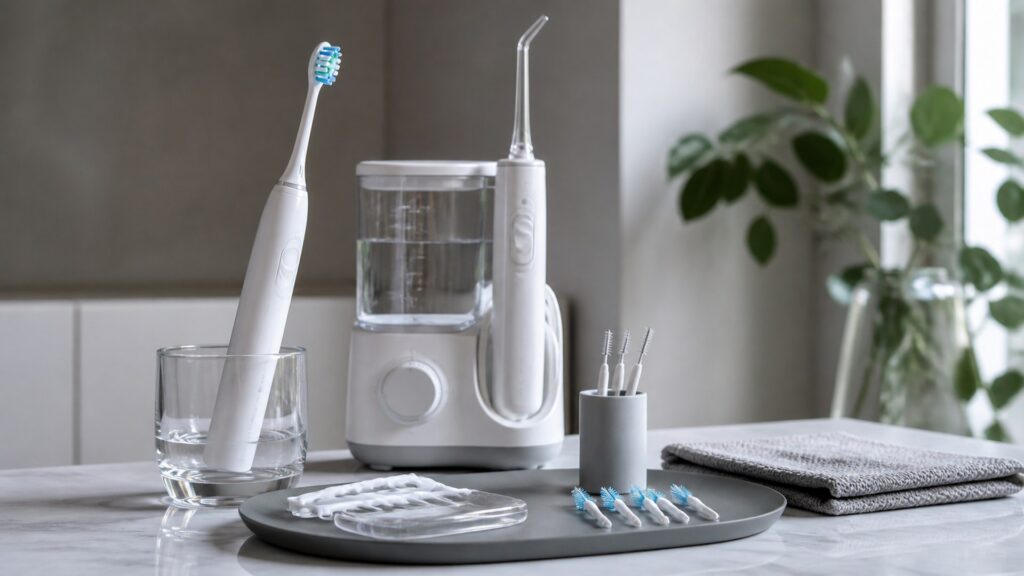
Buying framework
Assign a tool to every reachable surface
Begin with the cleaning map rather than a feature list. Brushing and interdental cleaning are complementary mechanical jobs, and each product should have a defined target.
Separate the two jobs: Use a toothbrush for exposed tooth faces and chewing surfaces, then choose a separate route for between-teeth areas the head cannot enter.
Map the missed locations: Notice whether access breaks down behind last molars, along inner surfaces, at tight contacts, around open gaps, or near braces and bridgework.
Favor controlled contact: Soft, intact bristles and a manageable grip support deliberate positioning. Added force cannot make an oversized head fit or a floss product reach correctly.
Choose feedback for the actual error: A timer addresses rushed sessions, quadrant prompts address uneven coverage, and a pressure alert addresses force. Pay only for feedback tied to a behavior you need to change.
Keep treatment claims out of the shortlist: Plaque-control tools support daily hygiene, but hard deposits, pain, swelling, or persistent bleeding require dental assessment rather than a more aggressive product.
Who this is for
Match the method to the access problem
People miss plaque for different mechanical reasons. Identify the difficult surface and the handling constraint before selecting a format.
The back-molar angle seeker: A long head collides with the cheek or makes inner surfaces awkward. Prioritize a compact soft head, slim neck, and handle that can be rotated without forcing the bristles.
The rushed, uneven brusher: You finish quickly or repeatedly skip the same area. A visible timer and quadrant pacing may be more useful than extra intensity modes because they prompt duration and movement.
The tight-contact cleaner: Choose floss that passes without shredding and can curve along each neighboring tooth. A holder may reduce finger demands if its angle still reaches the rear contacts.
The open-space or hardware user: Interdental brushes or directed water-flosser tips may navigate wider spaces, braces, or bridgework. Diameter and access path matter, and a dental professional can help with site-specific selection.
The limited-dexterity household: Large grips, reachable controls, stable reservoirs, and prethreaded holders can simplify handling. The best device is one the user can position, operate, clean, and refill without assistance that is rarely available.
What to pay attention to
Geometry and feedback do different work
The useful specifications explain contact, access, or execution. Mode counts and intense sensations deserve less weight when they do not change which surfaces are reached.
Contact and surface access
Compare the dimensions and materials that physically meet each tooth surface.
Technique control and feedback
Assess whether the handle and prompts correct a real coverage, force, or handling problem.
Brush-head footprint: A compact head can turn behind molars and approach inner tooth faces with less collision. Overall handle size does not reveal this access by itself.
Bristle texture and condition: Soft filaments are the routine starting point, but condition matters: flattened or splayed tufts make contact less predictable and indicate replacement or excessive pressure.
Pressure feedback: Powered brushes may flash, vibrate, or slow when force crosses a threshold. Choose a signal you can notice while keeping the head positioned, not merely a sensor listed on the box.
Pacing system: A two-minute timer tracks total duration; interval prompts divide that time into mouth sections. Neither confirms that bristles reached every margin or that the angle was correct.
Interdental working end: Floss varies in thickness, glide, spread, and resistance to shredding. Interdental brushes vary by diameter and wire geometry, so the correct match depends on the actual space.
Water-flosser handling: Pressure range, tip articulation, pause control, reservoir stability, and hose reach shape aiming and cleanup. Maximum pressure is not the default goal; directions and comfortable control govern use.
Avoid these traps
Do not confuse intensity with coverage
A product can feel powerful while missing plaque-bearing surfaces. These shortcuts usually solve the wrong part of the cleaning problem.
Buying one tool for the entire mouth: A toothbrush head cannot enter every interdental area, while floss or a water jet does not replace brushing exposed surfaces. Plan complementary roles instead of seeking one universal device.
Ranking powered brushes by mode count: Whitening, massage, or multiple intensity labels add little if the head cannot reach or the user ignores placement. Compare useful feedback and compatible head geometry first.
Scrubbing harder when plaque remains: Greater force does not correct a missed angle or blocked contact. Reposition the working end, select a more suitable size, and use pressure feedback if force control is the recurring issue.
Forcing an interdental brush: A wire that buckles or requires pressure is not appropriately matched to that space. Another diameter or a different interdental route may be needed, sometimes with professional sizing guidance.
Treating freshness as proof: Strong flavor, foam, or mouthwash sensation does not show that biofilm was mechanically disturbed. Judge the routine by surface access and technique, not the intensity that remains afterward.
Decision guidance
Build a two-part plaque-control kit
Select the brush for broad surface coverage, then add the interdental method that best negotiates your contacts and constraints. Use feedback only where it resolves a known technique gap.
If broad brushing access is the main problem: Choose a compact soft head and maneuverable handle. Add powered motion only if its pacing or pressure cues make your technique more consistent; the motor does not fix poor reach.
If tight contacts are the main problem: Pair the brush with floss that glides through and wraps along tooth sides without shredding. Consider a holder when finger control is the barrier, checking that its frame reaches posterior teeth.
If spaces are wider or irregular: Consider properly sized interdental brushes that make gentle filament contact without bending the wire. Different sites may require different diameters rather than one brush forced everywhere.
If appliances or dexterity complicate access: A water flosser, specialized tip, holder, or angled interdental brush may make the route more manageable. Confirm techniques around braces, implants, or bridgework with the treating dental professional.
If hard deposits or symptoms persist: Consumer tools are not substitutes for examination or professional removal of hardened deposits. Seek care for ongoing bleeding, swelling, pain, loose teeth, or areas that remain difficult to clean.
Ownership & compatibility
Maintain the parts that make contact
A well-chosen format only stays useful when its working end remains intact and clean. Refill supply and routine care belong in the purchase calculation.
Replace by wear and directions: Change manual brushes or powered heads when filaments splay, fade according to their indicator, or reach the maker's interval. Discard interdental brushes when wires bend or tufts collapse.
Rinse and air-dry: Remove visible debris and rinse each personal tool as directed, then let it dry in open air. Avoid storing wet working ends pressed together in a closed container.
Clean powered water systems: Empty and clean reservoirs, hoses, and tips according to the manufacturer's instructions, including any specified descaling. Check whether the tank opening and lid are easy to reach before buying.
Price the refill path: Confirm compatible heads, tips, floss cartridges, or interdental sizes are readily available. A low handle price can conceal a costly or fragile proprietary refill commitment.
FAQ
Plaque-removal product questions
These answers clarify product roles, feedback features, and the limits of home cleaning.
Is a powered toothbrush necessary for plaque removal?
Can brushing alone remove plaque between teeth?
What does a toothbrush pressure sensor actually do?
Are toothbrush timers accurate measures of cleaning?
Should I choose floss or an interdental brush?
Can a water flosser replace other interdental tools?
Does mouthwash remove plaque like brushing does?
Why do my gums bleed when I clean between teeth?
Can home products remove hardened plaque or tartar?
Bottom line
Choose contact first, feedback second
A complete setup covers exposed surfaces with a manageable soft toothbrush and between-teeth surfaces with a properly matched interdental route. Features earn their place only when they improve access or correct a specific technique problem.
Map every surface: Separate broad brushing zones from spaces that require interdental access.
Match the working end: Choose head size, floss construction, brush diameter, or jet control for the actual location.
Use targeted feedback: Select timers, pacing, or pressure alerts only for the behavior they can address.
Respect the boundary: Persistent symptoms and hardened deposits belong with a dental professional, not a harsher product.
Reading Shortcuts
Navigate the choices that shape mechanical plaque control.
Decision Reminders
Keep plaque-control purchases tied to access and technique.
- Coverage: Assign exposed and interdental surfaces to suitable tools.
- Contact: Favor controllable working ends over harsh sensation.
- Feedback: Match each prompt or sensor to a real technique gap.
- Fit: Do not force one interdental diameter into every space.
- Wear: Replace splayed heads and damaged working ends.
- Limits: Escalate persistent symptoms and hard deposits professionally.
Glossary Snippets
Useful terms for comparing plaque-control products.
When to Use a Top 10 Review
Use rankings after assigning the brushing and interdental roles.
- Jobs mapped: Know which surfaces each product must reach.
- Handling known: Exclude formats that exceed the user's dexterity.
- Feedback chosen: Prioritize only cues tied to a known error.
- Refills checked: Keep candidates with practical replacement paths.
Already down to two choices? A Comparison can isolate the decisive difference.
When to Use a Comparison
Compare finalists by surface access, feedback, and refill burden.
- Head geometry differs: Compare rear-molar and inner-surface access.
- Signals differ: Check how pacing and pressure warnings appear.
- Working ends differ: Evaluate floss, brush, or jet handling.
- Upkeep differs: Price heads, tips, cleaning, and storage.
Still exploring? Begin with a Top 10 after defining both cleaning roles.