
How to Choose Oral Care Products for Professional-Level Cleaning
No toothbrush, water flosser, or home kit can reproduce a professional dental examination or scaling. Dental professionals can identify conditions, assess areas you cannot see, and remove hardened calculus with training and appropriate instruments. The meaningful home goal is different: disrupt soft plaque thoroughly and consistently between visits.
Choose products that expose gaps in technique rather than promise a clinic in a box. A compact soft head, pressure feedback, timed coverage, an interdental method matched to the spaces, and occasional plaque-disclosing feedback can make home hygiene more systematic. The strongest kit improves reach without inviting harder scrubbing or self-scaling.
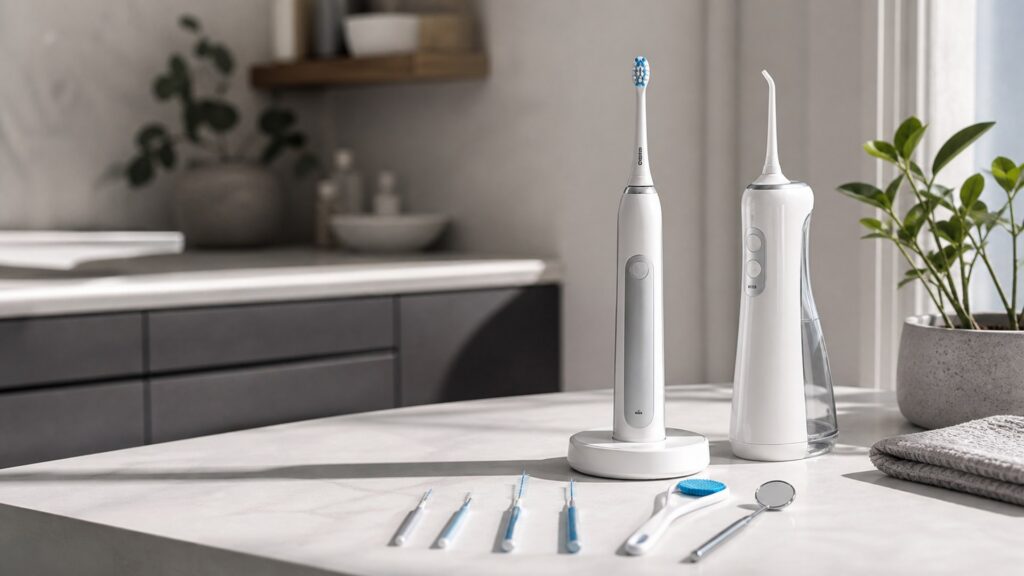
Buying framework
Define thoroughness as complete home coverage
Professional care and home hygiene have different jobs. Build the home routine around reachable surfaces, repeatable feedback, and a clear stop where examination or calculus removal begins.
Map every tooth surface: Plan outer, inner, chewing, gumline, posterior, and between-teeth contact. Extra brush modes do not compensate for a surface omitted from the route.
Use feedback to change technique: Timers address pacing, pressure sensors address force, and disclosing dye can reveal retained plaque. Each signal should prompt a specific adjustment rather than confer a score.
Pair brushing with interdental access: Brush filaments do not fully enter every contact. Select floss, interdental brushes, threaders, or a water flosser according to spacing, appliances, and hand control.
Reject home scaling: Metal scraping tools marketed for calculus removal cross the boundary of ordinary home hygiene. Hardened deposits and suspected disease belong with a dental professional.
Count the reset burden: Charging, replacement heads, reservoir cleaning, tip storage, and consumable dye all affect whether the supposedly advanced routine remains usable.
Who this is for
Thorough routines fail at different points
Find the surface or behavior that is currently unreliable. The appropriate upgrade may be feedback, access, or simplification rather than more power.
The uneven-coverage brusher: You finish quickly but repeatedly miss inner or rear surfaces. A quadrant timer, small head, and occasional disclosing check can make the route visible.
The heavy-handed powered user: Bristles flare and the handle is pressed firmly. Prioritize conspicuous pressure feedback and a head that cleans through placement, not force.
The appliance navigator: Braces, bridges, implants, or retainers create special access paths. Threaders, angled interdental tools, or directed water-flosser tips should be chosen with professional guidance for that appliance.
The low-maintenance thorough cleaner: You want complete coverage without a countertop of devices. A manual soft brush, one workable interdental format, and a clear sequence may outperform a complex kit that is rarely reset.
What to pay attention to
Specifications should reveal missed surfaces
Home-cleaning features are useful when they change position, force, access, or consistency. Judge them by the behavior they correct.
Coverage and technique feedback
Connect head geometry, timers, sensors, and visible plaque feedback to a named technique gap.
Home-use boundary and upkeep
Keep tools within routine hygiene and account for every replacement and cleaning obligation.
Head size and neck angle: A compact head and slim neck improve access behind last molars and along inner surfaces. Oversized heads can feel efficient while skipping tight curves.
Pressure-sensor behavior: Useful feedback is noticeable and immediate—light, vibration, slowdown, or stoppage. Confirm it operates during ordinary brushing rather than only in an app summary.
Timer structure: A two-minute timer measures duration; interval prompts divide the mouth into zones. Neither verifies plaque removal, but both can stabilize a systematic route.
Interdental geometry: Floss glide, holder reach, brush diameter, wire angle, and threader stiffness determine whether the space can be entered and both adjacent surfaces contacted.
Water-flosser controls: Tip rotation, pause button, pressure range, reservoir volume, and hose reach affect positioning and cleanup. Maximum pressure is not the purpose.
Disclosing visibility: Tablets, solutions, and swabs vary in mess, color intensity, and instructions. They provide temporary visual feedback and should not be interpreted as diagnosis.
Platform continuity: Check head and tip compatibility, local availability, charger footprint, battery status indication, and whether the reservoir can be fully accessed for cleaning.
Avoid these traps
Do not turn thoroughness into aggression
The professional-level label becomes hazardous when buyers equate it with scraping, maximum force, or self-diagnosis.
Buying a home scaler: A mirror and metal pick do not provide professional visibility, training, or infection control. Do not scrape hardened deposits yourself; arrange dental care.
Turning every setting to maximum: Fast motion or high water pressure does not prove improved surface contact. Use the tool's directions and correct placement before increasing intensity.
Collecting overlapping gadgets: Several powered devices can still leave the same interdental site untouched. Audit surfaces first, then assign one product to each actual access problem.
Treating disclosure as a health grade: Dye shows where plaque remains at that moment; it does not diagnose gum disease or cavities. Use it to adjust the route, not to avoid examination.
Confusing polish with cleanliness: A slick tooth surface or strong flavor can feel satisfying while posterior and interdental plaque remains. Sensation is not a substitute for mapped contact.
Decision guidance
Upgrade the missing part of the route
Begin with the failure point, then add the narrowest tool that fixes it. Some findings call for professional care rather than another device.
If brushing time is inconsistent: Choose a timer with interval prompts and a head that reaches your back teeth. Use the prompts to move through a fixed surface sequence.
If force is excessive: Select prominent pressure feedback and a comfortable handle for a light grip. Replace splayed heads and reassess technique rather than buying stiffer filaments.
If tight contacts are missed: Choose floss or tape that passes without shredding and can curve along tooth sides. A holder may reduce finger demands if its neck reaches posterior teeth.
If spaces or appliances need access: Consider correctly sized interdental brushes, threaders, or water-flosser tips. Ask a dental professional to demonstrate sizing and routing around the specific dental work.
If coverage is uncertain: Use a plaque-disclosing aid occasionally according to directions, then target the revealed route gap. Do not repeatedly scrub one stained area with excessive force.
If calculus or symptoms are present: Hardened deposits, persistent bleeding, pain, swelling, recession, or a loose tooth are not home-upgrade problems. Arrange professional examination and cleaning as advised.
Ownership & compatibility
Keep feedback tools trustworthy
Worn contact surfaces and neglected reservoirs change performance. A thorough routine includes inspection and replacement, not only purchase.
Retire distorted heads: Follow replacement guidance and change brush heads sooner when tufts flare or crush. Rapid wear can signal excessive pressure that a new head alone will not fix.
Keep interdental tools personal: Discard single-use items as directed, replace bent or frayed reusable pieces, and never force extra life from a compromised filament or wire.
Clean powered components: Wipe handles, dry charging areas, and follow maker instructions for seals and attachments. Check that replacement heads match the exact platform.
Service the water path: Empty and clean reservoirs, hoses, and tips as instructed, including descaling when specified. Store components so trapped moisture can dry.
FAQ
Thorough home-cleaning questions
These answers keep product expectations inside the home-care role.
Can a home device clean teeth like a dental hygienist?
Should I buy a dental scaler for home use?
Do more electric toothbrush modes improve cleaning?
What does a pressure sensor actually do?
Are plaque-disclosing tablets safe for daily use?
Does a water flosser provide a deep cleaning?
How do I know whether plaque has become calculus?
Can stronger toothpaste create a professional-clean feeling?
Which single upgrade makes home cleaning more thorough?
Bottom line
Thorough home care is systematic, not professional treatment
Build a repeatable path across visible surfaces and between teeth, using feedback only to correct technique. Keep professional examination and calculus removal firmly outside the home-product promise.
Map coverage: Give outer, inner, chewing, gumline, posterior, and interdental surfaces a place.
Use feedback purposefully: Let timers, sensors, and disclosure correct one known behavior.
Maintain every contact point: Replace worn heads and clean water paths as directed.
Respect the boundary: Calculus and persistent symptoms require professional care.
Reading Shortcuts
Navigate the main decisions in thorough home oral hygiene.
Decision Reminders
Keep thorough home oral hygiene tied to observable needs.
- Purpose: Name the exact job before choosing a format.
- Contact: Inspect the surface or material that does the work.
- Process: Count setup, use, cleanup, and replacement.
- Instructions: Require clear directions and warnings.
- Boundaries: Do not convert product claims into diagnosis.
- Record: Retain information needed for repeatable use.
Glossary Snippets
Terms that clarify the purchase.
When to Use a Top 10 Review
Use rankings after defining the role within thorough home oral hygiene.
- Role is fixed: Compare products that perform the same actual job.
- Requirements are fixed: Exclude candidates missing mandatory specifications.
- Burden is acceptable: Count training, cleaning, storage, or refills.
- A shortlist remains: Use ranked detail to narrow genuine peers.
Already down to two candidates? A Comparison is the sharper next step.
When to Use a Comparison
Compare finalists by their consequences for thorough home oral hygiene.
- Design differs: Compare contact geometry and control.
- Workflow differs: Count preparation and reset steps.
- Upkeep differs: Verify cleaning, replacement, and storage.
- Claims differ: Prefer documented limits over inflated language.
Still mapping the category? Start with a Top 10 after the decision criteria are settled.