
How to Choose Performance & Tuning for Reliability Tradeoffs
Reliability is not a brand reputation or a promise that a part will never fail. It is the probability that the complete vehicle performs its intended duty for an acceptable time with detectable deterioration and manageable consequences. Performance changes load, temperature, speed, traction, and repetition across connected systems.
Write the duty cycle before choosing the upgrade: how hard, how long, how often, in what weather, on which fuel, and with what recovery. Preserve emissions controls and diagnostics. Measure temperature, pressure, knock, slip, wear, and consumable use against a healthy baseline. Budget shorter service intervals and inspection time where evidence supports them. The best modification delivers the required outcome with sufficient margin, not the largest gain the hardware can briefly survive.
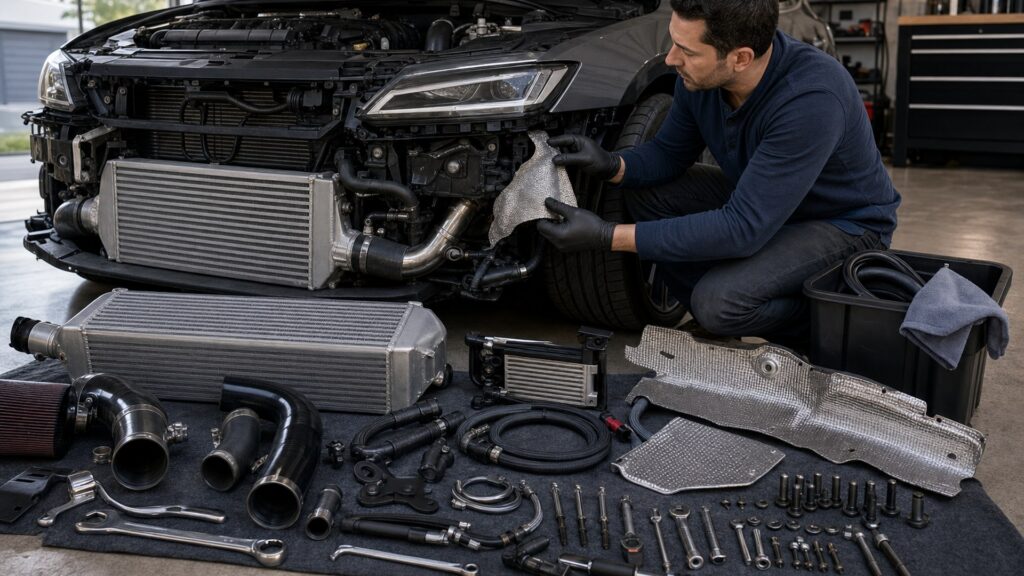
Buying framework
Build a reliability budget around the real duty cycle
Quantify stress, exposure, recovery, detection, service, and failure consequence before accepting more output or grip.
Define acceptable service: State performance target, operating duration, frequency, environment, fuel, maintenance tolerance, downtime, and acceptable component life.
Map added stress: Trace torque, pressure, heat, speed, grip, vibration, impact, and mass into fuel, cooling, brakes, driveline, bearings, mounts, and structure.
Preserve detection and protection: Keep truthful faults, knock response, temperature control, pressure limits, torque management, and derating rather than hiding symptoms.
Validate life indicators: Use repeated sessions, recovery trends, fluid and consumable condition, inspections, logs, and configuration records before increasing the stage.
Who this is for
Reliability targets differ by consequence and exposure
A short fair-weather drive, daily commute, towing route, and timed session place different value on margin, service, and recovery.
Daily drivers: Prioritize fuel availability, cold and hot starts, traffic heat, quiet diagnostics, emissions compliance, weather range, parts support, and predictable service.
Weekend performance users: Can accept measured consumable cost and inspection time, but still need stable transport, lawful road behavior, and a rollback plan.
Track or autocross drivers: Measure session heat, tire and brake cycles, lubrication, driver consistency, fastener checks, and event-completion margin before chasing peak output.
Heavy-load operators: Favor conservative torque delivery, cooling recovery, transmission and axle temperatures, tire capacity, brakes, and service intervals tied to load.
What to pay attention to
Reliability evidence beyond a single successful test
Useful evidence spans repeated loads, environmental range, wear progression, diagnostics, and recovery after the system is hot.
Margin Under Load
Pressure, temperature, fuel, lubrication, traction, torque, speed, vibration, and protective control.
Life and Recovery
Fatigue cycles, consumables, inspection, service intervals, parts support, diagnostics, failure containment, and rollback.
Repeated-condition data: Compare multiple matched runs or sessions for temperature creep, pressure stability, knock, slip, faults, output loss, and recovery time.
Fuel and calibration tolerance: Define supported fuel quality, ethanol content, temperature, altitude, sensor range, control authority, and safe response when conditions degrade.
Lubrication and cooling behavior: Verify level, pressure, aeration, temperature, flow, thermostat control, heat-exchanger capacity, airflow, and post-load recovery.
Consumable progression: Measure tire, pad, rotor, fluid, plug, filter, belt, clutch, and fastener condition by use cycles, not only odometer distance.
Failure transparency: Prefer systems with accessible inspection, genuine diagnostics, replacement parts, logs, and protective behavior that contains rather than conceals a fault.
Avoid these traps
Reliability claims that ignore accumulated exposure
One clean pull, lap, or test drive says little about heat soak, wear, fatigue, environmental range, and service burden.
Calling conservative calibration universally safe: Safety depends on exact hardware, fuel, environment, load, condition, controls, and validation; an adjective is not evidence.
Using stronger parts to justify unlimited load: Capacity in one component can transfer shock or heat to a weaker clutch, gear, joint, bearing, mount, tire, or structure.
Suppressing warnings for convenience: Disabled codes, monitors, torque limits, or temperature actions reduce detectability and can allow a local fault to cause broader damage.
Ignoring maintenance economics: Frequent fluids, tires, brakes, inspections, specialty labor, software support, and downtime can make an otherwise functional setup unsuitable.
Decision guidance
Choose the gain that leaves measurable operating margin
Accept a reliability trade only when its stress, detection, service, and failure consequences match the owner’s duty and budget.
If heat rises across repetitions: Improve maintenance, airflow, capacity, control, or recovery intervals before adding output, speed, mass, or grip.
If required fuel is not consistently available: Use a supported lower-demand calibration or reliable fuel strategy with correct sensing and safeguards rather than depending on optimistic knock correction.
If wear cannot be inspected: Choose a serviceable design with accessible joints, filters, fasteners, fluids, and sensors before accepting hidden fatigue or leakage.
If failure would strand or damage the vehicle: Increase margin, redundancy where appropriate, parts support, monitoring, rollback, and professional validation—or select a less aggressive stage.
Ownership & compatibility
Maintain reliability with configuration and condition records
Without a known build state and measured wear history, small changes become difficult to diagnose and safe limits drift.
Keep a duty log: Record configuration, software, fuel, weather, load, temperatures, pressures, faults, consumable measurements, service, and abnormal events.
Inspect by exposure: Schedule checks after heat cycles, track days, towing, launches, impacts, fluid events, and software changes rather than relying only on mileage.
Restore margin early: Respond to slower recovery, rising correction, pressure loss, wear acceleration, vibration, leaks, or recurring faults before secondary damage develops.
FAQ
Performance reliability tradeoff questions
These answers cover safe power, heat, service intervals, fuel, monitoring, protective controls, and component life.
How much power can my stock engine reliably handle?
Does a conservative tune guarantee reliability?
Why does heat matter after the first run?
Should maintenance intervals change after tuning?
Are forged internal parts always more reliable?
What gauges are most useful for reliability?
Can upgraded cooling offset any increase in power?
Why can more tire grip reduce reliability?
What signs mean a modification stage should be rolled back?
Bottom line
Reliability is the margin left after the performance is repeated
Define duty, measure accumulated stress, preserve protection and diagnostics, and choose a stage whose service burden and failure consequences remain acceptable.
Budget the stress: Map added load, heat, speed, traction, cycles, and environmental range across connected systems.
Keep failures visible: Retain truthful sensors, diagnostics, protection, inspection access, and complete configuration records.
Respond before damage: Track recovery and wear, service by exposure, and reduce the stage when evidence shows margin disappearing.
Reading Shortcuts
Move from the credible risk to a documented reliability budget that can be maintained and verified.
Decision Reminders
Keep the complete reliability budget in view while comparing equipment.
- Duty: How hard, long, and often.
- Margin: Temperature, pressure, fuel, and load.
- Protection: Keep control strategies truthful.
- Wear: Measure consumables and fatigue.
- Records: Configuration and exposure together.
- Rollback: Reduce demand when margin shrinks.
Glossary Snippets
Terms that separate useful performance from apparent compatibility.
When to Use a Top 10 Review
Use a product roundup only after the required capability and reliability budget limits are known.
- Problem defined: The visibility or mobility failure is specific.
- Vehicle mapped: Interfaces and limits are documented.
- Format chosen: The correct product family is settled.
- Evidence available: Finalists can be compared on relevant tests.
Have finalists already? Open a Comparison for a closer tradeoff.
When to Use a Comparison
Compare finalists that solve the same defined reliability budget need for the same vehicle and occupants.
- Application: Both match the exact vehicle and function.
- Performance: Evidence addresses the operating problem.
- Integration: Mounting and system effects are understood.
- Ownership: Inspection and service demands are acceptable.
Need a broader field? Use a Top 10 to form a shortlist.