
How to Choose Perfume for Layering Scents
Perfume layering is easiest when one scent supplies structure and the other makes a deliberate edit. Decide whether you want extra brightness, softness, warmth, dryness, or persistence before selecting a second bottle.
Learn both perfumes separately, then combine modest doses on skin. Change only order or quantity between trials so you can tell whether the pairing improves the full dry-down instead of merely producing a louder opening.
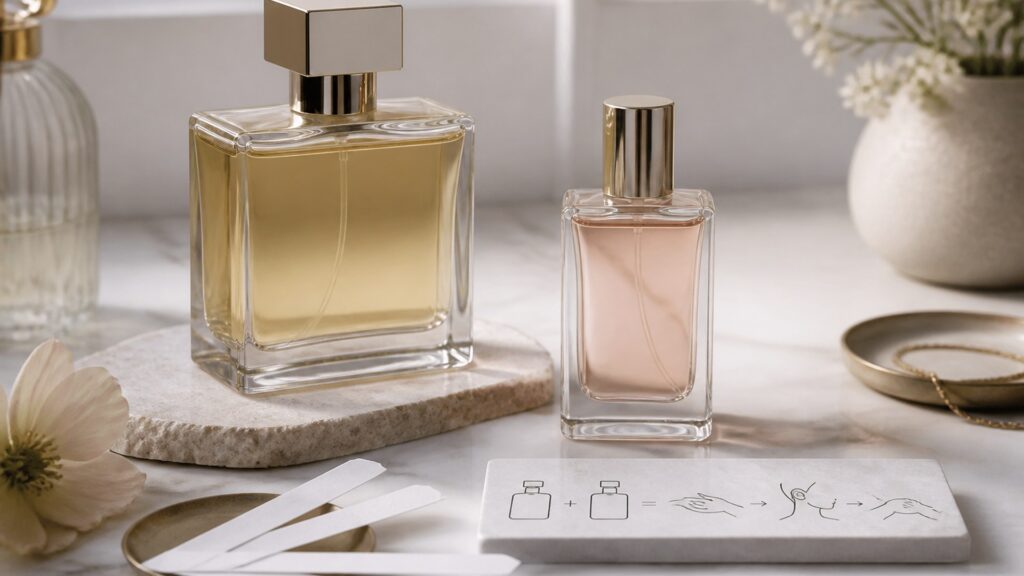
Buying framework
Define the scent layering job before comparing perfumes
Assign one perfume the lead and the other a supporting job before experimenting with spray order or placement.
Recreate the setting: A simple musk, citrus, vanilla, wood, or sheer floral often gives a busy composition room to remain readable.
Write a pass condition: Test each fragrance alone for several hours because an unpleasant base note will not become dependable inside a mixture.
Set the rejection line: Record exact sprays and application points; vague recipes are difficult to repeat and impossible to diagnose after failure.
Use profiles
Match the perfume to the person and frequency
Compare atomizer output because a broad mist and concentrated jet can create an accidental imbalance at equal spray counts.
The low-maintenance buyer: Apply the denser scent sparingly, wait through its opening, and add the lighter modifier only after judging initial strength.
The careful experimenter: Separate application areas can preserve contrast, while stacking on one spot encourages greater blending and shared evaporation.
The targeted upgrader: Do not combine several unfamiliar bottles at once, since irritation, fatigue, and muddy development become hard to attribute.
Specifications
Read perfume specifications through real use
Recheck the blend after four and eight hours for sweetness, sharpness, missing notes, excessive projection, and fabric persistence.
Evidence from the first trial
Samples and travel sprays offer better learning value than full bottles purchased solely to rescue an incomplete wardrobe.
Evidence after repetition
Avoid assuming matching note lists ensure harmony; materials with the same name can differ greatly in texture and intensity.
Working behavior: Keep successful formulas in a dated log with weather and setting, then retire pairings that require constant correction.
Contact and comfort: Assign one perfume the lead and the other a supporting job before experimenting with spray order or placement.
Package and control: A simple musk, citrus, vanilla, wood, or sheer floral often gives a busy composition room to remain readable.
Common mistakes
Avoid shortcuts that distort the scent layering decision
Test each fragrance alone for several hours because an unpleasant base note will not become dependable inside a mixture.
Rewarding the loudest claim: Record exact sprays and application points; vague recipes are difficult to repeat and impossible to diagnose after failure.
Testing under ideal conditions: Compare atomizer output because a broad mist and concentrated jet can create an accidental imbalance at equal spray counts.
Ignoring the boundary: Apply the denser scent sparingly, wait through its opening, and add the lighter modifier only after judging initial strength.
Decision guidance
Decide when basic, premium, or no purchase makes sense
Separate application areas can preserve contrast, while stacking on one spot encourages greater blending and shared evaporation.
Choose a basic option: Do not combine several unfamiliar bottles at once, since irritation, fatigue, and muddy development become hard to attribute.
Upgrade for evidence: Recheck the blend after four and eight hours for sweetness, sharpness, missing notes, excessive projection, and fabric persistence.
Wait when uncertainty remains: Samples and travel sprays offer better learning value than full bottles purchased solely to rescue an incomplete wardrobe.
Ownership & compatibility
Keep the perfume reliable after purchase
Avoid assuming matching note lists ensure harmony; materials with the same name can differ greatly in texture and intensity.
Build the reset step: Keep successful formulas in a dated log with weather and setting, then retire pairings that require constant correction.
Watch compatibility: Assign one perfume the lead and the other a supporting job before experimenting with spray order or placement.
Know the retirement signal: A simple musk, citrus, vanilla, wood, or sheer floral often gives a busy composition room to remain readable.
FAQ
Questions about perfumes for scent layering
Test each fragrance alone for several hours because an unpleasant base note will not become dependable inside a mixture.
What should I check first when choosing a perfume for scent layering?
How long should I test the perfume?
When is a more expensive perfume worthwhile?
Bottom line
Finish the scent layering choice with observable proof
Record exact sprays and application points; vague recipes are difficult to repeat and impossible to diagnose after failure.
Restate the actual role: Compare atomizer output because a broad mist and concentrated jet can create an accidental imbalance at equal spray counts.
Rehearse an ordinary day: Apply the denser scent sparingly, wait through its opening, and add the lighter modifier only after judging initial strength.
Write the purchase reason: Separate application areas can preserve contrast, while stacking on one spot encourages greater blending and shared evaporation.
Reading Shortcuts
Move directly to the scent layering decision stage you need.
Decision Reminders
Keep the evidence for scent layering visible while comparing.
- Role: The perfume serves the named task.
- Proof: The trial observes harmonious development, controlled diffusion, comfortable wear, and satisfying dry-down.
- Care: Protect the flacon from sunlight, heat, humidity, and loose caps.
Glossary Snippets
Useful language for comparing perfumes.
When a Top 10 List Helps
Use rankings to discover credible perfumes, then screen them for scent layering.
- The format is undecided: A broad list reveals plausible forms and price levels.
- A shortlist is needed: Rankings narrow discovery but do not replace fit testing.
Have finalists already? Open the comparison section.
When a Direct Comparison Helps
Compare finalists after establishing their suitability for scent layering.
- Two candidates remain: Side-by-side evidence exposes meaningful tradeoffs.
- An upgrade is uncertain: Compare whether added cost corrects the original weakness.
Still exploring? Start with the Top 10 section.