
How to Choose Perfume for Travel Sizes
A perfume travel size should contain enough familiar scent for the journey without turning one leak, loss, or confiscation into a costly event. Begin with trip length, wear frequency, luggage rules, and replacement access.
Compare factory purse sprays, miniature bottles, refillable atomizers, sample vials, rollerballs, and solids by closure, dose, labeling, durability, and cleaning. The smallest format is not automatically the most dependable.
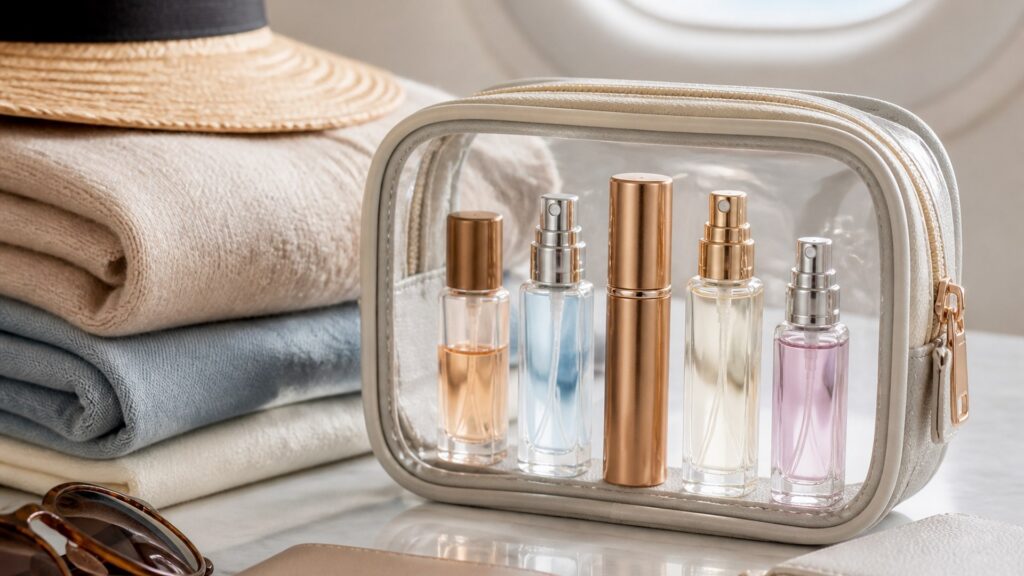
Buying framework
Define the portable fragrance job before comparing perfumes
Multiply normal sprays by planned wearing days, then add a small margin rather than carrying the entire vanity bottle.
Recreate the setting: A branded purse spray preserves formula compatibility, while a decant lets travelers choose volume and reduce replacement cost.
Write a pass condition: Inspect collars, valves, caps, seams, glass thickness, and protective sleeves before trusting a container beside clothing or electronics.
Set the rejection line: Leave expansion space in refillable vessels because pressure and temperature changes can push liquid through a marginal seal.
Use profiles
Match the perfume to the person and frequency
Place the filled unit in a separate closed pouch overnight, rotating it to expose every joint before packing.
The low-maintenance buyer: Write the perfume name, concentration, and decant date on a durable label that survives handling and minor spills.
The careful experimenter: Count sprays from the travel nozzle because its output may differ enough to alter projection, longevity, and remaining volume.
The targeted upgrader: Rollerballs minimize airborne mist but touch skin repeatedly; solids resist leakage yet may not recreate the original alcohol formula.
Specifications
Read perfume specifications through real use
Check current transport rules for each carrier and border instead of relying on a familiar limit from an earlier trip.
Evidence from the first trial
Protect fragrance from checked-bag impacts, direct sun, freezing compartments, and hot vehicles whenever cabin transport is allowed.
Evidence after repetition
Do not refill over old perfume residue unless the vessel is designed for cleaning and has dried without odor.
Working behavior: Replace an atomizer that seeps, sputters stained liquid, loses pressure, cracks, or gives the contents a metallic smell.
Contact and comfort: Multiply normal sprays by planned wearing days, then add a small margin rather than carrying the entire vanity bottle.
Package and control: A branded purse spray preserves formula compatibility, while a decant lets travelers choose volume and reduce replacement cost.
Common mistakes
Avoid shortcuts that distort the portable fragrance decision
Inspect collars, valves, caps, seams, glass thickness, and protective sleeves before trusting a container beside clothing or electronics.
Rewarding the loudest claim: Leave expansion space in refillable vessels because pressure and temperature changes can push liquid through a marginal seal.
Testing under ideal conditions: Place the filled unit in a separate closed pouch overnight, rotating it to expose every joint before packing.
Ignoring the boundary: Write the perfume name, concentration, and decant date on a durable label that survives handling and minor spills.
Decision guidance
Decide when basic, premium, or no purchase makes sense
Count sprays from the travel nozzle because its output may differ enough to alter projection, longevity, and remaining volume.
Choose a basic option: Rollerballs minimize airborne mist but touch skin repeatedly; solids resist leakage yet may not recreate the original alcohol formula.
Upgrade for evidence: Check current transport rules for each carrier and border instead of relying on a familiar limit from an earlier trip.
Wait when uncertainty remains: Protect fragrance from checked-bag impacts, direct sun, freezing compartments, and hot vehicles whenever cabin transport is allowed.
Ownership & compatibility
Keep the perfume reliable after purchase
Do not refill over old perfume residue unless the vessel is designed for cleaning and has dried without odor.
Build the reset step: Replace an atomizer that seeps, sputters stained liquid, loses pressure, cracks, or gives the contents a metallic smell.
Watch compatibility: Multiply normal sprays by planned wearing days, then add a small margin rather than carrying the entire vanity bottle.
Know the retirement signal: A branded purse spray preserves formula compatibility, while a decant lets travelers choose volume and reduce replacement cost.
FAQ
Questions about perfumes for portable fragrance
Inspect collars, valves, caps, seams, glass thickness, and protective sleeves before trusting a container beside clothing or electronics.
What should I check first when choosing a perfume for portable fragrance?
How long should I test the perfume?
When is a more expensive perfume worthwhile?
Bottom line
Finish the portable fragrance choice with observable proof
Leave expansion space in refillable vessels because pressure and temperature changes can push liquid through a marginal seal.
Restate the actual role: Place the filled unit in a separate closed pouch overnight, rotating it to expose every joint before packing.
Rehearse an ordinary day: Write the perfume name, concentration, and decant date on a durable label that survives handling and minor spills.
Write the purchase reason: Count sprays from the travel nozzle because its output may differ enough to alter projection, longevity, and remaining volume.
Reading Shortcuts
Move directly to the portable fragrance decision stage you need.
Decision Reminders
Keep the evidence for portable fragrance visible while comparing.
- Role: The perfume serves the named task.
- Proof: The trial observes harmonious development, controlled diffusion, comfortable wear, and satisfying dry-down.
- Care: Protect the flacon from sunlight, heat, humidity, and loose caps.
Glossary Snippets
Useful language for comparing perfumes.
When a Top 10 List Helps
Use rankings to discover credible perfumes, then screen them for portable fragrance.
- The format is undecided: A broad list reveals plausible forms and price levels.
- A shortlist is needed: Rankings narrow discovery but do not replace fit testing.
Have finalists already? Open the comparison section.
When a Direct Comparison Helps
Compare finalists after establishing their suitability for portable fragrance.
- Two candidates remain: Side-by-side evidence exposes meaningful tradeoffs.
- An upgrade is uncertain: Compare whether added cost corrects the original weakness.
Still exploring? Start with the Top 10 section.