
How to Choose Professional & Salon Beauty Products for Hair Stylists
A stylist uses products as parts of a timed station sequence: section, cut, formulate, apply, rinse, dry, shape, finish, and reset. Shear geometry, dryer balance, airflow controls, hot-tool plate behavior, color-bowl stability, and backbar dosing determine whether that sequence stays precise through the fifth appointment—not merely whether a product impresses during a brief demonstration.
Build the shortlist from the services actually booked and the station's limiting points. Account for hand position, cords, duty cycles, temperature selection, shared dispensing, contact-item classification, ventilation, cooling, and cleaning. Professional labeling does not authorize medical claims, unsupported color mixing, or electrical assumptions; staff still need current directions, training, and scope boundaries.
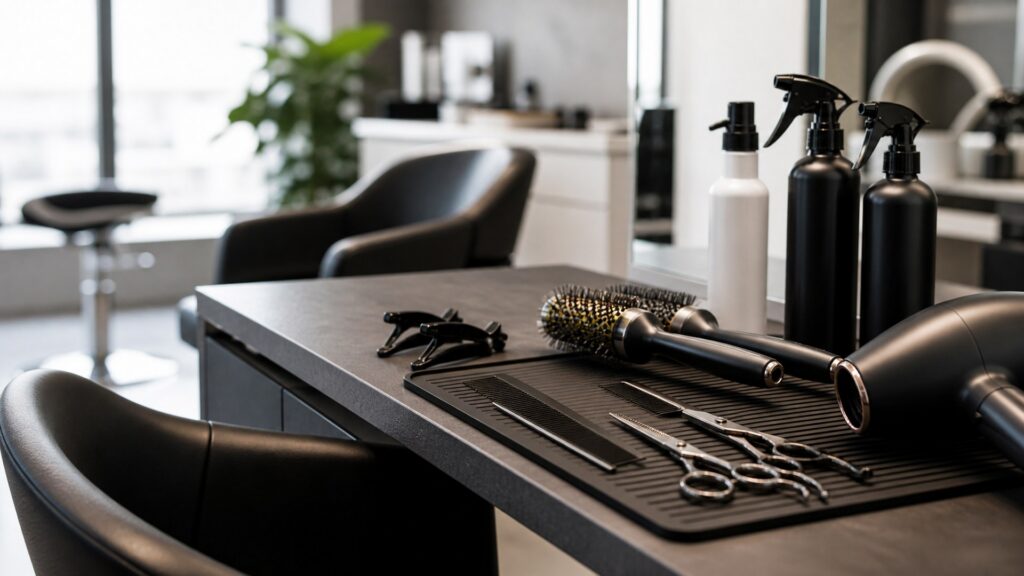
Buying framework
Build around the service sequence
Every product should remove friction from a named cutting, styling, color-support, or reset step. Judge the complete shift rather than one dramatic feature.
Map the booked menu: Separate precision cutting, clipper work, blowouts, thermal finishing, texture services, and color support. Do not buy specialty capability without a real appointment path.
Protect hand control: Evaluate grip, balance, ring size, control location, cord pull, and repeated reach in the actual working posture. Low weight alone does not establish comfort.
Prefer adjustable output: Separate heat and airflow, stable temperature selections, and usable speed controls let the stylist adapt a section without defaulting to maximum intensity.
Control shared product: Use metered pumps, narrow nozzles, or documented dispensing tools that keep used hands and implements out of backbar stock while stabilizing cost per service.
Time the reset: Include hair removal, surface processing, implement handling, filter checks, cord cooling, hot-tool parking, linen changes, and restocking before declaring a station efficient.
Who this is for
Different specialties load tools differently
The best station depends on repeated motion, service duration, heat demand, and formula handling. These profiles point to different priorities.
The precision cutter: Shear handle geometry, edge service, comb stiffness, sectioning control, and unobstructed station layout dominate. Extra heat-tool attachments add little to the core service.
The blowout specialist: Dryer balance, airflow direction, separate heat and speed, filter access, cord reach, and documented duty behavior accumulate across long appointments.
The colorist: Reliable scales, stable bowls, brush width, timer visibility, formula-specific containers, controlled backbar, and lot records matter more than a broad styling kit.
The texture-focused stylist: Multiple diffuser or nozzle shapes, temperature range, wide sectioning tools, and product dispensing must support diverse curl patterns and service techniques without universalizing one routine.
The mobile stylist: Guarded edges, leak containment, dual-location electrical planning, compact heat-resistant storage, clean-versus-used zones, and manageable cord packing outweigh permanent-station display.
What to pay attention to
Specifications become shift-long consequences
Professional details matter when they change control, fatigue, service timing, or reset. Inspect the working interface rather than the marketing tier.
Hand control and service output
Connect grip, balance, edges, airflow, heat, and delivery geometry to the exact service motion.
Shift endurance and station reset
Evaluate repeated duty, filters, cords, cooling, cleaning, shared stock, and replacement.
Shear geometry: Offset versus even handles, ring diameter, finger rest, blade length, tension adjustment, and balance alter wrist and thumb position. Fit should be assessed in the stylist's real cutting grip.
Dryer airflow controls: Separate airspeed and heat choices provide more control than combined presets. Concentrator fit, nozzle rotation, intake placement, and cool-shot access affect section work.
Hot-tool plates or barrels: Edge shape, plate alignment, barrel diameter, temperature increments, control lock, stand, and auto shutoff change handling. Maximum temperature is not the selection target.
Electrical nameplate and duty: Verify voltage, frequency, power draw, plug, cord rating, environmental limits, and stated operating cycle against salon infrastructure. Adapters do not establish compatibility.
Color-support geometry: Bowl base stability, graduated markings, tint-brush width, bristle stiffness, scale resolution, and timer visibility support directed formulation and section placement.
Backbar dispensing: Pump output, bottle stability, closure, label visibility, and ability to avoid return contact influence dose consistency and contamination control across providers.
Cleaning and service access: Removable filters, smooth housings, accessible hinges, replaceable guards, and supported servicing reduce reset friction. Decorative seams can trap hair or residue.
Avoid these traps
Professional work does not require maximum everything
The most expensive errors are often intensity, repetition, or compatibility mistakes hidden behind a professional label.
Buying shears by price and length: Blade length does not reveal hand fit, balance, tension behavior, or serviceability. Test the handle geometry and confirm sharpening support before purchase.
Using maximum heat as default: Highest settings do not prove faster, safer, or better styling. Choose controlled output for the service, section, hair condition, and product directions.
Treating every bowl as inert: Color and treatment formulas may specify compatible tools and mixing containers. Follow manufacturer directions rather than assuming any decorative vessel is suitable.
Oversizing shared backbar: A large bottle can remain open too long, occupy the wrong zone, and encourage uncontrolled pumping. Compare appointment throughput, open life, dose, and refill lead time.
Skipping reset time in bookings: Cooling hot tools on an improvised surface or rushing implement processing transfers operational risk to the next client. Build legitimate reset steps into the schedule.
Decision guidance
Upgrade the station's actual bottleneck
Identify where control or time is lost, then change the narrowest relevant tool. A complete re-kit is rarely the first answer.
If cutting causes hand strain: Compare offset, swivel, ring size, finger rest, weight distribution, and blade length in working posture. Training or technique review may matter alongside equipment.
If blow-drying runs long: Check airflow path, nozzle fit, intake cleanliness, section size, brush pairing, and control accessibility before increasing heat. Choose a dryer rated for the shift pattern.
If thermal output drifts: Remove abnormal tools from service and verify plate alignment, controls, cord, and service history. Replacement should prioritize stable selectable output, not a hotter ceiling.
If color stations become inconsistent: Standardize scales, timers, bowl and brush types, labeled dispensing, formula directions, and staff sign-off. Do not solve a protocol gap with more shade inventory.
If shared product use varies: Measure pump output and define service doses while preserving label, lot, opening, and storage information. Investigate unexplained consumption rather than silently increasing stock.
If turnover misses schedule: Time hair removal, contact-item processing, tool cooling, cord management, surface reset, and restocking separately. Redesign the slowest justified step without shortening required procedures.
Ownership & compatibility
Keep the station predictable across shifts
Edges, vents, cords, settings, and pumps change with use. Inspection and logs prevent familiar tools from quietly producing different behavior.
Service cutting tools: Clean, lubricate, adjust, sharpen, and store shears or clippers according to their instructions. Remove nicked, loose, rusted, or damaged implements from client use.
Clear air paths: Clean dryer and clipper filters or vents on the maker's schedule. Restricted airflow changes heat and may shorten equipment life.
Inspect electrical tools: Check cords, plugs, strain relief, plates, barrels, housings, controls, and stands. Tag out abnormal equipment and use qualified repair rather than improvised fixes.
Rotate backbar deliberately: Track supplier, lot, expiry, opening, storage, pump condition, and consumption where relevant. Keep room or station decants identified and permitted.
FAQ
Hair-stylist product questions
These answers clarify fit, output, throughput, and service boundaries.
How should professional hair shears fit a stylist?
What dryer specifications matter for salon blowouts?
Should a salon flat iron have the highest temperature?
How large should professional backbar bottles be?
Can color bowls and brushes be chosen by style?
What does duty cycle mean for salon tools?
How should hot tools be handled during station turnover?
When should a stylist stop using an electrical tool?
Can stylists recommend products for scalp conditions?
Bottom line
A stylist product must survive the whole shift
Choose tools and backbar by service role, hand control, adjustable output, repeated duty, shared dispensing, and reset. Professional status comes from a supported workflow, not maximum heat or prestige.
Fit the menu: Buy capability for services the station actually performs.
Fit the hand: Judge geometry, balance, controls, and cords in working posture.
Control output and dose: Prefer adjustable settings and repeatable dispensing.
Protect turnover: Plan cooling, cleaning, records, and replenishment between clients.
Reading Shortcuts
Navigate multi-room spa operations decisions.
Decision Reminders
Keep every shortlist tied to multi-room spa operations.
- Service: Name the exact treatment step.
- Contact: Classify each client-touching component.
- Dose: Prevent used tools from returning to bulk product.
- Reset: Document cleanup between appointments.
- Training: Make technique consistent across staff.
- Boundary: Defer conditions outside professional scope.
Glossary Snippets
Operating terms used in this guide.
When to Use a Top 10 Review
Use rankings after requirements for multi-room spa operations are fixed.
- Service role fixed: Compare products for the same protocol step.
- Contact path fixed: Exclude items without a supported hygiene route.
- Room fit known: Check storage, dose, and turnover requirements.
- Finalists remain: Rank only operationally deployable choices.
Already down to two systems? A Comparison can resolve the workflow difference.
When to Use a Comparison
Compare finalists by consequences for multi-room spa operations.
- Dispensing differs: Compare dose control and shared-stock exposure.
- Contact differs: Review disposal or reprocessing instructions.
- Room burden differs: Count staging, reset, and storage.
- Training differs: Prefer reproducible written controls.
Still exploring? Start with a Top 10 after defining the service and contact class.