
How to Choose Scalp Care for Damage Repair
Scalp care cannot repair damaged hair fiber. Hair beyond the scalp is nonliving material; treatments may coat, lubricate, strengthen temporarily, or reduce friction, but they do not make split or severely weathered strands biologically new again.
The useful connection is coordination. Comfortable clean scalp skin supports a manageable routine, while damaged lengths need targeted conditioning, reduced chemical and heat stress, gentle handling, and sometimes trimming. Pain, open skin, spreading rash, patchy loss, or sudden shedding belongs with qualified clinical care.
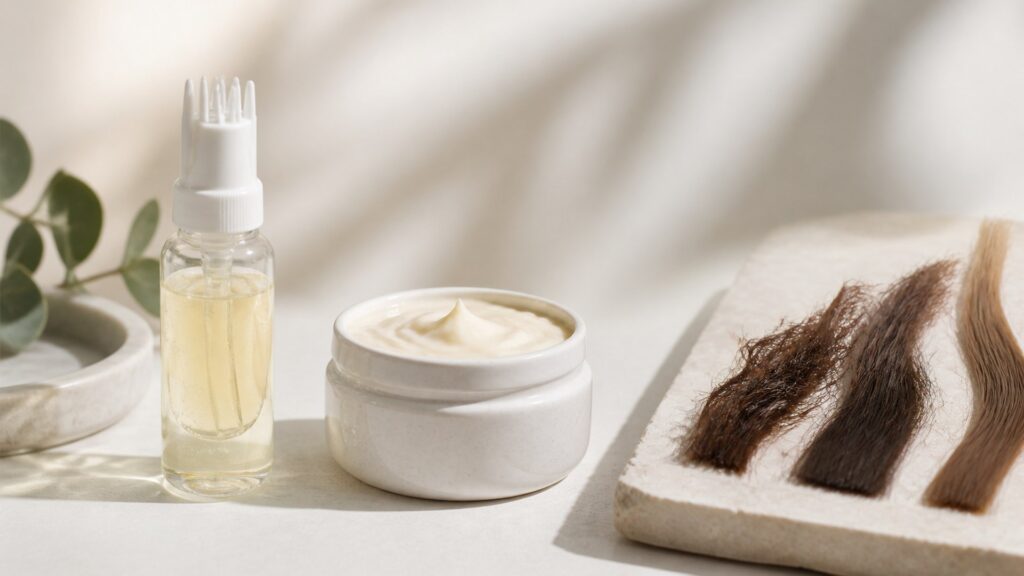
Two-surface plan
Separate scalp health from fiber damage
Skin symptoms and strand failures require different evidence, products, placement, and expectations. A “root-to-tip repair” slogan should not collapse those distinctions.
Map scalp condition: Record oil, flakes, itch, burning, tenderness, bumps, odor, shedding, and reactions after chemical services or new products.
Map fiber damage: Locate split ends, white breakage points, porous color bands, heat-worn sections, roughness, tangles, and lost elasticity along the lengths.
Remove the damaging source: Review bleach overlap, heat settings, tight styles, extensions, rough tools, towel friction, and detangling force before expecting treatment to compensate.
Damage profiles
Coordinate the routine around the dominant exposure
Chemical processing, heat, tension, and mechanical wear can affect both skin comfort and fibers, but the response should still be targeted to each area.
Post-bleach user: Follow service aftercare, avoid adding stimulating scalp products to tender skin, and use a separate lengths protocol for porous or weakened hair.
Frequent heat styler: Reduce temperature and passes, keep scalp products away from hot-tool contact, and choose conditioning that lowers friction through stressed lengths.
Tension-breakage pattern: Reassess braids, extensions, elastics, wig fit, and repeated pulling; scalp serum cannot neutralize ongoing traction or restore snapped fibers.
Product roles
Read scalp directions and repair claims independently
A product may be suitable for skin, hair fiber, or both, but the intended surface, mechanism, dose, contact time, and rinse step must be explicit.
Skin evidence
A scalp step should improve cleanliness or comfort without persistent burning, residue, increased flakes, tenderness, or hair-loss changes.
Fiber evidence
A lengths treatment should reduce friction, tangling, or breakage in comparable sections after the full wash and styling routine.
Scalp-care purpose: Confirm whether the formula cleanses, removes buildup, moisturizes intact skin, or addresses another defined cosmetic concern without claiming fiber reconstruction.
Lengths-treatment mechanism: Conditioners, proteins, silicones, oils, polymers, and bond-support products can change feel or handling; compare their protocols and realistic endpoints.
Placement instructions: Do not apply a mask to skin or a scalp active through all lengths unless the maker clearly directs that use.
Repair mistakes
Avoid making the scalp carry a lengths problem
Coating roots with heavy masks, scrubbing after chemical irritation, and stacking stimulating products can create a new skin problem while damaged ends remain unchanged.
Expecting growth to fix current ends: New hair emerges gradually; it does not repair split or broken fiber already several inches from the scalp.
Applying protein to scalp by default: A strengthening treatment intended for lengths does not become scalp care because breakage is visible. Follow the labeled surface and rinse instructions.
Delaying a necessary trim: Products can temporarily smooth splits, but severely compromised ends may continue unraveling and tangling until removed.
Routine choice
Choose one scalp step and one fiber step when needed
A split routine is clearer and often safer than asking one intensive formula to cleanse skin, soothe irritation, strengthen lengths, seal ends, and improve growth.
Simplify scalp care: Use appropriate cleansing and one targeted skin product only when an observed scalp concern justifies it.
Treat damaged lengths separately: Choose conditioning, protein, or bond support from the damage history and direct the product to affected fibers at the stated frequency.
Seek professional guidance: Escalate severe pain, chemical burns, open skin, infection-like changes, patchy loss, sudden shedding, or symptoms that persist despite gentle care.
Controlled wash day
Protect the scalp while reducing fiber friction
Application sequence and handling determine whether separate products reach the correct area without tangling hair or irritating skin.
Section for precise placement: Apply scalp products along partings and lengths treatments below the roots, using measured amounts instead of saturating everything.
Detangle with support: Use adequate slip, manageable sections, and end-to-root progress; no repair formula makes forceful pulling harmless.
Keep tools clean and smooth: Wash applicators, combs, clips, and brushes, and replace cracked or rough items that scratch skin or catch weakened strands.
FAQ
Scalp care and damage-repair questions
These answers explain the limits of scalp products, realistic fiber treatment, and when symptoms need professional assessment.
Can scalp care repair damaged hair lengths?
Should damage-repair masks be applied to the scalp?
When does hair damage require professional advice?
Bottom line
Care for the scalp and repair the routine
The honest plan keeps skin clean and comfortable, reduces ongoing chemical and mechanical stress, treats lengths within cosmetic limits, and trims damage that products cannot reverse.
Write two baselines: Track scalp symptoms separately from split ends, snapping, tangling, roughness, elasticity, and the location of previous services.
Change one step per surface: Keep scalp and lengths placement distinct so comfort and fiber response can be evaluated without overlapping variables.
Respect the limits: Retain treatments for measurable handling gains, not promises of biological restoration to hair that has already left the scalp.
Reading Shortcuts
Move directly to the damage repair decision stage you need.
Decision Reminders
Keep the evidence for damage repair visible while comparing.
- Role: The scalp-care product serves the named task.
- Proof: The trial observes comfortable application, manageable residue, observable improvement, and no worsening symptoms.
- Care: Keep the applicator clean, avoid cross-contamination, and follow label frequency limits.
Glossary Snippets
Useful language for comparing scalp-care products.
When a Top 10 List Helps
Use rankings to discover credible scalp-care products, then screen them for damage repair.
- The format is undecided: A broad list reveals plausible forms and price levels.
- A shortlist is needed: Rankings narrow discovery but do not replace fit testing.
Have finalists already? Open the comparison section.
When a Direct Comparison Helps
Compare finalists after establishing their suitability for damage repair.
- Two candidates remain: Side-by-side evidence exposes meaningful tradeoffs.
- An upgrade is uncertain: Compare whether added cost corrects the original weakness.
Still exploring? Start with the Top 10 section.