
How to Choose Seat Protection for Ride-Share and Commuter Cars
High-use cars need protection that resets quickly between occupants while leaving belts, airbags, controls, and presentation surfaces obvious. For ride-share and commuter cars, begin with the interfaces and restrictions that cannot be corrected by extra padding, stronger materials, faster charging, or more storage.
Build the passenger-turnover coverage decision from passenger turnover, quick wipe-down, and buckle access. Use the actual cabin, completed load, and governing manufacturer directions so each conclusion remains tied to this vehicle rather than a universal claim.
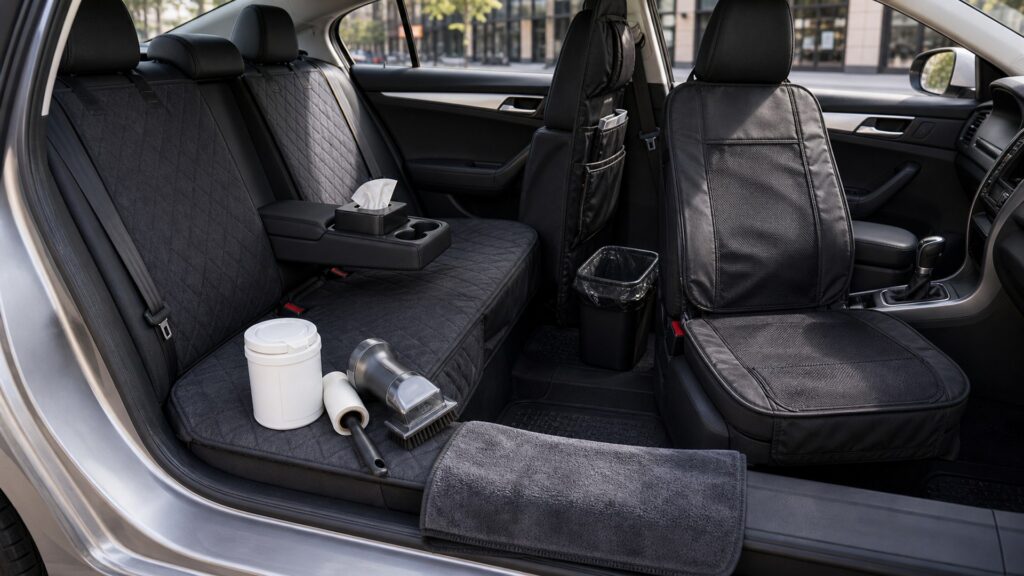
Buying framework
Set the decision order for high-turnover seat coverage
For passenger-turnover coverage, establish passenger turnover prior to pricing and secondary features. The next gates cover quick wipe-down, buckle access, and side-airbag clearance in the order a failed condition would end the installation.
Passenger Turnover: Make passenger turnover the first measurement. Repeated entry and exit favors a panel that stays aligned without asking each passenger to reposition it. A candidate that misses passenger turnover does not advance to comfort features.
Quick Wipe-Down: Make quick wipe-down the early compatibility screen. Cleaning claims should name approved methods and drying requirements for both the cover and upholstery beneath. Remove products that cannot demonstrate quick wipe-down without altering original equipment.
Buckle Access: Make buckle access the loaded-use trial. A rider must be able to locate and fasten the belt without searching under a skirt or cushion flap. Keep the trial reversible until buckle access remains predictable under the complete load.
Side-Airbag Clearance: Make side-airbag clearance the final pre-purchase gate. Never cover a marked deployment seam unless the vehicle maker explicitly permits that cover arrangement. Approve the installation only after side-airbag clearance agrees with the governing manufacturer directions.
Who this is for
Match the design to the real routine
A full-time ride-share driver, highway commuter, mixed delivery driver, and fleet operator face different cleaning cycles and passenger turnover. Use the busiest recurring shift to set the protection priority.
Full-Time Ride-Share Driver: Prioritize passenger turnover for this profile, then judge the passenger-turnover coverage outcome with seat-adjustment range under the longest ordinary session. Discard options that need repeated repositioning.
Daily Highway Commuter: Make buckle access the opening screen for this user. During the passenger-turnover coverage mock-up, add odor retention and observe the complete movement, temperature, or contact range.
Delivery-And-Passenger Driver: Give this buyer a parked trial centered on side-airbag clearance and its controlling manufacturer directions. The passenger-turnover coverage choice advances only when edge stability stays visible and directly reachable.
Shared Fleet Operator: Favor reversible passenger-turnover coverage hardware for this routine. Photograph rear-pocket load in the accepted position and schedule a inspection interval review prior to the return or installation window closes.
What to pay attention to
Turn specifications into visible consequences
A useful passenger-turnover coverage specification predicts what happens at seat-adjustment range or professional appearance after installation. Translate dimensions, ratings, and materials into a visible parked outcome instead of ranking numbers alone.
Vehicle interface
Judge geometry, attachment, and access against high-turnover seat coverage.
Loaded operation
During the passenger-turnover coverage trial, include every regular occupant, device, cable, cargo item, or moving component that can alter edge stability.
Seat-Adjustment Range: Run the seat through every passenger adjustment while parked and watch for trapped anchors or stretched straps. Translate the published construction into a parked assessment that shows whether rear-pocket load changes under the full load. During passenger-turnover coverage, connect that observation to rear-pocket load and write down the usable boundary.
Odor Retention: The practical limit for odor retention appears during adjustment and cleaning. Removable washable textiles can be easier to refresh than thick layers that hold moisture and odors. Note any interference with professional appearance. Use the passenger-turnover coverage outcome to decide whether professional appearance stays within its permitted range.
Edge Stability: Treat the stated range for edge stability as a starting point. Corners, hooks, and nonslip backing should resist ordinary sliding without concentrating pressure on trim. Verify access again after all nearby equipment is positioned. Photograph this passenger-turnover coverage condition after loading, with inspection interval scheduled for a later comparison.
Rear-Pocket Load: Material compatibility controls rear-pocket load more than a broad durability claim. Seat-back pockets should carry only light items and remain tidy when the front seat changes position. Examine rear-pocket load directly because a universal label cannot establish passenger-turnover coverage compatibility. Replace a universal claim with direct passenger-turnover coverage evidence about passenger turnover at the contacting faces.
Professional Appearance: A specification for professional appearance matters only when it predicts loaded behavior. Neutral fit, hidden anchors, and unwrinkled surfaces usually look more professional than oversized universal coverage. Record the first warning, obstruction, or loss of function. Keep the measured quick wipe-down outcome with the passenger-turnover coverage notes for the final shortlist.
Avoid these traps
Shortcuts that hide incompatibility
Poor passenger-turnover coverage choices usually begin with an unmeasured clearance, an unloaded demonstration, or an ignored instruction. Find those errors while repositioning or returning the cover remains possible.
Guessing at quick wipe-down: Photographs cannot establish quick wipe-down for passenger-turnover coverage. Measure its complete boundary in the vehicle and confirm that edge stability remains directly accessible.
Testing seat-adjustment range without the daily load: An empty passenger-turnover coverage demonstration hides compression, heat, leverage, and blocked movement. Recreate seat-adjustment range with the daily occupants or equipment present.
Treating side-airbag clearance guidance as optional: Airbag and restraint guidance sets a firm boundary for commercial-seat coverage. Leave out any flap, hook, extra pad, or storage feature that the vehicle instructions do not allow in that position.
Delaying the inspection interval review: Schedule the first passenger-turnover coverage inspection prior to demanding use. Small changes at inspection interval should trigger cleaning, correction, or removal prior to they become damage or failure.
Decision guidance
Let the limiting condition favor the design
Let the first failed passenger-turnover coverage boundary remove unsuitable cover families. Price, appearance, and smart features belong only in comparisons where passenger turnover and side-airbag clearance already pass.
If passenger turnover defines the usable range: Use passenger turnover to establish the passenger-turnover coverage shortlist. Among compatible choices, prefer the option that keeps odor retention straightforward without extra pressure or unsupported hardware.
When buckle access creates the main exposure: Reproduce the worst daily buckle access condition during the passenger-turnover coverage trial. Advance only designs that also keep rear-pocket load visible, stable, and easy to look over.
Where edge stability must stay accessible: Reject an passenger-turnover coverage arrangement that hides, tensions, or reroutes edge stability. The surviving design should preserve professional appearance without requiring a special user sequence.
If inspection interval controls ownership effort: Contrast the cleaning, removal, and inspection work associated with inspection interval. Favor the passenger-turnover coverage candidate whose seat-adjustment range can be rechecked without dismantling unrelated equipment.
Ownership & compatibility
Keep the installation inspectable and reversible
A sound passenger-turnover coverage installation stays open to inspection as heat, moisture, grit, and repeated handling change rear-pocket load. Early correction protects the accessory and the vehicle.
Document the installed state: Photograph rear-pocket load when the passenger-turnover coverage installation is new. After the first week, contrast alignment, pressure, surface condition, and access prior to cleaning both interfaces as directed.
Clean for the actual exposure: Build cleaning around daily passenger contact and actual spills. Use approved products, remove hidden moisture promptly, and avoid spraying cleaners near seat switches, perforations, seams, or electrical equipment.
Repeat checks after changes: A different occupant, restraint, vehicle, EV, cable, or parking position can alter passenger turnover. Rebuild the passenger-turnover coverage evidence rather than transferring an earlier compatibility assumption.
FAQ
Questions about high-turnover seat coverage
These answers resolve narrow compatibility and ownership questions that should be checked prior to or soon after installation.
How can a ride-share seat cover stay aligned?
Which materials are quickest to wipe between riders?
How should passenger belt access be tested?
Can a cover cross a seat-mounted airbag seam?
What seat adjustments should a driver check?
How can seat protection avoid retaining odors?
What keeps protector edges from curling during entry?
Are seat-back pockets appropriate for ride-share cars?
How often should commercial seat protection be inspected?
Bottom line
Favor the installation you can verify
The defensible passenger-turnover coverage choice fits the specific vehicle, respects the controlling manufacturer directions, and makes inspection interval practical after installation.
Resolve the hard limits: Approve passenger turnover and side-airbag clearance for the passenger-turnover coverage installation prior to comparing convenience.
Load the complete system: Observe seat-adjustment range, edge stability, and nearby movement while the passenger-turnover coverage arrangement matches daily use.
Retain the evidence: Keep measurements, photographs, and manufacturer directions so inspection interval can detect a meaningful change.
Reading Shortcuts
Open the unresolved passenger-turnover coverage section: boundaries, specifications, user conditions, or focused questions.
High-Turnover Seat Coverage Checks
Complete the passenger-turnover coverage observations while stationary with the ordinary load present.
- Passenger Turnover: Measure the available range.
- Quick Wipe-Down: Follow the applicable manufacturer directions.
- Buckle Access: Include the completed load.
- Side-Airbag Clearance: Move nearby equipment fully.
- Seat-Adjustment Range: Record the first conflict.
- Odor Retention: Keep a reversible exit plan.
Glossary Snippets
Terms that describe the physical and operating limits behind passenger-turnover coverage.
When to Use a Top 10 Review
Use an passenger-turnover coverage ranking only after passenger turnover and edge stability have removed incompatible cover families.
- Passenger Turnover: The primary boundary is known.
- Quick Wipe-Down: The permitted interface is documented.
- Buckle Access: The loaded condition has been reproduced.
- Side-Airbag Clearance: The recurring ownership demand is understood.
Already down to 2–3 options? A Comparison is usually the faster next step.
When to Use a Comparison
Judge the final two choices with identical passenger-turnover coverage measurements, manufacturer directions, loads, and movement paths.
- Seat-Adjustment Range: Both candidates preserve this function.
- Odor Retention: Both remain stable under the daily load.
- Edge Stability: Both permit direct inspection.
- Rear-Pocket Load: The difference changes a real ownership outcome.
Still exploring? Start with a Top 10 to build a shortlist first.