
How to Choose Shaving & Hair Removal Products for Men
Men’s grooming is not one shaving problem. A dense beard line, curved scalp, and broad chest or body zone present different hair lengths, contours, visibility, and consequences from repeated contact. Product choice should begin with the area and desired finish—not assumptions about how close every user wants to shave.
Cartridge and safety razors cut close at the surface; trimmers preserve controlled stubble; foil and rotary shavers offer different contour access; body groomers add guards and skin-contact features; depilatories use timed chemical action only on labeled areas. Coarse or curly growth can make pass count and cutting direction especially important, but persistent irritation or ingrown concerns deserve professional advice rather than aggressive grooming.
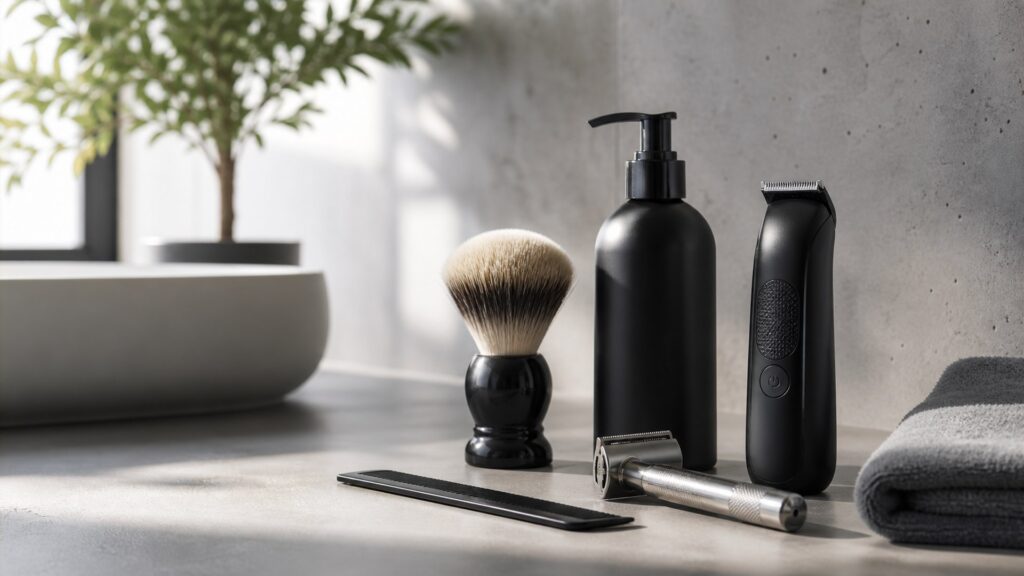
Buying framework
Choose by zone, finish, and contour
Map the grooming area and finish before comparing motors or blade counts. The useful format gives controllable access without unnecessary passes.
Define the finish: Separate clean surface shaving, visible stubble, length maintenance, and chemical removal.
Map the contour: Beard edges, jaw, neck, scalp, chest, and body folds demand different head size and visibility.
Read hair behavior: Dense, coarse, curly, flat-lying, or multi-directional growth changes pre-trimming, direction, and pass count.
Limit repeated contact: Favor a sharp or sound working surface, manageable sections, lubrication where directed, and light pressure.
Respect zone labels: Use body groomers and depilatories only on permitted areas and follow every timing, guard, and testing direction.
Who this is for
Match the tool to the grooming map
These profiles reflect finish and access rather than stereotypes.
The beard-line shaper: Needs a narrow trimmer edge or controllable razor for cheeks, neckline, moustache corners, and transitions between lengths.
The daily close shaver: Prioritizes repeatable surface cutting, wet or dry preference, few passes, and readily available cartridges, foils, or cutters.
The stubble maintainer: Needs stable short guards, fine length increments, and a head that follows jaw and neck without repeatedly recutting.
The scalp groomer: Values broad but contour-following contact, rear-head reach, secure wet grip, and easy hair clearing.
The chest and body groomer: Needs area-permitted guards or formulas, reach across broad zones, controlled contact around contours, and practical shower or sink cleanup.
What to pay attention to
Specifications describe skin contact
Compare the working surface, controllability, and complete preparation rather than promised smoothness alone.
Contact mechanism and exposure
Identify exactly what touches skin and for how long.
Routine burden and interval
Count preparation, discomfort, cleanup, and replacement between results.
Razor head and blade exposure: Cartridge articulation, guard, lubrication, and handle control change pressure and pass count.
Foil, rotary, and guard design: Opening geometry and cutter protection affect hair capture, contour following, and allowable areas.
Depilatory formula directions: Permitted locations, application thickness, contact window, removal, patch test, and repeat interval define use.
Wax format and temperature: Strip, hard, soft, or pre-coated formats have different hair-length, warming, application, and cleanup needs.
Epilator head geometry: Tweezers, speed settings, cap, lighting, and grip affect section width and repeated passes.
Cleaning and replacement path: Washability, brush access, drying, blade life, foil condition, cartridges, wax supplies, and storage shape ownership.
Avoid these traps
Do not chase closeness past control
Extra passes, pressure, heat, or chemical time can increase exposure without creating a reliable improvement.
Using one method everywhere: Body-area labels and geometry differ; a product suited to legs may not be permitted or controllable elsewhere.
Pressing harder: Pressure does not repair a dull blade, damaged foil, poor angle, or inadequate trimming.
Extending depilatory time: Never exceed the labeled contact window to chase missed hair; remove as directed.
Overheating wax: Use the specified warming method and temperature checks instead of assuming hotter wax grips better.
Repeating passes automatically: Reworking the same area increases contact and friction; improve preparation or change method.
Decision guidance
Assign a format to each zone
One kit may combine a close-shaving tool with a guarded trimmer because the desired finish changes by area.
For crisp beard boundaries: Choose a detail trimmer, safety razor, or cartridge format you can see and steer accurately; protect the surrounding length.
For close facial shaving: Compare cartridge, safety, foil, and rotary routes by skill, contour access, wet or dry routine, and replacement burden.
For deliberate stubble: Use a trimmer with secure guards and increments fine enough to preserve the intended shadow rather than cutting to skin.
For scalp work: Choose a head that follows curves and can be guided behind the head; include mirror strategy, rinseability, and blade or foil condition.
For chest or body zones: Use a labeled body groomer or depilatory, pre-trim long hair when directed, and follow area, timing, and patch-test instructions exactly.
Ownership & compatibility
Keep the working surface predictable
Wear, residue, storage, and consumables change contact after purchase.
Replace cutting parts: Change dull or damaged cartridges, foils, cutters, and guards according to condition and directions.
Clean without improvising: Remove hair and residue using the specified method, then dry washable parts before storage.
Control consumables: Track wax, strips, applicators, depilatory quantity, batteries, and proprietary replacement heads.
Store by label and condition: Protect blades and foils, cap chemical products, manage cords, and follow temperature or moisture limits.
FAQ
Men’s grooming product questions
These answers clarify zones, finishes, hair behavior, and upkeep.
Is a foil or rotary shaver better for the face?
Should coarse beard hair be trimmed before shaving?
What tool is best for maintaining short stubble?
Can the same razor shave the face and scalp?
What matters in a body groomer?
Are safety razors appropriate for beard-line detail?
Can men use depilatory cream on the chest?
How often should electric-shaver foils be replaced?
What helps reduce repeated passes on curly beard growth?
Bottom line
Select the method by contact and repeatability
The best route fits the body area, starting hair, acceptable exposure, desired interval, and realistic cleanup. Product directions set the boundary.
Choose the mechanism: Compare cutting, guarded cutting, chemical action, waxing, and epilation.
Respect the area: Use only products and attachments permitted for that location.
Control exposure: Limit pressure, passes, heat, and timing according to directions.
Watch the response: Stop and escalate persistent or severe reactions appropriately.
Reading Shortcuts
Navigate the decisions behind method selection by body area, hair state, contact, discomfort, and upkeep.
Decision Reminders
Keep the shortlist tied to real use.
- Role: Give every purchase a defined job.
- Method: Compare how contact and handling differ.
- Limits: Respect labels, scope, and escalation boundaries.
- Upkeep: Include cleaning, replacement, and supply.
Glossary Snippets
Useful terms for this decision.
When to Use a Top 10 Review
Use rankings after the method and constraints are settled.
- Need defined: Remove candidates without a clear role.
- Method chosen: Compare only relevant formats.
- Limits checked: Verify directions and compatibility.
- Finalists ready: Inspect the decisive differences.
A focused Comparison can separate close finalists.
When to Use a Comparison
Compare finalists by consequences, not feature count.
- Contact differs: Compare the working method.
- Burden differs: Count preparation and cleanup.
- Controls differ: Evaluate repeatability.
- Upkeep differs: Price ongoing ownership.
Use a Top 10 after defining the exact format.