
How to Choose Stair Machines for Interval Sessions
A stair machine for intervals needs two useful speeds: the working pace you want and a recovery pace you can genuinely control. The important part is how it moves between them. A high top speed is little help if the controls are hard to reach, the response is unpredictable or slowing down takes most of the recovery period.
Compare the complete cycle of steady climbing, a controlled increase, recovery and stopping. On a pedal stepper, check how resistance and pedal travel behave as cadence changes. On a revolving staircase, pay particular attention to speed response, tread placement and accessible stop controls.
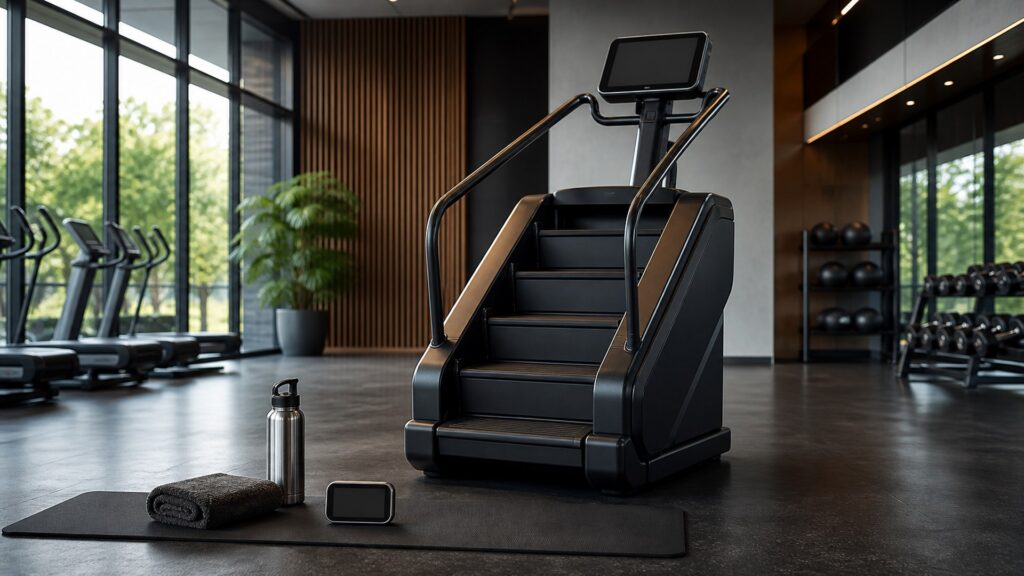
Buying framework
Buy for the change of pace
Define the intended session: Describe the work and recovery portions you expect to use, including their approximate length and effort. You are checking whether the machine supports your routine, not choosing a workout from its maximum rating.
Check the recovery end first: Try the lowest useful pace. If it still feels rushed after effort, the advertised range does not meet your needs.
Observe the transition: Ask for a modest increase and decrease during a demonstration. Notice any delay between the command and the actual movement, and whether you can maintain secure foot placement throughout.
Separate normal and emergency stopping: Use the normal control to end a session. Learn the emergency procedure from the manual and seller without improvising a high-speed test.
Who this is for
Match the format to your intervals
Revolving staircase: Useful when you want a machine-controlled stepping pace. Look for reachable speed controls and repeatable transitions, not only the number of program levels.
Full-size pedal stepper: The user sets the stepping rhythm while the mechanism provides resistance. Check whether pedal travel stays controlled as you speed up and whether the resistance can be changed without awkward reaching.
Compact hydraulic stepper: Can suit shorter stepping sessions when its instructions permit the intended use. Check cooling requirements and sustained operation before planning repeated work bouts or back-to-back sessions.
Connected machine: A class or saved program can simplify timing. Confirm that manual control, recovery adjustments and stopping remain accessible when the program changes pace.
What to pay attention to
Check controls, range and repeatability
Steps per minute: Use actual cadence where supplied, since level numbers are not standardized across machines. The StairMaster 4G product page, for example, lists 24–162 steps per minute; the range does not establish how quickly a change happens.
Control location: Try the buttons from your normal climbing posture. A reachable handrail control can be more useful during a transition than a feature hidden several menus deep.
Tread and rail fit: Check your training shoes at the intended effort. Small placement errors become more consequential when movement speeds up; a comfortable slow demonstration alone is not enough.
Timing and feedback: Look for a clear elapsed-time display and settings you can reproduce. Step counts, floors and calorie estimates may be calculated differently, so avoid treating them as interchangeable measurements.
Sustained operation: Confirm that the model is intended for the total session length and repeated use. Follow any cooling or duty limitations in the manual.
Avoid these traps
Do not confuse a high limit with good control
Maximum-speed shopping: The fastest model may offer little advantage if you cannot use its recovery setting comfortably.
Ignoring adjustment delay: A short work interval can be mostly acceleration on a slow-responding machine. Ask for a demonstration of the actual sequence you intend to use.
Recovering off moving steps: Do not build a routine around jumping onto side surfaces or stepping away from moving treads. Follow the manufacturer’s mounting, recovery and stopping instructions.
Assuming a workout app proves suitability: A program name does not override a machine’s operating limits or ensure the controls work well for you.
Decision guidance
Demonstrate the full work-and-recovery sequence
Begin at an easy pace: Establish stable stepping and locate the controls before increasing effort.
Make one controlled increase: With the seller’s guidance, use a pace within your ability and the machine’s instructions. Observe the response without chasing the maximum.
Return to recovery: Check how soon the machine reaches the requested pace and whether you can settle into it. Repeat only within a comfortable demonstration.
Review the interaction: You should be able to change settings, read time and stop without searching through screens or losing your footing. Reject a model whose transitions undermine control.
Ownership & compatibility
Plan for repeated use and service
Wear and inspection: Follow the model’s schedule for treads or pedals, rails, drive components and fasteners. Report new slipping, jerking or unreliable speed changes before continuing.
Hydraulic cooling: Do not generalize one compact stepper’s limits to every machine. The Sunny NO. 012 SMART manual, for example, warns that its cylinders become hot and must cool between uses.
Software and power: Check offline manual operation and the specified electrical installation. A class library is optional to a sound purchase; dependable control and local support are not.
FAQ
Stair machine interval FAQ
What is the most important interval feature?
Are resistance levels comparable across brands?
Can a mini stepper handle intervals?
Do I need automatic programs?
Should I test the maximum speed in a shop?
Bottom line
Choose the machine that handles both halves
For timed pace changes: Prefer clear, reachable controls and consistent response across work and recovery.
For user-paced stepping: Prioritize smooth pedal action at changing cadence and sufficient permitted session duration.
Final comparison: Choose control, tread fit and dependable recovery before maximum speed, program count or screen size.
Reading Shortcuts
Use the sections below to check fit, practical constraints and ownership before choosing.
Decision Reminders
Keep these checks in view when comparing finalists.
- Check recovery before maximum speed.
- Keep speed and stop controls within reach.
- Confirm permitted session duration.
Glossary Snippets
Terms that help compare the actual machines.
When to Use a Top 10 Review
Use rankings to find candidates after defining your space, fit and session requirements.
- Look for: Exact-model dimensions, control details and ownership support.
- Then verify: The manufacturer’s manual and a suitable demonstration.
Evidence: StairMaster 4G specifications supply the stated cadence range and handrail-control example. Sunny NO. 012 SMART manual, p. 6 explains that model’s cylinder cooling requirement. Sources reviewed September 23, 2026. No hands-on product test is claimed.
When to Use a Comparison
Use a direct comparison after two or three models meet the basic requirements.
- Fit check: Check recovery before maximum speed.
- Cost check: Include delivery, setup, wear parts, service and any subscription.
Keep the exact model and warranty terms alongside the quote so similar names do not hide different specifications.