
How to Choose Stair Machines for Small Spaces
A stair machine fits a small room only when there is space for the person climbing it, a clear way to get on and off, and the clearances required by its manual. The cabinet footprint is just the starting measurement. A low ceiling, a door that opens into the pedals or a narrow delivery turn can rule out an otherwise attractive model.
Choose a compact pedal stepper when storage is essential and its movement suits you. Consider a revolving staircase only when it can occupy a permanent, correctly measured position. Treat folding and transport wheels as features to demonstrate, not promises that any machine will disappear after a workout.
Buying framework
Measure the space you will actually use
Mark the operating area: Tape the base dimensions on the floor, then add the manufacturer’s entry, exit and surrounding clearances. Open doors and drawers and walk the usual route through the room. A machine that blocks a necessary passage does not fit.
Check the ceiling separately: Ask the manufacturer for the required ceiling height for your height and the exact model. Account for your position on the steps, natural movement and overhead fixtures. Do not add your height to the cabinet height; the relevant elevation is the specified user standing position.
Check both delivery and storage: Measure the assembled machine, shipping carton, door openings and turns. If storage matters, measure its approved stored configuration as well. Removing a handle or balancing a machine upright is not an acceptable substitute for documented storage instructions.
Who this is for
Match the format to the available room
Mini pedal stepper: A small base can be easier to store than a revolving staircase. Check its lifting weight, pedal travel and support needs; a compact model without handrails may not suit someone who needs a steady handhold.
Stepper with a handlebar: Integrated support may make the movement more comfortable, but it increases the storage envelope. Demonstrate any folding mechanism and check that the locking parts are accessible without pinching fingers.
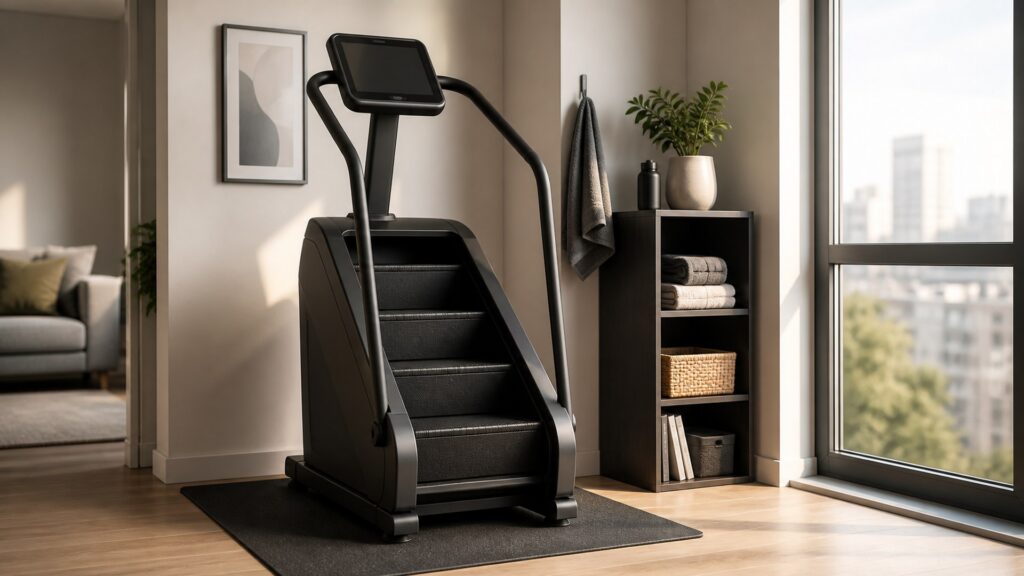
Revolving staircase: Choose this for continuous stair climbing in a permanent position. It needs overhead space, a safe approach to the moving treads and a delivery plan; a compact commercial description does not mean closet-sized.
Vertical climber: This is an alternative movement, not a smaller version of a staircase. Check overhead reach and whether you want coordinated arm-and-leg climbing before trading floor area for height.
What to pay attention to
Dimensions that deserve a second check
Use size versus storage size: Keep both measurements on your shortlist. For example, a folding frame may fit in a corner when closed yet obstruct the doorway when opened.
Clearance in the manual: Check the exact requirement rather than applying a universal allowance. The Sunny SF-S021055 manual specifies at least 2 feet of free space around that model; this illustrates why a small base still needs a larger operating area.
Floor and support: Verify user capacity, a solid level surface and every stabilizer’s contact. A soft mat cannot make an undersized or unstable installation suitable.
Outlet and access: For powered equipment, keep the electrical connection within the installation requirements and out of the mounting route. Leave access for service instead of trapping the housing against furniture.
Avoid these traps
Small-space shortcuts that backfire
Buying from footprint alone: A width-and-length specification excludes the person, entry path and required clearance.
Assuming wheels make daily moving easy: Try the permitted move on comparable flooring. Carpet, thresholds and the machine’s balance may make relocation impractical.
Treating a low ceiling as a posture problem: Do not plan to crouch through workouts or place the machine beneath a fan. Choose another location or format.
Ignoring the return route: A unit can be unboxed for delivery but still require repacking for return. Confirm collection arrangements and fees before purchase.
Decision guidance
Rehearse a complete setup and put-away
Before delivery: Leave the taped operating area in place through an ordinary day. Check household traffic, the door swing and access to outlets and windows.
At a demonstration: Get on, step at a controlled pace, stop and get off. If storage is part of the plan, have the seller demonstrate the approved folding and movement procedure.
During a home trial: Repeat the setup when you would normally exercise. Include shoes, mat, accessories, cleanup and storage; a routine you avoid repeating is not a successful space saving.
Make the decision: Keep a permanent staircase only if its full operating space remains available. Prefer a genuinely manageable pedal stepper when reclaiming the room is essential.
Ownership & compatibility
Keep the room usable after purchase
Storage conditions: Follow the manual’s orientation and temperature/moisture requirements. Do not store a compact stepper where moving pedals or hot components are accessible to children or pets.
Moving and cleaning: Use the intended lifting points and transport method. Recheck level and stability after relocation, and keep dust out of joints and moving parts according to the manual.
Service and removal: Ask whether parts can be replaced in the available space. Include eventual removal in the cost comparison; the smallest purchase price can still carry awkward collection costs.
FAQ
Small-space stair machine FAQ
Can I put a stair machine in a bedroom?
Does a mini stepper need extra space around it?
Is an eight-foot ceiling enough?
Can I store a stepper upright?
Which matters more: folded size or weight?
Bottom line
Choose a machine that leaves room to live
For a multipurpose room: Favor a format you can safely set up and store using the approved procedure.
For a dedicated corner: A revolving staircase can work if the ceiling, clearances, floor and delivery route all pass.
Before paying: Confirm the exact model dimensions and clearance instructions in writing. A compact label is not an installation plan.
Reading Shortcuts
Use the sections below to check fit, practical constraints and ownership before choosing.
Decision Reminders
Keep these checks in view when comparing finalists.
- Measure the person as well as the machine.
- Keep household passages open.
- Demonstrate storage before relying on it.
Glossary Snippets
Terms that help compare the actual machines.
When to Use a Top 10 Review
Use rankings to find candidates after defining your space, fit and session requirements.
- Look for: Exact-model dimensions, control details and ownership support.
- Then verify: The manufacturer’s manual and a suitable demonstration.
Evidence: Sunny SF-S021055 manual, p. 1 gives that model’s surrounding clearance, surface and storage requirements. Other models have different instructions. Sources reviewed September 23, 2026. No hands-on product test is claimed.
When to Use a Comparison
Use a direct comparison after two or three models meet the basic requirements.
- Fit check: Measure the person as well as the machine.
- Cost check: Include delivery, setup, wear parts, service and any subscription.
Keep the exact model and warranty terms alongside the quote so similar names do not hide different specifications.