
How to Choose Tires & Wheels for Maintenance Planning
Tire maintenance tracks condition. A tire can retain tread while wearing its inner shoulder, lose pressure, develop impact damage, or age unused in the spare well. Wheel corrosion or runout can create leaks and vibration resembling tire defects.
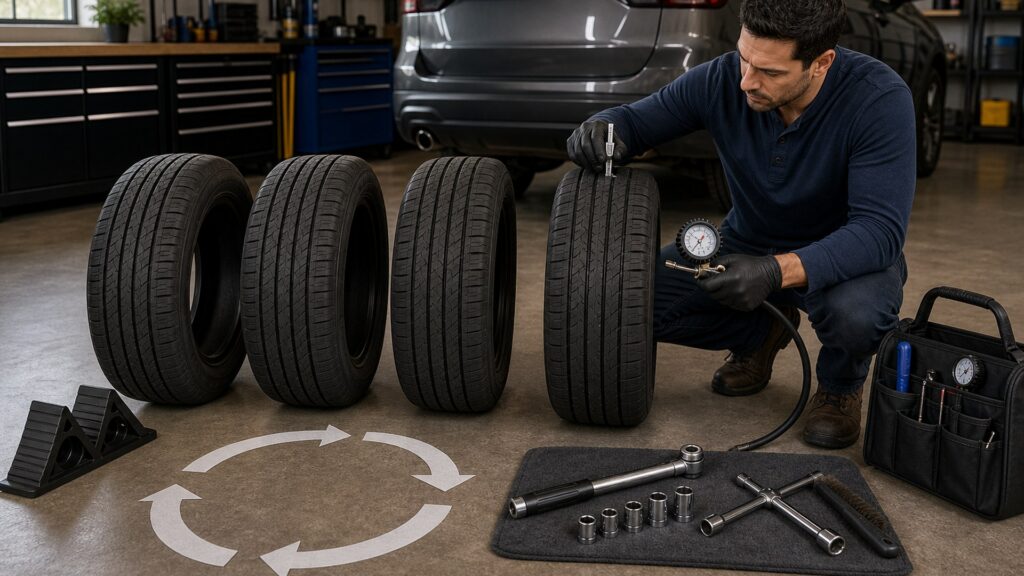
Create a monthly record for every road tire and spare: cold pressure, tread across the width, visible damage, leakage, vibration, TPMS state, position, repairs, and age. Use the allowed rotation pattern and pressure specification, then investigate new wear rather than moving it. Have punctures, impacts, balance, alignment, and wheel damage assessed professionally. Register tires, monitor recalls, store seasonal sets correctly, and replace when condition, performance, age guidance, or matching requirements demand it—not when the budget happens to notice.
Buying framework
Trend tire condition by position and time
Consistent measurements expose pressure loss, irregular wear, impact damage, and aging before a warning or roadside failure.
Create the baseline: Record tire and wheel identity, TIN, position, cold pressure, tread across the width, repairs, age, TPMS, alignment, balance, spare, and installation date.
Inspect on a fixed rhythm: Check monthly, before long trips, after impacts, after load changes, and whenever pressure, noise, vibration, steering, or braking behavior changes.
Diagnose patterns before rotating: Use inner-center-outer wear, circumference, pressure history, vehicle pull, vibration speed, and suspension condition to find the cause.
Set retirement triggers: Use tread, damage, chronic leakage, bulges, cracks, exposed material, repair limits, vibration, recalls, performance, age guidance, and matching needs.
Who this is for
Maintenance plans differ by use and package
Low-mileage vehicles, high-mileage commuters, staggered sets, trucks, EVs, and seasonal wheels consume tires in different ways.
High-mileage commuters: Benefit from frequent pressure and tread trending, allowed rotations, balance and alignment response, road-hazard inspection, and replacement budgeting.
Low-mileage and stored vehicles: Need age, flat-spot, ozone, UV, pressure, storage, spare, valve, and seasonal inspection despite apparently deep tread.
Staggered or directional packages: Require position-specific records and restricted rotation patterns, making alignment, matching, pressure, and early wear response more important.
Heavy, high-torque, towing, or EV use: Track axle loading, torque wear, pressure, shoulder condition, alignment, brake or regeneration effects, heat, and replacement matching more closely.
What to pay attention to
Maintenance measurements that change a decision
A useful log records repeatable values and symptoms that lead to inflation, diagnosis, service, rotation, or retirement.
Tire Condition
Cold pressure, tread map, cuts, cracks, bulges, punctures, repairs, beads, age, heat, contamination, and performance.
Vehicle and Wheel
Alignment, balance, runout, bearings, suspension, brakes, load, wheel corrosion, fasteners, valves, TPMS, and spare.
Pressure trend: Use an accurate gauge under consistent cold conditions, compare every position with vehicle guidance, investigate repeated loss, and include the spare.
Tread and wear map: Measure inner, center, and outer grooves at repeatable locations, note feathering, cupping, heel-toe wear, flat spots, and position changes.
Vibration diagnosis: Record speed, acceleration or coasting, steering or seat sensation, temperature, load, recent impacts, balance, runout, wheel damage, and suspension findings.
TPMS maintenance: Distinguish low-pressure warning from malfunction, inspect sensors and valves during service, use correct kits and torque, relearn properly, and preserve pressure references.
Wheel and mounting-face condition: Inspect bends, cracks, corrosion, bead seat, valve hole, coating damage, debris, center pilot, fastener seats, balance weights, and approved repair limits.
Avoid these traps
Maintenance habits that hide developing tire problems
Adding air, rotating, or balancing without diagnosing the trend can move symptoms while the underlying defect continues.
Checking pressure only when TPMS warns: The system is not a substitute for monthly gauge checks, and a malfunction or threshold warning may arrive after meaningful underinflation.
Measuring only the easiest outer tread: Inside shoulders can wear severely because of alignment, load, or suspension conditions while the visible outer area looks acceptable.
Rotating through an active defect: Moving a damaged or abnormally worn tire can change where the symptom appears without correcting pressure, alignment, balance, load, or component wear.
Assuming deep tread means unlimited life: Age, cracking, separation, repairs, vibration, storage, heat, and manufacturer replacement guidance can retire a tire before tread reaches minimum depth.
Decision guidance
Choose tools and services that improve diagnosis
Buy measurement tools for repeatable records and use professional service when stored energy, internal damage, mounting, or structural wheel work exceeds safe inspection.
If one tire repeatedly loses pressure: Inspect promptly for puncture, valve, bead, wheel, temperature, or damage; repeated topping off is not a completed repair.
If tread wear differs across the width: Check pressure history, alignment, load, suspension, wheel, rotation, and driving conditions before changing the rotation schedule.
If vibration begins after an impact: Reduce or stop use as conditions warrant and obtain professional tire, wheel, runout, balance, hub, bearing, and suspension inspection.
If replacement is needed mid-set: Follow vehicle and tire guidance for axle or full-set matching, size, construction, tread, circumference, AWD limits, and placement rather than choosing by price alone.
Ownership & compatibility
Run the maintenance plan as a living record
The log should make the next service decision obvious and follow seasonal sets, repairs, rotations, and vehicles without losing identity.
Update at every service: Record pressure, tread map, position, mileage, rotation, balance, alignment, repair, TPMS, wheel work, symptoms, fastener procedure, and technician findings.
Audit seasonal storage: Label positions, clean and dry sets, protect from sun, ozone, heat, chemicals and moisture, support safely, monitor pressure where applicable, and inspect before mounting.
Forecast replacement: Budget from measured wear rate, seasonal needs, availability, age guidance, matching rules, upcoming trips, and installation lead time—not the first exposed wear bar.
FAQ
Tire and wheel maintenance questions
These answers cover pressure, TPMS, tread, rotation, alignment, balance, punctures, age, spares, and replacement matching.
How often should tire pressure be checked?
Why is the TPMS light not enough for maintenance?
Where should tread depth be measured?
How often should tires be rotated?
When does an alignment need inspection?
Can every tread puncture be repaired?
How old is too old for a tire?
Why should the spare tire be inspected?
How should replacement tires be matched to the remaining set?
Bottom line
Good tire maintenance turns symptoms into early decisions
Measure consistently, trend every position, diagnose wear before moving it, and retire tires or wheels when condition—not just mileage—removes safety margin.
Measure and map: Track cold pressure, tread width, damage, leakage, vibration, TPMS, age, repairs, and spare.
Diagnose before moving: Connect wear to inflation, alignment, balance, load, suspension, wheel, braking, and position.
Plan replacement early: Use condition, performance, recalls, age guidance, matching, availability, and upcoming duty to budget the next set.
Reading Shortcuts
Move from the operating need to a documented condition-trending plan that can be installed and verified.
Decision Reminders
Keep the complete condition-trending plan in view while comparing tires and wheels.
- Pressure: Monthly, cold, every tire.
- Tread: Map inner, center, outer.
- Symptoms: Record leakage, noise, vibration.
- Cause: Pressure, load, alignment, wheel.
- Lifecycle: Repairs, TIN, age, recalls.
- Replace: Condition and matching, not mileage.
Glossary Snippets
Terms that separate useful performance from apparent compatibility.
When to Use a Top 10 Review
Use a product roundup only after the required performance and condition-trending plan limits are known.
- Problem defined: The visibility or mobility failure is specific.
- Vehicle mapped: Interfaces and limits are documented.
- Format chosen: The correct product family is settled.
- Evidence available: Finalists can be compared on relevant tests.
Have finalists already? Open a Comparison for a closer tradeoff.
When to Use a Comparison
Compare finalists that solve the same defined condition-trending plan need on the same vehicle.
- Application: Both match the exact vehicle and function.
- Performance: Evidence addresses the operating problem.
- Integration: Mounting and system effects are understood.
- Ownership: Inspection and service demands are acceptable.
Need a broader field? Use a Top 10 to form a shortlist.