
How to Choose Tires & Wheels for Wheel Size and Clearance Checks
Wheel fitment is a three-dimensional moving problem. Two wheels with the same diameter, width, and offset can have different spoke curves, barrel drops, mounting pads, flange shapes, and balance-weight locations. Two tires with the same labeled size can measure differently on different rim widths.
Build the clearance proof from drawings, tire dimensions, and exact-vehicle measurements. Verify hub, bolt pattern, fastener seat and engagement, wheel load, TPMS, and brake template before considering the fender. Map inboard and outboard space through steering lock, compression, droop, roll, alignment, and loaded deflection. Include hoses, liners, chains, snow or mud, heat, and service access. A calculator can screen candidates; it cannot approve the package. Commission the installed set with controlled motion and post-drive inspection.
Buying framework
Build separate interface and motion envelopes
Wheel-to-hub, wheel-to-brake, tire-to-suspension, tire-to-body, and tire-to-electronics each need direct verification.
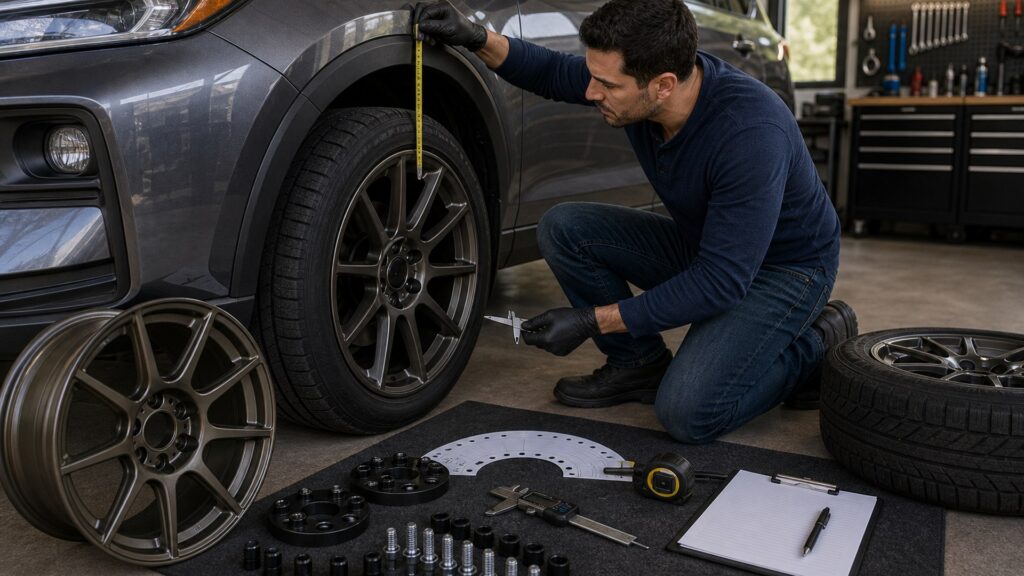
Measure the existing baseline: Record actual tire dimensions, wheel diameter and width, offset, backspacing, hub, fasteners, brakes, clearances, alignment, ride height, and load.
Obtain candidate geometry: Use exact drawings, tire measuring-rim data, section and diameter, wheel barrel and spoke profiles, pad thickness, center bore, and tolerances.
Overlay every motion: Check steering sweep, compression, droop, roll, tire deflection, heat, snow or mud accumulation, chains, and suspension or body compliance.
Commission with staged checks: Test hub seating, fasteners, brake rotation, steering, controlled loading, low-speed motion, rubbing, TPMS, vibration, and a post-drive inspection.
Who this is for
Clearance priorities change with package purpose
Brake downsizing, performance width, winter wheels, off-road diameter, and lowered suspension expose different tight points.
Winter downsizing buyers: Confirm minimum brake barrel and spoke clearance, approved tire diameter and load, TPMS, fasteners, chain space, corrosion, and speed rating.
Performance-width buyers: Model tread support, steering and fender sweep, strut and spring clearance, alignment range, wheel strength and mass, and event class.
Off-road diameter buyers: Check gearing, brakes, axle and body clearance, travel, steering, bump stops, liners, chains, spare, jack height, and mud packing.
Lowered or modified-suspension vehicles: Recalculate travel, camber and toe change, spring and perch position, control arms, bump stops, fenders, liners, and loaded ride height.
What to pay attention to
Clearance specifications measured at the tightest point
Nominal offset and tire size are screening values; exact profiles, tolerances, motion, and load decide the package.
Hard Interfaces
Hub, center bore, bolt circle, mounting face, fastener seat and engagement, wheel load, caliper, barrel, spokes, and weights.
Moving Interfaces
Tire section, tread, steering, suspension, body, liner, hoses, alignment, deflection, heat, chains, snow or mud, and service.
Tire measured dimensions: Use exact model data for measuring rim, section width, tread width, overall diameter, loaded radius, rim range, and growth or tolerance where provided.
Wheel profile: Obtain actual barrel diameter and drop, spoke shape, mounting pad, flange, width, offset, backspacing, center bore, valve, and load rating.
Brake envelope: Compare caliper templates with barrel, spokes, pad, weights, tolerances, heat, wheel flex, debris, and future brake service or replacement.
Steering and travel envelope: Inspect inner and outer shoulders, strut, spring, tie rod, control arms, knuckle, hoses, body, liner, bumper, and fender through motion.
System calibration effects: Verify circumference, speed display, AWD limits, ABS, stability, TPMS, driver assistance, spare, gearing, headlamp aim where ride height changes, and legal coverage.
Avoid these traps
Clearance checks that stop at static straight-ahead fit
The smallest gap often appears during combined steering, compression, load, roll, heat, and tire deflection—not while parked on level ground.
Trusting nominal tire size: Actual section and tread width, diameter, shoulder shape, rim width, pressure, load, and model tolerances vary within the same label.
Assuming equal offset means equal position: Wheel width and flange geometry change inner and outer edges; spoke and barrel shapes independently determine brake clearance.
Using spacers before diagnosing the tight point: Moving outward may solve strut clearance while creating fastener, hub, bearing, steering, fender, coverage, and chain problems.
Calling rubbing normal settling: Any contact identifies an unresolved envelope under that load and motion; damage can affect tire, hose, wiring, body, suspension, or wheel.
Decision guidance
Reject the package if any envelope lacks evidence
A candidate must clear hard interfaces and moving zones with specified tolerance while preserving load, electronics, spare, and legal requirements.
If brake clearance is unknown: Use the exact brake and wheel template or direct approved measurement; do not infer clearance from diameter or another wheel model.
If tire data are given on another rim width: Adjust expectations using manufacturer data and stay within approved rim range, then verify actual mounted section and clearance.
If clearance requires a spacer: Use only a complete supported arrangement with correct hub, fasteners, engagement, rating, geometry, inspection, and legal status—or select another wheel.
If the gap disappears under travel: Choose different tire or wheel geometry or an approved vehicle solution; do not rely on wear-through, trimming, or added pressure without engineering support.
Ownership & compatibility
Recheck clearance as the vehicle changes
Alignment, load, suspension wear, ride height, tire replacement, wheel repair, brake service, and impacts can consume the original margin.
Keep a clearance record: Store drawings, templates, measurements, pressures, alignment, ride height, load, photos, fasteners, TPMS, spare, and installed part identifiers.
Inspect early operating cycles: Look for polish, rubber dust, liner movement, hose abrasion, balance-weight loss, heat marks, fastener issues, leakage, vibration, steering change, and TPMS faults.
Repeat after relevant work: Recheck after alignment, suspension, brakes, wheel repair, tire model change, cargo or towing change, chains, body repair, or impact.
FAQ
Wheel size and clearance questions
These answers cover offset, backspacing, tire dimensions, brakes, spacers, steering, suspension, chains, electronics, and post-installation checks.
Why can two tires with the same size fit differently?
Are offset and backspacing interchangeable?
How do I check whether a wheel clears my brakes?
Can a wheel spacer safely create clearance?
What must be checked at full steering lock?
Does suspension lift guarantee larger-tire clearance?
How much clearance is enough for snow chains?
How can wheel size affect ABS and stability control?
What should I inspect after installing a different wheel size?
Bottom line
Clearance is a measured operating envelope
Use exact tire and wheel geometry, verify every hard interface, simulate full motion and load, then inspect the installed package for evidence of lost margin.
Measure actual parts: Nominal size screens candidates; exact tire dimensions, wheel profiles, brake templates, and tolerances decide.
Move the complete system: Steering, travel, roll, deflection, heat, chains, snow or mud, hoses, and bodywork all consume space.
Commission and preserve: Stage the checks, document the envelope, inspect early use, and repeat after vehicle or component changes.
Reading Shortcuts
Move from the measured problem to a documented dynamic-clearance proof that can be installed and verified.
Decision Reminders
Keep the complete dynamic-clearance proof in view while comparing tires and wheels.
- Actual: Use exact dimensions and drawings.
- Hub: Pattern, bore, seat, engagement.
- Brake: Template barrel, spokes, weights.
- Motion: Steering, compression, droop, roll.
- Environment: Heat, chains, snow, mud.
- Recheck: Inspect after use and changes.
Glossary Snippets
Terms that separate useful performance from apparent compatibility.
When to Use a Top 10 Review
Use a product roundup only after the required performance and dynamic-clearance proof limits are known.
- Problem defined: The visibility or mobility failure is specific.
- Vehicle mapped: Interfaces and limits are documented.
- Format chosen: The correct product family is settled.
- Evidence available: Finalists can be compared on relevant tests.
Have finalists already? Open a Comparison for a closer tradeoff.
When to Use a Comparison
Compare finalists that solve the same defined dynamic-clearance proof need on the same vehicle.
- Application: Both match the exact vehicle and function.
- Performance: Evidence addresses the operating problem.
- Integration: Mounting and system effects are understood.
- Ownership: Inspection and service demands are acceptable.
Need a broader field? Use a Top 10 to form a shortlist.