
How to Choose Towing, Trailers & Hauling for Load Planning
Load planning begins before a ramp drops or a forklift approaches. Each item needs a credible weight, dimensional envelope, movement profile, attachment strategy, and unload sequence. Without those details, a trailer can be under gross capacity yet overloaded at one axle, ramp, or anchor.
Turn the manifest into a placement and restraint drawing, then verify it with actual axle and hitch measurements. Working load limits, blocking, edge protection, route conditions, and reinspection belong in the same plan. A clean-looking load is not evidence that the system is balanced or immobilized.
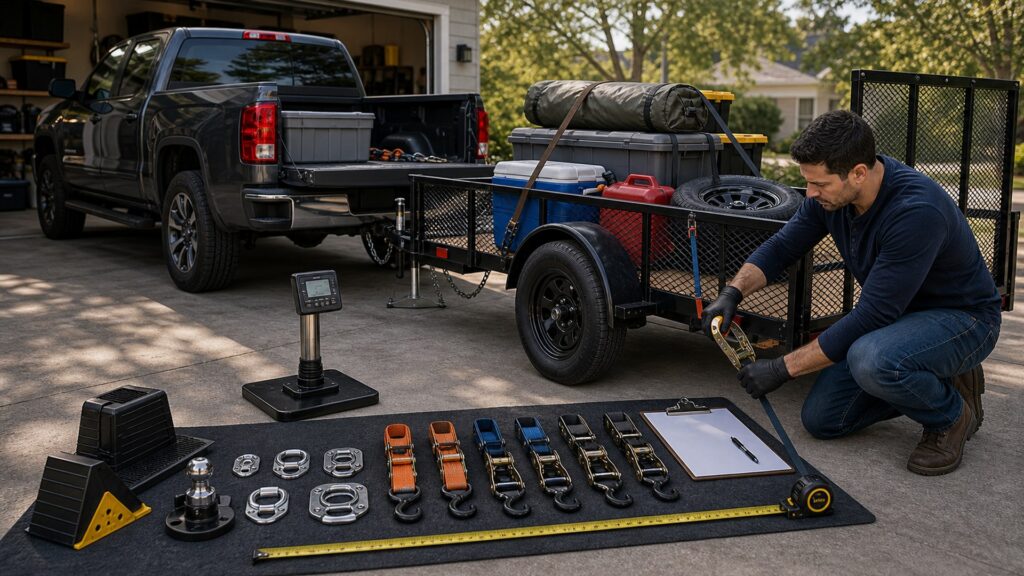
Buying framework
Create the load plan before the first lift
A load plan connects item data to placement, axle and hitch limits, restraint, loading order, and the route. It should be clear enough that another trained person can reproduce the safe configuration.
Build a cargo manifest: Record each item's actual or defensible weight, dimensions, center-of-gravity clues, rolling or articulated parts, liquids, attachments, lifting points, tie-down points, surface sensitivity, and unload priority. Separate unknowns that require weighing or manufacturer confirmation.
Draw the dimensional envelope: Compare cargo length, width, height, overhang, door and fender clearance, deck contact, ramp angle, turning space, and tie-down access. Include pallets, cradles, dunnage, packaging, and lifting equipment rather than measuring the bare object alone.
Assign weight to axles and hitch: Place dense cargo with trailer and vehicle manufacturer guidance, then measure tongue or pin load and axle groups. Gross weight can pass while one trailer axle, tow-vehicle axle, tire, or hitch component is overloaded.
Design movement control: Identify forward, rearward, lateral, vertical, rolling, and articulation risks. Combine rated anchors, tiedowns, connectors, tensioners, blocking, bracing, chocks, cradles, and edge protection so the weakest component and load path are understood.
Plan verification and reinspection: Weigh the representative loaded combination, document securement, confirm doors and ramps, and inspect after the load settles or at intervals required by law, manufacturer guidance, or the operation. Route changes and weather may justify earlier checks.
Who this is for
Match the plan to cargo behavior
Mass alone does not describe a load. Tall, rolling, long, liquid, fragile, and mixed cargo each demand different placement and restraint logic.
Dense materials and pallets: Masonry, tile, bagged goods, metal, and machinery can concentrate load in a small footprint. Confirm deck or floor concentrated-load capability, forklift access, pallet condition, axle placement, blocking, and anchors before using available floor area as a capacity estimate.
Rolling vehicles and equipment: Wheels, tracks, steering joints, attachments, and suspension allow movement. Use machine-specific securement points, chocks or cradles, rated ramps, parking or transport modes, attachment restraint, and commodity-specific requirements where applicable.
Long materials: Lumber, pipe, ladders, and fabricated pieces introduce overhang, bending, sliding, and multiple support points. Plan racks or bunks, forward stops, transverse restraint, flagging or lighting, turning clearance, and applicable length rules without crushing the material.
Tall or top-heavy cargo: Appliances, cabinets, tanks, and equipment with raised centers of gravity can tip before tiedowns reach full load. Use a suitable trailer, wide support, blocking, opposed restraint, low placement, route control, and manufacturer-approved attachment points.
Mixed household or jobsite loads: Items of different density and fragility can settle, crush, or hide anchors. Load by weight and unload sequence, isolate hard edges, immobilize small pieces in appropriate containers, and prevent heavy objects from transferring force into fragile cargo.
What to pay attention to
Measurements and securement ratings that govern the plan
The plan needs values for mass, position, restraint strength, and access. Use documented working limits rather than visual confidence.
Mass & Placement
Cargo manifest, actual weights, gross and axle limits, tongue or pin load, center of gravity, dimensions, and loading sequence.
Restraint & Trip Control
Working load limits, anchors, tiedown direction, blocking, rolling prevention, edge protection, route forces, settling, and reinspection.
Scale capacity and resolution: Truck scales, platform scales, tongue scales, load cells, or manufacturer systems must suit the expected weight and measurement method. Check range, accuracy, setup surface, calibration or verification guidance, and whether axle groups can be isolated.
Trailer and vehicle weight limits: Use actual loaded vehicle and trailer weights against GVWR, GAWR, GCWR, payload, trailer ratings, hitch components, and tires. Do not transfer unused capacity between unrelated components or use a gross total to hide an axle overload.
Deck, ramp, and point loading: A deck's distributed capacity may not cover narrow wheels, jack stands, stabilizers, pallets, or machine tracks. Verify concentrated-load limits, crossmember support, ramp wheel paths, hinge ratings, loading angle, and ground support under manufacturer instructions.
Working load limit and load path: Use the service rating assigned to tiedowns, chains, binders, fittings, anchors, and cargo attachments. The lowest-rated or least-suitable component controls the path. Break strength is not the value to substitute for working load.
Anchor location and tiedown angle: Anchor direction, height, spacing, accessibility, and structure affect how restraint opposes movement. Poor angles can add vertical or lateral effects and make tensioning difficult. Use the equipment maker's guidance and applicable securement rules.
Blocking, bracing, and edge protection: Dunnage should support without collapsing, blocking should resist the intended direction, and chocks must remain captured. Edge protection must protect tiedowns from cutting or abrasion without creating a slippery contact or damaging the cargo.
Route and clearance data: Confirm legal and physical width, height, length, axle, bridge, grade, surface, turn, parking, and weather constraints. A load that is stable on level pavement may need different equipment or routing for steep, rough, or restricted sites.
Avoid these traps
Load-planning shortcuts that miss local overloads
A neat-looking load can still overload one component or move when braking, turning, or crossing rough pavement.
Balancing by eye: Visual centering does not reveal axle load, tongue or pin weight, or center of gravity. Weigh the loaded configuration and use manufacturer guidance for placement instead of shifting cargo until the trailer merely looks level.
Checking gross weight only: Trailer GVWR and GCWR can pass while a tow-vehicle rear axle, trailer axle, tire, hitch, ramp, deck point, or anchor fails its own limit. Preserve the component-level checks in the plan.
Using break strength as WLL: Break strength describes failure under a test and is not an allowable service load. Use the labeled working load limit and applicable calculation, including the lowest-rated connector, tensioner, anchor, or cargo attachment.
Tensioning without edge control: A ratchet can cut webbing over a sharp edge, crush fragile cargo, deform a component, or overload an anchor before the load is stable. Add suitable protection, blocking, cradles, or another restraint path rather than simply pulling harder.
Skipping the recheck: Webbing stretches, cargo settles, tires compress, temperature changes, and rough roads move dunnage. Stop and inspect at the intervals required for the operation and whenever handling changes; do not wait for noise or visible movement.
Decision guidance
Choose equipment from the load's movement risk
Placement and restraint should address the specific behavior of the cargo, not imitate a photograph of a different load.
If the load is dense and compact: Verify point loading and axle distribution before adding tiedowns. Position under manufacturer guidance, use suitable dunnage, and choose anchors and restraint paths that oppose sliding without concentrating excessive force on fragile packaging.
If the load can roll or steer: Use chocks, cradles, blocking, transport locks, and rated tiedowns at approved points. Secure articulating booms, buckets, ramps, or attachments separately where required, and follow commodity-specific rules for vehicles or equipment.
If the load is tall: Lower its center of gravity when possible, widen support, resist tipping in multiple directions, and avoid weak upper attachment points. Reevaluate route speed, curves, crosswind, overhead clearance, and the trailer architecture rather than relying on extreme strap tension.
If the cargo is long or overhanging: Support the full structure at appropriate points, control forward and lateral movement, protect ends and tiedowns, and verify legal marking, lighting, and dimension requirements. Check turning sweep and unload space at both ends of the trip.
If the load contains liquids or loose pieces: Use tanks, containers, bulkheads, bags, bins, covers, or enclosures designed for the material and movement. Account for fluid surge or settling and keep containment distinct from the rated restraint needed for the container itself.
Ownership & compatibility
Keep measurement and securement equipment trustworthy
Repeatable load plans depend on readable ratings, undamaged gear, and records that reflect the current trailer and cargo.
Inspect and identify every component: Check webbing, stitching, chain, hooks, binders, ratchets, nets, anchors, track fittings, chocks, ramps, scales, and dunnage. Keep WLL markings readable and retire equipment under manufacturer or regulatory criteria when damage or identity is uncertain.
Store securement gear by type and condition: Clean and dry equipment as specified, protect it from chemicals, ultraviolet light, heat, sharp edges, and standing moisture, and segregate damaged items immediately. Organized kits reduce the temptation to mix unknown components during loading.
Save repeat-load records: Keep manifests, photographs, item weights, scale tickets, axle readings, tongue or pin measurements, anchor maps, and reinspection notes. A documented successful configuration is a starting point, not permission to ignore a changed machine or attachment.
Audit changes before reuse: New racks, toolboxes, spares, batteries, deck repairs, anchors, tires, routes, cargo attachments, or operators can alter the plan. Recalculate and remeasure rather than editing an old diagram by intuition.
FAQ
Load-planning FAQ for towing and hauling
Answers about scales, axle weight, tiedown ratings, placement, and reinspection.
What information belongs in a cargo manifest?
Can I stay under trailer GVWR and still be overloaded?
How do I measure tongue weight?
What is the difference between break strength and WLL?
How many straps does my cargo need?
Why does tiedown angle matter?
When should I use blocking instead of more straps?
How soon should I reinspect a secured load?
Can I reuse a load plan for the same machine?
Bottom line
Measure, place, restrain, and recheck
A strong load plan shows where every pound sits, how every movement is resisted, and how the configuration will be verified before and during transport.
Start with item data: Weight, dimensions, mobility, and unload order drive the design.
Protect local limits: Axles, tires, hitch parts, deck points, anchors, and ramps matter alongside gross totals.
Build a rated load path: Use WLL, blocking, edge protection, and suitable cargo attachment points.
Document the verification: Scale readings, photographs, and reinspection make the plan repeatable.
Reading Shortcuts
Capture weight, dimensions, movement, and unload order.
Decision Reminders
Checks to complete before the combination moves.
- Weigh the real item: Catalog averages can omit attachments.
- Check axle groups: Gross weight can hide a local overload.
- Measure hitch load: Placement changes tongue or pin weight.
- Use WLL: Break strength is not the planning rating.
- Protect sharp edges: Tension alone can damage tiedowns.
- Schedule reinspection: Loads settle and restraints change.
Glossary Snippets
Terms used in this towing decision.
When to Use a Top 10 Review
Use rankings after cargo behavior and required measurement or securement equipment are known.
- The manifest is complete: Compare tools for a defined load.
- The weight range is known: Select suitable scales and components.
- The movement risk is mapped: Choose chocks, blocking, or tiedowns appropriately.
- The route is known: Screen clearance and reinspection needs.
Already down to 2–3 options? A Comparison is usually the faster next step.
When to Use a Comparison
Compare products only within the same measured load plan.
- Compare WLL and labeling: Ratings must remain identifiable.
- Compare anchor fit: Hooks and fittings must suit the track or point.
- Compare edge control: Protect both cargo and restraint.
- Compare inspection and storage: Durable gear must remain easy to examine.
Still building a shortlist? Start with a Top 10.