
How to Choose Vehicle Security Systems for Installation and Wiring Requirements
Security-system reliability is largely decided behind the trim. Two packages with similar alarms and apps can impose very different requirements for vehicle-specific firmware, dashboard access, power feeds, data connections, immobilizer authorization, relays, interlocks, antennas, and sensors. The quote must identify those requirements before work begins.
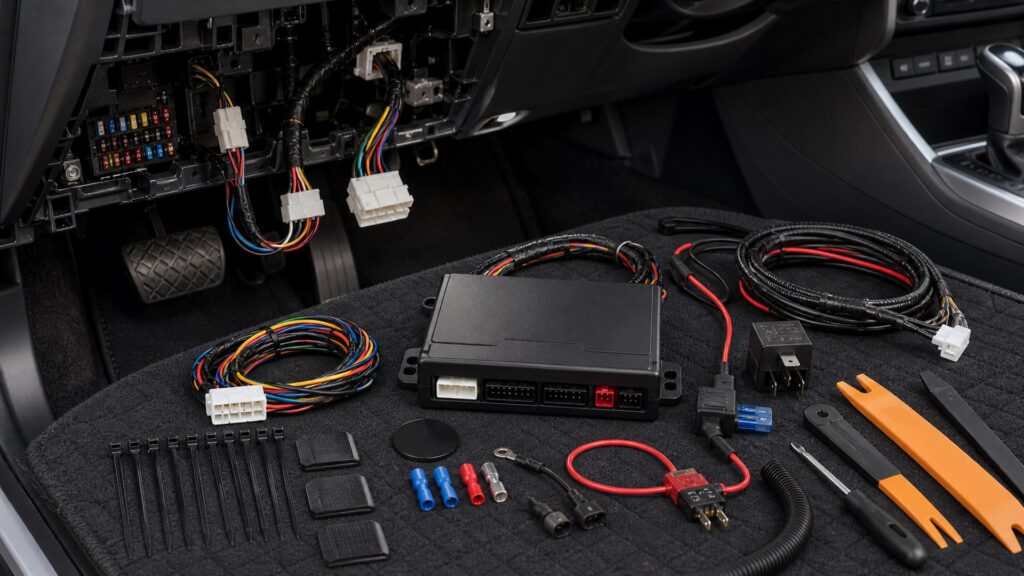
Buy the installation as a documented electrical system. Require an exact vehicle and powertrain match, current diagrams, protected circuits, mechanically secure connections, safe cable routing, and a complete test plan. A T-harness can reduce selected splices, but it cannot replace correct configuration, safe disassembly, sleep-current measurement, or proof that every factory function still works.
Buying framework
Turn the feature list into a wiring plan
Map each desired function to its module, connector, circuit, data message, fuse, ground, sensor, antenna, interlock, and programming step.
Freeze the exact vehicle: Record VIN, year, trim, engine or propulsion type, transmission, key style, factory remote start, alarm, telematics, and recent module updates.
Map every requested function: Link locks, perimeter, sensors, siren, remote start, tracking, and notifications to required circuits, data messages, antennas, accounts, and interlocks.
Request an interface schedule: List main module, firmware, T-harness, bypass, relays, sensors, cellular unit, fuses, grounding point, programming tool, and unsupported functions.
Write acceptance tests first: Define normal and failure tests for arm, trigger, disarm, keys, remote start, hood, brake, gear, takeover, shutdown, sleep, scan, and override.
Who this is for
Match installation depth to vehicle architecture
A simple alarm input and an integrated remote-start platform occupy very different portions of the vehicle.
Alarm-only installation: Perimeter inputs, a siren, impact sensing, status LED, and safe power may avoid deep ignition and immobilizer work.
Remote-start security buyer: Expect exact firmware, authentication, engine sensing, hood, brake, gear, shutdown, takeover, climate, and charging-state requirements.
Cellular tracking owner: Add modem placement, GPS view, account transfer, backup power, wake schedule, parked current, subscription, and privacy to the wiring plan.
Complex or warranty-sensitive vehicle: Seek a documented specialist who understands gateways, multiplexed networks, airbag zones, trim service, diagnostics, and reversible removal.
What to pay attention to
Specifications that determine electrical reliability
Connector coverage, load handling, protection, routing, firmware, and current draw matter more than a tidy feature label.
Electrical Integrity
Evaluate circuit identification, load, fuse location, grounds, splices, relays, network connections, insulation, strain relief, and parked draw.
Installation Lifecycle
Evaluate exact-vehicle firmware, disassembly, module security, antenna and sensor placement, access, documentation, updates, removal, and service mode.
Harness coverage: Identify which connections are plug-in and which remain discrete; verify connector revisions, adapter needs, pin condition, locks, and strain relief.
Power and protection: Size conductors and relays for actual loads, place fuses near sources, isolate added circuits, protect pass-throughs, and avoid unapproved fuse taps.
Ground quality: Use a documented metal grounding point with correct preparation, fastener security, corrosion control, conductor size, and voltage-drop verification.
Network and immobilizer integration: Confirm supported CAN networks, gateway access, firmware, key-learning requirements, retained keys, limitations, and behavior after factory software updates.
Interlock and sensor wiring: Route hood, brake, gear, door, trunk, siren, shock, tilt, glass, temperature, and antenna wiring away from airbags, pedals, heat, water, and moving parts.
Sleep and diagnostic results: Measure the complete sleep cycle, compare pre/post scans, inspect warning lamps, test charging voltage, and investigate unexplained wakeups or codes.
Avoid these traps
Wiring shortcuts that create delayed failures
Problems often appear later as intermittent starts, dead batteries, broken trim, diagnostic faults, or service confusion.
Assuming a T-harness makes installation plug-and-play: It covers only named connectors; power, grounds, antennas, sensors, programming, interlocks, configuration, and testing still require skilled work.
Accepting unidentified wire taps: Every connection should have a circuit purpose, method, protection, routing, photo, and removal plan rather than disappearing into taped bundles.
Mounting modules where service damages them: Avoid knee airbags, pedal space, drains, heaters, sharp brackets, moving columns, frequently removed trim, and inaccessible deep cavities.
Testing immediately after key-off: Many vehicles take time to sleep; measure long enough to capture module shutdown, cellular check-ins, and unexpected recurrent wake events.
Decision guidance
Choose the least invasive supported integration
Prefer reversible, documented interfaces and omit functions that require unsupported commands or unsafe interruption.
Use shallow integration when needs are narrow: Choose perimeter and local sensing that preserves factory authentication when deeper convenience or tracking functions are unnecessary.
Use a supported harnessed platform when available: A current exact-vehicle interface can reduce invasive work if all remaining connections and firmware limitations are disclosed.
Choose custom wiring only with evidence: Require current diagrams, load calculations, professional connection methods, protected routing, diagnostic competence, and a complete as-built record.
Drop unsupported functions: Do not improvise network commands, interlocks, or immobilizer behavior merely to retain a package feature that lacks documented vehicle coverage.
Ownership & compatibility
Document the installation for future service
Photos, versions, circuit records, overrides, and test results make later diagnosis and removal practical.
Keep an as-built packet: Store module labels, firmware, harness numbers, connection photos, fuse locations, sensor settings, account ownership, overrides, scans, and current measurements.
Retest after relevant changes: Battery, key, windshield, dashboard, body-module, gateway, telematics, firmware, collision, or remote-start work can alter integration behavior.
Plan service and removal: Know how to enter service mode, identify added fuses, reach modules, transfer accounts, restore circuits, and remove hardware without guessing.
FAQ
Installation questions to settle before booking
The installer should answer these for the exact vehicle, not a model-family assumption.
Does a T-harness eliminate wire cutting?
Is immobilizer bypass the same as disabling security?
Where should the main fuse be installed?
Can the system share an existing ground?
Should security wiring connect to the CAN bus?
How is remote-start safety tested?
What is a reasonable sleep-current test?
Will a dealer update affect the system?
What documentation should the installer provide?
Bottom line
Accept the system only after measured tests
Final payment should follow repeatable operation, clean diagnostics, correct sleep, and unchanged factory behavior.
Specify every interface: Connect requested functions to exact hardware, firmware, circuits, networks, loads, locations, and interlocks.
Protect the vehicle first: Use correct fusing, grounds, connections, routing, fastening, diagnostics, and safe failure behavior.
Keep measured proof: Retain scans, sleep results, functional tests, photos, settings, overrides, accounts, and a removal plan.
Reading Shortcuts
Move through the electrical integration from power entry to final sleep-current verification decision in order.
Decision Reminders
A clean installation is a documented, testable electrical design.
- Freeze the exact vehicle: Verify and record this requirement.
- Map every requested function: Verify and record this requirement.
- Request an interface schedule: Verify and record this requirement.
- Keep an as-built packet: Verify and record this requirement.
- Retest after relevant changes: Verify and record this requirement.
- Plan service and removal: Verify and record this requirement.
Glossary Snippets
Terms used in this security system plan.
When to Use a Top 10 Review
Use rankings only after the requirements are fixed.
- Specify every interface: Use this as a shortlist filter.
- Protect the vehicle first: Use this as a shortlist filter.
- Keep measured proof: Use this as a shortlist filter.
- Exclude: Use this as a shortlist filter.
Already down to 2–3 options? A Comparison is usually the faster next step.
When to Use a Comparison
Compare finalists through the arm, trigger, notify, disarm, authorized-start, sleep, override, and service sequence; make vehicle-specific wiring an explicit recorded result.
- Freeze the exact vehicle: Check both candidates against this requirement.
- Map every requested function: Record the result for each shortlisted option.
- Request an interface schedule: Use the same operating conditions for both tests.
- Write acceptance tests first: Keep the evidence with the final decision.
Still exploring? Start with a Top 10 to build a shortlist first.