
How to Choose Vehicles for Family and Cargo Needs
Family vehicle fit is determined with everyone and everything aboard. Seat count and maximum cargo volume can look generous while child restraints block access, the stroller misses the hatch opening, or passengers and luggage consume payload.
Map each occupant, install the intended restraints, load recurring cargo behind the seats that remain upright, and test the exact routine. Then compare doors, climate, visibility, ratings, cleanup, parking, and future restraint stages.
Buying framework
Build an occupant-and-cargo map
Family suitability is a physical layout problem. Assign seats, restraints, access paths, and cargo before comparing body styles or convenience features.
List every recurring occupant: Include adults, children by restraint stage, caregivers, older relatives, pets, and occasional passengers. Record who loads or buckles each person, where doors can open, and which positions must remain reachable without removing another seat.
Install the restraint plan: Check both vehicle and child-restraint instructions, LATCH and tether locations, belt geometry, head restraints, seat movement, adjacent-seat interaction, front-seat clearance, and access to each buckle. Use the actual restraints or dimensionally accurate test units.
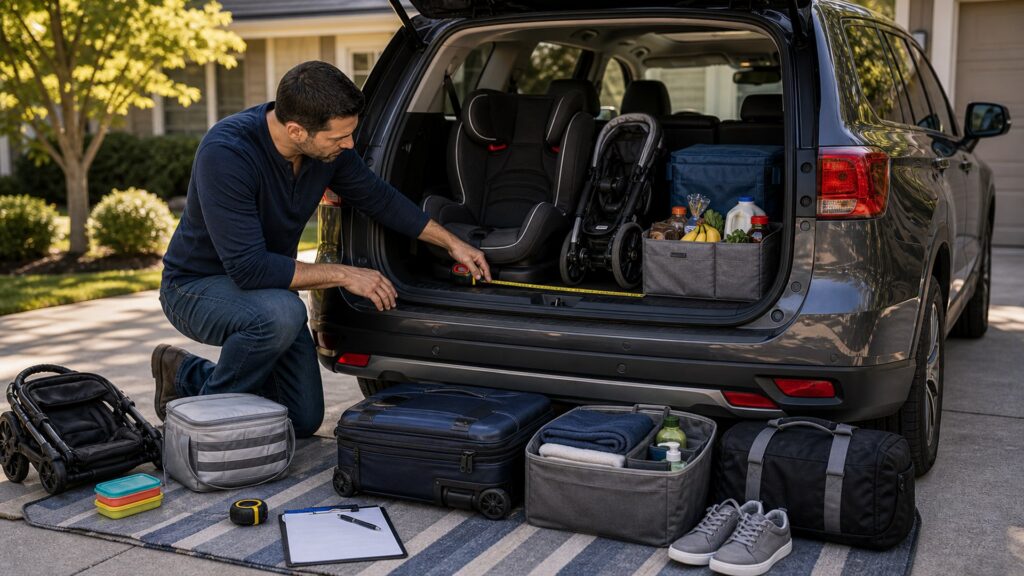
Measure cargo behind occupied seats: Load stroller, wheelchair, sports gear, groceries, luggage, pet crate, emergency kit, and charging or roadside equipment in the seating layout actually used. Measure hatch opening, lift-over, floor length, height, and visibility.
Check payload and exterior carriers: Count occupants and onboard cargo before roof boxes, hitch carriers, bikes, trailers, or mobility equipment. Verify vehicle payload, axles, tires, roof rails, hitch, carrier, and tongue-load limits for the exact unit.
Test the family routine: Run school pickup, curb loading, garage parking, highway merging, tight turns, night visibility, rear climate, device storage, cleanup, and an emergency exit. The best layout is the one caregivers can operate safely when rushed.
Who this is for
Family structure changes the ideal cabin
Age spacing, restraint stages, mobility needs, and cargo frequency matter more than household headcount.
Families with rear-facing seats: Rear-facing restraints can consume front-seat travel and make center positions difficult. Test driver and front-passenger comfort, door opening, carrier clearance, buckle access, and whether another restraint can be installed without prohibited contact.
Three-child households: Advertised rear-seat width does not prove three restraints fit. Install the exact seats, confirm independent secure installation and accessible buckles, verify top-tether availability, and repeat the test after converting one child to a booster.
Households using a third row: Evaluate the path with second-row restraints installed, adult foot and knee room, head restraints, climate, visibility, emergency exit, and cargo left behind the third row. A nominal seat can be impractical for daily loading.
Families carrying mobility equipment: Measure folded and operating dimensions, lift height, ramp or hoist needs, securement, caregiver reach, passenger transfer, and emergency access. Confirm payload and installed-equipment approvals with the vehicle and accessibility-equipment providers.
Sport, travel, and pet households: Long gear, coolers, luggage, crates, bikes, and muddy equipment need floor length, ventilation, tie-downs, washable surfaces, and separation from occupants. Test the fully occupied trip rather than the maximum cargo mode with seats folded.
What to pay attention to
Family specifications are about geometry and access
Published volume and seat count need physical verification in the exact cabin.
People & Access
Restraint installation, seat positions, doors, third row, climate, visibility, and caregiver reach.
Cargo & Limits
Opening geometry, occupied-seat storage, payload, roof and hitch loads, cleanup, and trip equipment.
LATCH, tethers, and belt geometry: Identify lower-anchor and top-tether positions, allowed borrowing, belt buckle stalks, inflatable belts if present, head-restraint rules, and vehicle-seat adjustments. Follow both manuals because a convenient-looking position may not permit the intended restraint.
Second-row width and door opening: Measure usable cushion width, contour, buckle access, armrests, door aperture, sill height, and clearance beside parked cars. Sliding doors can improve access, while wide hinged doors may need more garage or curb space.
Third-row access and occupancy: Test entry with second-row seats and restraints in their real positions. Check foot space, headroom, belt fit, head restraints, air vents, windows, lighting, motion comfort, and a practical exit route for the intended passenger.
Cargo opening and occupied-seat volume: Compare hatch or door width, height, lift-over, floor depth, roof taper, wheel-well intrusion, underfloor storage, spare-tire location, and tie-downs. Measure with every required passenger seat upright.
Payload, roof, and hitch limits: Use the exact vehicle label and manuals. Occupants, luggage, accessories, roof boxes, bicycles, hitch carriers, mobility equipment, and trailer tongue weight can reach payload before the cabin looks full.
Climate, visibility, and controls: Evaluate rear vents and controls, sun load, window shades, defrosting, camera view, pillars, mirrors, parking aids, child locks, emergency releases, and the driver's ability to monitor passengers without depending on a distracting screen.
Cleanup and durability: Compare floor height, seat material care, removable mats, crevices, cupholders, door pockets, cargo liners, spare storage, odor control, pet barriers, and whether a spill can reach electronics, seat tracks, or restraint anchors.
Avoid these traps
Family fit assumptions that fail after delivery
Small packaging differences can make a comfortable showroom cabin frustrating with restraints and cargo installed.
Counting seats instead of usable positions: A seating label does not guarantee acceptable adult fit, child-restraint compatibility, tether access, or entry. Assign the real passengers to real positions and install the intended restraints before purchase.
Testing cargo with every seat folded: Maximum volume is irrelevant when the children, caregiver, or pet occupy those rows. Compare the opening and floor behind the seats that stay upright during the difficult recurring trip.
Forgetting future restraint stages: A rear-facing seat, forward-facing harness, high-back booster, and backless booster interact differently with buckles, head restraints, and adjacent seats. Test today's plan and map the next likely transition.
Treating roof or hitch carriers as free space: External cargo adds weight, height, length, wind exposure, access constraints, and limits from the roof, rails, hitch, carrier, axles, and tires. It may also block cameras, lights, liftgates, or parking.
Buying excess size for rare trips: Permanent size increases parking, energy, tire, and maneuvering burdens. Price delivery, rentals, roof boxes, or occasional larger transport before carrying a third row or large cargo area unused every day.
Decision guidance
Choose the layout that solves the hardest weekly routine
Body style matters less than doors, seat interactions, and cargo space with occupants aboard.
If two restraints and compact cargo dominate: A sedan, hatchback, or compact crossover may work if front-seat travel, door access, stroller fit, and payload pass. Compare trunk or hatch geometry and the ability to load without moving installed restraints.
If three restraints share one row: Prioritize verified restraint fit, independent buckle access, top tethers, door opening, and adult front-seat comfort. A wider-looking SUV is not automatically better than a minivan, wagon, or differently shaped two-row vehicle.
If daily third-row access dominates: Start with minivans and three-row vehicles that allow entry with the actual second-row setup. Compare sliding doors, aisle or tilt mechanisms, third-row climate, cargo behind the row, and garage fit.
If bulky mobility or sports gear dominates: Favor low lift-over, square openings, long flat floors, strong tie-downs, payload margin, and safe restraint for equipment. Test ramp, hoist, crate, bicycle, or wheelchair geometry before choosing style or trim.
If towing accompanies family travel: Calculate occupants, luggage, accessories, hitch hardware, and measured tongue load against payload, axles, tires, and hitch limits. A high trailer rating can coexist with insufficient payload for a fully occupied vacation.
Ownership & compatibility
Keep the family configuration safe and workable
Children grow, seats change, cargo expands, and accessories quietly consume capacity.
Register and inspect restraints: Register child seats for recall notices, follow expiration and replacement guidance, inspect installations when seats or positions change, and seek qualified help when needed. Keep vehicle and restraint instructions accessible.
Track load-changing accessories: Record roof rails, boxes, hitch carriers, running boards, mobility equipment, organizers, pet barriers, and other additions. Recheck payload, dimensions, door movement, sensors, lighting, emergency exits, and restraint access after installation.
Maintain family-use systems: Service tires, brakes, wipers, lighting, climate, doors, liftgate, cameras, batteries, charging equipment, and safety recalls. Clean without damaging belts, buckles, airbags, anchors, sensors, or child-restraint components.
Rehearse changing routines: Revisit the seating and cargo map after a new child, restraint transition, caregiver, pet, sport, school schedule, commute, or mobility need. Correct the layout before a rushed trip exposes the conflict.
FAQ
Family and cargo vehicle FAQ
Answers about child seats, third rows, cargo volume, payload, doors, and family test drives.
Can I rely on a vehicle's advertised seating capacity?
How do I test whether three child seats fit?
Is a minivan always better than a three-row SUV?
What cargo measurements should families take?
Does a roof box count against vehicle payload?
Why can a full family exceed payload quickly?
What should I test on a family test drive?
How should I evaluate a third row?
When should I redo the family seating plan?
Bottom line
Choose the cabin that works when everyone is aboard
The family vehicle should solve the occupied-seat passenger and cargo problem without exceeding payload or turning every buckle and loading task into a workaround.
Assign every position: Test real occupants, restraints, access paths, climate, and visibility.
Load the recurring cargo: Measure openings and floor space with required seats upright.
Protect the ratings: Count occupants, accessories, roof loads, carriers, and tongue weight.
Plan for change: Evaluate the next restraint stage, caregiver, sport, pet, or mobility need.
Reading Shortcuts
Start with exact needs and written facts.
Decision Reminders
Checks to complete before committing.
- Compare exact units: Trim names do not prove identical equipment.
- Get totals in writing: Price and contract terms matter more than payment alone.
- Test real fit: Bring seats, cargo dimensions, and typical drivers.
- Quote ownership first: Insurance, energy, tires, service, and parking vary.
- Check safety evidence: Use ratings, recalls, labels, and manuals.
- Keep an exit plan: Mileage, condition, debt, and demand shape flexibility.
Glossary Snippets
Terms used in this decision.
When to Use a Top 10 Review
Use rankings after the requirements and budget are fixed.
- The mission is documented: Filter candidates against real trips and loads.
- Nonnegotiables are measured: Reject units that fail fit or capacity.
- Ownership costs are estimated: Rank value after recurring costs are visible.
- Evidence is comparable: Use the same configuration and scenario.
Already down to 2–3 options? A Comparison is usually faster.
When to Use a Comparison
Compare finalists under one written scenario.
- Compare fit: Use identical passenger, cargo, route, or mileage assumptions.
- Compare capability: Read exact labels and configuration data.
- Compare total cost: Include acquisition, use, service, and exit.
- Compare confidence: Review contracts, inspections, safety data, and support.
Still building a shortlist? Start with a Top 10.