
How to Choose Vehicles for Test Drive Priorities
A test drive is most useful when it is designed before the salesperson hands over the key. Every candidate should face the same stationary fit check, low-speed maneuvers, representative route, parking task, and passenger or cargo routine.
Use a scorecard and test the exact configuration whenever possible. The goal is not to discover the vehicle's limit; it is to learn whether regular drivers can operate it comfortably, predictably, and confidently in the household's real environment.
Buying framework
Use one route and one scorecard
A useful test drive is repeatable. Evaluate every finalist under the same driver setup, roads, parking tasks, passenger load, and notes instead of following whichever route a salesperson suggests.
Prepare before arriving: Confirm the exact VIN, trim, tires, fuel or battery state, and critical equipment. Bring driver's license, parking measurements, child restraints or templates, cargo dimensions, and a scorecard. Request enough time for a cold start and representative route.
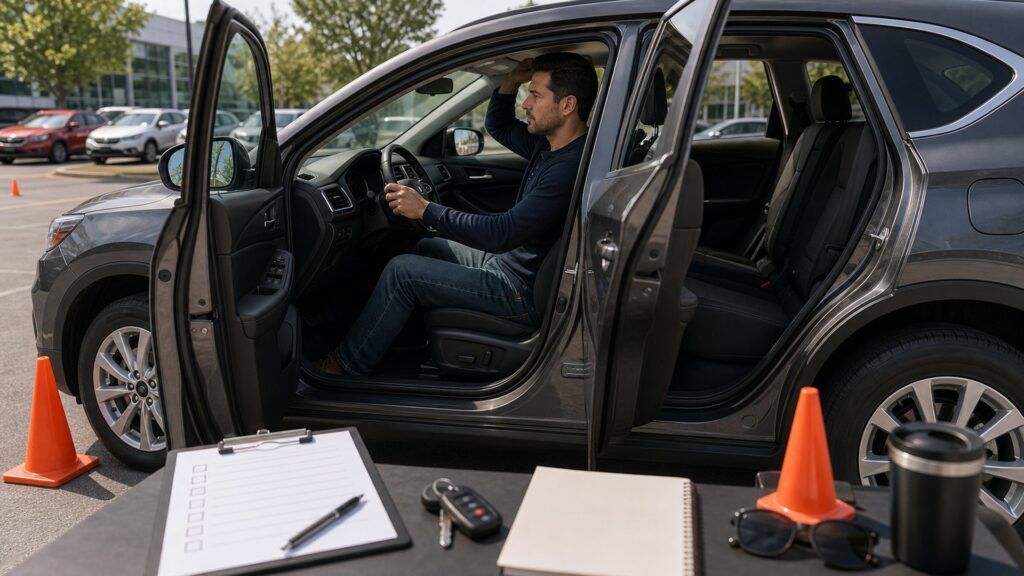
Complete the stationary fit check: Adjust seat, wheel, mirrors, head restraint, belt, and displays before moving. Test entry, pedal reach, control access, sightlines, storage, rear seats, restraints, cargo opening, charging or fuel door, spare equipment, and emergency releases.
Begin with low-speed control: Observe cold-start behavior, brake-pedal response, steering effort, creep or clutch behavior, turning circle, camera coverage, parking sensors, curb view, and maneuvering in a realistic space. Check whether controls distract from looking outside.
Drive a representative route: Include broken pavement, neighborhood speeds, stop-and-go traffic, grades, merging, highway speed, curves, wind or noise exposure, and safe braking opportunities. Use normal inputs first; do not test limits or violate traffic rules.
Repeat the family and ownership routine: Load the passengers or measured substitutes, park at home if permitted, test garage and charger fit, evaluate cargo loading, and record scores immediately. Revisit only the strongest candidates under the same conditions.
Who this is for
Different missions need different routes
The test should emphasize the situations that create the greatest daily burden or safety concern.
Urban commuters: Prioritize outward visibility, mirror and camera coverage, tight turns, curb awareness, door clearance, low-speed response, brake modulation, stop-and-go comfort, parking aids, secure storage, and whether regenerative braking or stop-start behavior feels predictable.
Families and caregivers: Install intended child restraints, test buckling and third-row access, load stroller or mobility gear, use sliding or hinged doors in real parking width, check rear climate and ride, and let every regular driver evaluate seating and controls.
Highway and rural drivers: Allow enough time to assess seating support, lane placement, passing response, wind and tire noise, headlights if possible, rough surfaces, hills, range display, driver-assistance behavior, and the effort required to monitor mirrors and traffic.
Work, payload, and towing users: Confirm the exact ratings separately, then test cab access, bed or cargo height, tie-down reach, trailer-camera views, hitch alignment tools, mirrors, brake-controller interface, steering at low speed, and ride with a representative permitted load when practical.
Hybrid and EV shoppers: Evaluate accelerator mapping, regenerative braking modes, transition to friction braking, range and energy displays, charging port access, route planning, cabin conditioning, startup sounds, and whether the household can understand and repeat the preferred settings.
What to pay attention to
Priorities that reveal themselves only in use
Numbers narrow a shortlist; the drive shows whether the driver can operate the exact vehicle smoothly and confidently.
Driver & Road
Position, sightlines, controls, braking, steering, ride, powertrain, assistance, and noise.
Household Routine
Entry, restraints, cargo, parking, garage, charging, driver changes, and repeatability.
Driving position and control reach: Check hip and eye position, thigh support, lumbar range, pedal alignment, steering-wheel adjustment, dead pedal, belt comfort, head restraint, display focus, stalks, climate, drive modes, and touch-screen tasks without compromising posture or attention.
Sightlines and visual workload: Observe windshield base, pillars, mirror coverage, rear glass, shoulder checks, camera image, lens cleanliness, night glare, screen prompts, and the time eyes leave the road. Test with the seat in each regular driver's actual position.
Brake pedal and deceleration: Evaluate initial response, progressive modulation, stopping consistency, hill hold, parking brake, and any transition between regenerative and friction braking. A test drive cannot prove component life, but unexpected pull, pulsation, warning, or pedal change needs investigation.
Steering, ride, and body control: Use familiar roads to compare on-center behavior, turning effort, return, tracking, impact harshness, secondary motion, seat isolation, and passenger comfort. Tire pressure, wheel size, load, drive mode, and weather can change the result.
Powertrain response and noise: Check low-speed smoothness, launch, transmission or motor response, grade behavior, merging, engine or motor noise, vibration, and response delay. Use legal, normal maneuvers; a brief acceleration burst cannot substitute for total mission fit.
Driver-assistance usability: Confirm which systems are installed and test settings only under safe, permitted conditions. Evaluate alerts, lane support, adaptive cruise controls, blind-spot information, camera behavior, override feel, and how easily the driver can understand current system status.
Parking, cabin, and cargo routine: Measure garage fit, door opening, lift-over, seat folding, hatch clearance, charger-cable reach, car-seat access, storage, visibility around children or obstacles, and control behavior when reversing. Repeat the most frequent awkward task.
Avoid these traps
Test drives that confirm a preference instead of testing it
A short pleasant route can hide poor visibility, uncomfortable seating, difficult controls, or household-fit conflicts.
Driving only the dealer loop: A smooth route may omit highway merging, broken pavement, hills, tight parking, and the household's normal roads. Agree on a lawful representative route and repeat it for every finalist.
Skipping the stationary setup: If the seat, mirrors, wheel, restraints, and displays are not adjusted first, the evaluation mixes unfamiliar setup with vehicle behavior. Record each driver's workable position before comparing comfort or visibility.
Testing a different configuration: Wheel size, tires, seats, suspension, powertrain, driver-assistance hardware, mirrors, and software can vary by trim. Test the exact VIN whenever possible and document any difference from the vehicle being purchased.
Treating novelty as quality: Strong acceleration, a large screen, or aggressive regenerative braking can impress quickly while poor controls, glare, noise, ride, or brake transitions become tiring. Score difficult daily tasks after the excitement fades.
Ignoring the second driver and passengers: A vehicle that fits the primary shopper can block another driver's sightline or child-seat space. Include regular drivers and test the occupied seating and cargo arrangement, not only an empty front cabin.
Decision guidance
Let the hardest routine break the tie
A candidate that wins the easy road but fails parking, access, braking feel, or long-seat comfort should not survive the shortlist.
If two vehicles feel similar in town: Repeat highway, rough-road, parking, and cargo tests. Compare seating fatigue, noise, sightlines, control workload, tire behavior, assistance status, and the exact equipment or warranty differences rather than seeking a more dramatic acceleration test.
If a control feels confusing: Stop safely and use the manual or a product specialist before continuing. Test whether regular drivers can identify modes, warnings, climate, wipers, lights, parking brake, assistance status, and emergency controls without relying on memory or distraction.
If visibility is the concern: Adjust correctly, then test pillars, mirrors, shoulder checks, cameras, parking obstacles, night glare where possible, and passenger or cargo blockage. Driver aids can supplement sightlines but do not make every obstruction disappear.
If ride comfort is uncertain: Use the same seats, tire pressures, wheel specification, route, speed, and drive mode. Include rear passengers and longer exposure; a five-minute front-seat impression may not reveal head toss, tire noise, or seat pressure.
If the plug-in system is unfamiliar: Test charging-port placement, cable reach, charge scheduling, state-of-charge limits, route planning, regenerative modes, friction-brake transition, cabin preconditioning, and backup fueling or charging. Confirm the exact vehicle's power and connector specifications separately.
Ownership & compatibility
Save the scorecard with the purchase record
The test-drive notes explain why the vehicle was chosen and provide a baseline for later changes.
Record the exact conditions: Save VIN, mileage, tire and wheel specification, pressure status, fuel or charge, weather, route, passengers, drive modes, warnings, and scores. Note differences from the delivered unit that must be rechecked.
Recheck at delivery: Confirm seating, visibility, controls, braking response, steering, warning lights, driver-assistance status, charging or fuel equipment, tires, keys, and promised repairs on the actual vehicle before acceptance.
Use the baseline for service: If later noise, vibration, pulling, pedal feel, steering, range, ride, or alerts differ materially, document when and under what conditions. Follow manufacturer guidance and obtain diagnosis rather than normalizing a new symptom.
Reevaluate after driver or load changes: New drivers, restraints, mobility equipment, roof loads, hitch equipment, tires, software, or commuting routes can change fit and behavior. Repeat the relevant scorecard tasks after a material change.
FAQ
Vehicle test-drive FAQ
Answers about routes, cold starts, braking, passengers, EVs, driver aids, and repeat comparisons.
How long should a vehicle test drive be?
Why should I request a cold start?
What route should I use for comparison?
Should I test hard braking during a test drive?
What should families bring to the test drive?
How can I evaluate driver-assistance features safely?
What should EV shoppers test besides acceleration?
Should every regular driver repeat the route?
How should I compare notes after multiple drives?
Bottom line
A test drive should answer a written question
Use the exact vehicle, a repeatable route, real household tasks, and immediate notes to expose fit and behavior differences.
Set the vehicle up: Adjust every driver and verify controls, sightlines, seats, and equipment.
Repeat one route: Include low-speed work, rough pavement, highway, grades, and parking.
Bring the household: Test restraints, passengers, cargo, garage, and charging routines.
Record the baseline: Save VIN, conditions, scores, concerns, and delivery rechecks.
Reading Shortcuts
Start with exact needs and written facts.
Decision Reminders
Checks to complete before committing.
- Compare exact units: Trim names do not prove identical equipment.
- Get totals in writing: Price and contract terms matter more than payment alone.
- Test real fit: Bring seats, cargo dimensions, and typical drivers.
- Quote ownership first: Insurance, energy, tires, service, and parking vary.
- Check safety evidence: Use ratings, recalls, labels, and manuals.
- Keep an exit plan: Mileage, condition, debt, and demand shape flexibility.
Glossary Snippets
Terms used in this decision.
When to Use a Top 10 Review
Use rankings after the requirements and budget are fixed.
- The mission is documented: Filter candidates against real trips and loads.
- Nonnegotiables are measured: Reject units that fail fit or capacity.
- Ownership costs are estimated: Rank value after recurring costs are visible.
- Evidence is comparable: Use the same configuration and scenario.
Already down to 2–3 options? A Comparison is usually faster.
When to Use a Comparison
Compare finalists under one written scenario.
- Compare fit: Use identical passenger, cargo, route, or mileage assumptions.
- Compare capability: Read exact labels and configuration data.
- Compare total cost: Include acquisition, use, service, and exit.
- Compare confidence: Review contracts, inspections, safety data, and support.
Still building a shortlist? Start with a Top 10.