
How to Choose Yoga & Pilates Equipment for Core Strength
Core-focused yoga and Pilates equipment should make control easier to learn, not simply make every move harder. The best kit starts with a grippy mat that supports floor work, then adds props that improve alignment, resistance, or instability only when they match your current practice.
For core strength, the real question is how each piece changes bracing, balance, and range of motion. This guide explains where mats, blocks, straps, rings, balls, sliders, rollers, and bands fit, which specs matter, and how to avoid buying equipment that encourages sloppy movement at home.
Buying framework
Start with control before adding challenge
A useful core-strength setup is built in layers: floor stability, alignment support, then resistance or instability. Choose equipment by the movement problem it solves, not by how advanced it looks.
Build from the mat up: A non-slip mat is the base for planks, bridges, roll-ups, and kneeling work. Pick enough cushioning for your spine and knees without making standing balance feel spongy.
Use props to preserve alignment: Blocks, wedges, and straps should help you keep a stable pelvis, neutral spine, and reachable range. They are not just beginner aids when they prevent rounding, twisting, or gripping through a core drill.
Match resistance to small-muscle control: Pilates rings and bands are most useful when they give steady feedback through the inner thighs, arms, or trunk. If the resistance pulls you out of position, it is too aggressive for the exercise.
Add instability gradually: Mini balls, stability balls, balance pads, and sliders make the core respond to movement. They work best after you can brace calmly on the floor without rushing or collapsing into the lower back.
Buy for your actual space: A stability ball or full roller can be excellent but awkward in a small room. If storage is tight, a mat, two blocks, a strap, a ring, and sliders may create more usable sessions.
Who this is for
Match the kit to the way you practice
Core training looks different for a yoga flow, a mat Pilates class, or a short home routine between other workouts. Use these profiles to decide which equipment deserves space first.
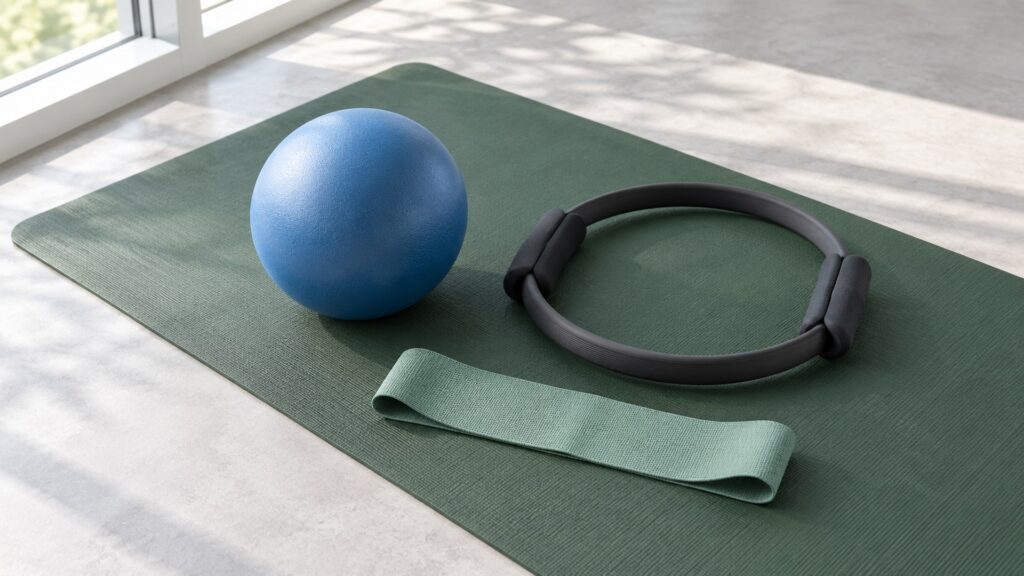
Mat Pilates regulars: Prioritize a slightly cushioned Pilates mat, a ring, a mini ball, and light to medium bands. These pieces support roll-ups, hundreds, bridges, side-lying leg work, and controlled resistance without needing a reformer.
Yoga practitioners building stability: Start with a firm, grippy yoga mat, two blocks, and a strap. That combination helps with plank transitions, standing balance, boat pose variations, and hamstring range without turning every session into equipment management.
Small-space home exercisers: Choose flat or stackable pieces: a mat, blocks, sliders, a strap, and loop bands. Skip a large stability ball unless you can leave it inflated without blocking the room or becoming a storage nuisance.
Beginners learning bracing: Avoid starting with highly unstable tools. A supportive mat, blocks, strap, and a soft mini ball give tactile feedback while you learn breathing, pelvic control, and slower transitions.
Progression-focused movers: If your basics are consistent, sliders, balance pads, and a stability ball can raise the control demand. Look for equipment that lets you scale range or contact points rather than forcing one difficult version.
What to pay attention to
Specs that change how core work feels
The important details are not flashy. Mat thickness, surface texture, prop firmness, and resistance level determine whether your trunk can work steadily or whether another body part starts compensating.
Stability, grip, and support
This lens covers floor contact: how the mat, blocks, straps, and wedges help you keep balance, reach, and pressure points under control.
Resistance and instability progression
This lens covers challenge: how rings, bands, balls, sliders, and balance tools increase effort while still letting you move deliberately.
Mat thickness: Around-the-house yoga work often benefits from a firmer mat, while Pilates floor sequences may need extra padding under the spine and hips. Very thick foam can feel comfortable but may reduce balance feedback.
Surface texture: A tacky or textured surface matters when hands, forearms, or feet press into the mat during planks and transitions. Sweat behavior differs across rubber, foam, cork, and microfiber finishes.
Block density and shape: Foam blocks feel lighter and softer; cork or wood blocks feel firmer and more stable. Rounded edges are easier on hands, while sharper profiles can feel more precise in supported poses.
Ring and band resistance: Resistance should be smooth enough for slow pulses and holds. Too much tension makes users shrug, grip the hip flexors, or shorten the movement before the trunk can contribute.
Ball size and inflation: Mini balls should support controlled squeezing, bridging, and balance cues without rolling away. Larger stability balls need a diameter and inflation level that let you sit or brace without losing posture.
Slider surface match: Core sliders need the right underside for carpet or hard floors. If they drag, the exercise becomes jerky; if they fly too easily, the movement may outrun your bracing.
Avoid these traps
Common buying mistakes with core props
Most disappointments come from choosing equipment that is either too soft, too slick, too unstable, or too disconnected from the movements you actually practice. These mistakes are preventable.
Choosing difficulty over control: A wobble board or stability ball can look more serious than blocks or a strap. But if you cannot hold alignment on the floor first, instability teaches you to rush instead of brace.
Buying one mat for every style: Yoga balance work and Pilates spine-loaded floor work do not always want the same surface. A mat that cushions roll-ups beautifully may feel too compressible for standing poses and plank transitions.
Ignoring cleaning behavior: Sweaty core sessions put forearms, hands, feet, and sometimes the back directly on the surface. Materials that absorb moisture or hold odor can become unpleasant if you expected a quick wipe-down routine.
Overfilling the kit: A pile of props can make short sessions feel complicated. Buy pieces that create distinct jobs: one stable base, one alignment aid, one resistance tool, and one optional instability challenge.
Treating props as medical fixes: Yoga and Pilates tools can support movement practice, but they are not a diagnosis or treatment plan for pain. If symptoms are sharp, persistent, or limiting, equipment choice should not replace qualified guidance.
Decision guidance
How to build the right core-strength setup
Use the equipment as a progression, not a shopping list. The right sequence depends on whether you need more floor support, better range, clearer resistance, or a harder balance challenge.
If you own nothing yet: Start with the mat because every other choice assumes a stable floor. Add two blocks and a strap if your yoga or Pilates work includes hamstring reaches, supported twists, or poses where flexibility limits alignment.
If Pilates is your main routine: Choose a thicker Pilates mat, then consider a ring, mini ball, and light bands. That combination supports trunk-focused floor exercises without requiring the cost, room, or mechanics of a reformer.
If yoga flow is the priority: Put grip and firmness ahead of plushness. Blocks and a strap often do more for controlled core engagement than a soft mat because they let you hold shape through transitions.
If you want harder variations: Add sliders, a stability ball, or a balance pad only after basic positions feel steady. Choose tools that let you reduce range at first, then lengthen the lever as your control improves.
If space or consistency is the issue: Favor equipment you can store where you exercise. A simple kit that is ready in one minute will build more core-strength practice than a larger setup that stays packed away.
Ownership & compatibility
Keep the equipment usable after the first week
Yoga and Pilates props are low-maintenance, but they still need realistic care. Cleaning, storage, inflation, and elastic wear affect whether the equipment remains pleasant and safe to use.
Clean according to material: Closed-cell mats and foam blocks usually wipe down more easily than absorbent surfaces. Follow the maker's cleaning guidance and avoid harsh products that can make rubber, foam, cork, or microfiber break down sooner.
Watch inflatable pieces: Mini balls and stability balls lose firmness over time. Store them away from sharp edges and heat, then check inflation before exercises where posture or balance depends on predictable support.
Inspect resistance tools: Bands, tubing, and Pilates rings should feel smooth and consistent through the movement. Cracks, stretched areas, loose handles, or uneven resistance are signs to retire the piece before it snaps or distracts you.
Make storage part of the choice: Long rollers, large balls, and thick mats need a real home. If equipment blocks the room, it becomes friction; stackable blocks, straps, rings, and sliders are easier to keep in rotation.
FAQ
Questions buyers ask before setting up
These answers cover the practical uncertainties that come up once you start narrowing the kit.
Do I need a different mat for Pilates than for yoga?
Are blocks and straps useful for core strength?
Should beginners buy a stability ball first?
What does a Pilates ring add?
Are core sliders better on carpet or hard floors?
How thick should a core workout mat be?
Do resistance bands replace weights for core training?
Is cork, rubber, or foam best for mats?
When should I add balance pads or wobble tools?
Bottom line
Choose equipment that improves control
Core-strength equipment should support better positions, clearer feedback, and gradual challenge. Start with the pieces that make practice repeatable, then add resistance or instability only when it improves movement quality.
First priority: Choose a mat that gives the right mix of grip, firmness, and cushioning for your main practice.
Best early props: Blocks and a strap are small, inexpensive tools that can improve range and alignment before you chase harder variations.
Progression tools: Rings, bands, balls, sliders, and balance pads are most valuable when they add challenge without changing your posture.
Reality check: A compact setup you use consistently beats a larger kit that feels awkward to store, clean, or set up.
Reading Shortcuts
Jump to the equipment choice that matters most for your practice.
Decision Reminders
Keep these checks in mind while comparing yoga and Pilates props.
- Grip first: A slick mat undermines planks, transitions, and kneeling work before the core gets a fair chance.
- Support is not cheating: Blocks and straps can protect alignment so the trunk does the intended work.
- Resistance should be smooth: Bands and rings are useful only when they keep movement controlled instead of jerky.
- Instability is optional: Balls, pads, and sliders belong after you can manage the basic shape.
- Storage affects consistency: Large props help only if they are easy to keep accessible.
- Cleanability matters: Sweaty floor work rewards surfaces that wipe down easily and dry predictably.
Glossary Snippets
A few equipment terms worth knowing before you compare.
When to Use a Top 10 Review
Use a ranked list once you know which equipment category belongs in your setup.
- You know the prop type: A list helps compare mats, rings, bands, or sliders within one narrowed category.
- You need shortlist speed: Use rankings when you already understand the tradeoffs and want fewer choices.
- You want spec scanning: A Top 10 format is better for side-by-side materials, sizes, and resistance notes.
- You are replacing one piece: Ranked picks are useful when the rest of your kit is already working.
Already down to 2-3 options? A Comparison is usually the faster next step.
When to Use a Comparison
Use a comparison when two equipment types or models seem close but solve different problems.
- Mat versus mat: Compare thickness, grip, surface material, and portability when the choice feels close.
- Ring versus bands: A comparison clarifies feedback, resistance direction, and exercise variety.
- Ball versus sliders: Use it when you are deciding between instability styles for harder core work.
- Still exploring: If you do not know the prop type yet, return to the guide before narrowing models.
Still exploring? Start with a Top 10 to build a shortlist first.