How to Evaluate the Features and Limitations of Foot Care

Start with the result that matters to you. Studies can measure the texture of a rough patch and the skin’s hydration separately. To judge a foot cream or file, pin down what it promises, what was measured, what the test compared, and how much the feet in the test resemble yours.

By: Review Streets Research Lab
Updated: November 25, 2026
Explainer · 11–14 min read
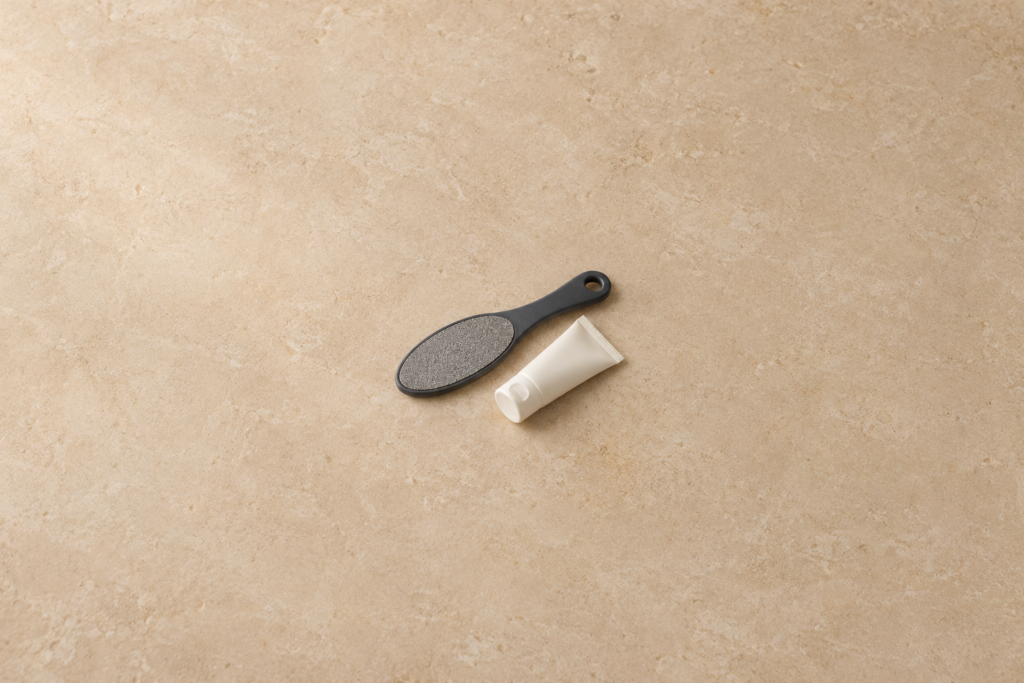
A dark paddle foot file and a plain white lotion tube on beige stone.
What you’ll learn

From foot-care promise to evidence

A foot-care promise can start with a word like smooth. The next step is to decide what you’d actually need to see or feel to say the promise was met.

  • Separate the two surfaces listed for a file from evidence about the finish it leaves.
  • Read the time window printed with a claim.
  • Distinguish what people report from what a test records.
  • See what a trial can learn by comparing a cream with its own base.
  • Separate improvement since the start from an advantage over another product.
  • Locate the patch of skin a foot-care study followed.
  • Recognize when a trial’s main question is still open after follow-up.

Tip: When a dry-heel claim says the skin improved, put the claim into words someone could check. Fewer visible flakes is one example.

Key terms

The language of foot-care evidence

The terms below help you read a study in the order you’d use it. Start with its question and measurement, then find the reference it uses to interpret the result.

Product claim

The feature or benefit a maker says a product offers.

  • Feature: The two faces of a file can be listed as physical features.
  • Result: A Drug Facts label states what a drug is intended to do.
  • Time window: A one-day claim has a one-day deadline.

Endpoint

The defined result a study measures to answer a particular question.

  • Criterion: A study can count a heel crack as healed only when it meets its definition of complete healing.
  • Method: An instrument can take a hydration reading from the skin.
  • Time point: A rating at the final visit answers a question about that visit.

Comparator

The reference a study uses to judge the result in the group or product it is testing.

  • Starting point: A baseline is the reading taken before the study intervention.
  • Active alternative: A second finished product gives the test an actual alternative to compare against.
  • Simulated comparison: A sham control mimics a study intervention while leaving out the part researchers want to assess.

Vehicle control

The base of a formula used as the comparison in a trial.

  • What stays in: The foot-cream trial’s base was itself a preparation applied to the skin.
  • What changes: In that trial, several additions separated the tested cream from its base.
  • What it tests: A comparison like that tests the contribution of those additions together.

Xerosis

The clinical term for dry skin.

  • Visible sign: Dry heels can show visible flakes.
  • Severity: The term itself leaves the degree of dryness open.
  • Separate reading: A dryness study may also measure water loss through the skin.

Plantar callus

A thickened patch of skin on the bottom of the foot.

  • Pressure: Pressure or repeated rubbing can lead to a callus.
  • Location: A callus study can focus on the forefoot, the part of the sole nearest the toes.
  • Area: Measuring the size of the patch gives it a result of its own.

Tip: Plantar means on the sole. Look for the particular area a study followed, such as the part of the foot just behind the toes.

The promise

Read the exact claim

Start by looking at the words the maker chose. A term such as repair can suggest several changes, so look for the specific result the maker actually describes.

  • Name the job. Kerasal markets Intensive Foot Repair for moisturizing and smoothing dry feet.
  • Separate the feature from the expected change. Earth Therapeutics describes a coarse face for callused skin and a finer face for finishing rough patches on its Precisso Platinum file. Those are the maker’s stated roles.
  • Pin down the patch. A claim about the heel is more specific than a claim about the sole. In a study from another site, such as the ball of the foot, the result belongs to that site.
  • Keep the clock attached. Kerasal advertises a visible change in one day. The time in the claim tells you when to look. You still need a description of what would count as a change.
  • Read intended use separately. The U.S. Drug Facts label for Scholl’s Extra Thick Callus Remover discs lists callus removal and pain relief through removal. In the U.S., claims to treat disease or affect the body’s structure or function fall under the drug definition.

Turn the promise into a question you could answer. For a hypothetical product that offers smoother-looking heels, ask what should look different and when a reader could expect to see it.

The outcome

Look at what was measured

Readers who care about what a bare heel looks like and readers who care about how it feels may be asking different things of the same product. Start by finding out how the result was recorded.

  • Choi and colleagues graded heel photos for signs such as flaking and scaling. The grades describe visible features of the skin.
  • A trial on sole calluses measured hydration with an instrument that takes an electrical reading from the skin. The team used images to record surface texture on the same patches.
  • Kerasal reports users’ impressions of greater hydration. That observation concerns how their feet felt. A change on an instrument would require a separate reading.

If flakes are what you notice when you take off your socks, a visual flake score is closer to your question than a hydration number on its own.

The reference

Find out what it was compared with

The starting point tells you how much changed over time. A study with a comparison group can also tell you whether the change differed between groups. Those two answers can point in different directions.

  • A podiatry clinic trial compared a procedure for painful forefoot calluses with a simulated version. Older participants in both groups reported less pain than at the start. The difference between groups failed to reach statistical significance. The result applies to the procedure tested.
  • In a 2017 study, researchers tested a moisturizing cream on one foot and its base on the other in 57 people with diabetes. After about four weeks, feet scored lower for dryness with the tested cream. That comparison evaluates the added ingredients as a group.
  • A 1998 paired-foot trial used two finished preparations for mild to moderate dryness. Dryness improved during the trial. The researchers found no statistically significant difference between the two preparations, which bounds the claim to what that study could detect.

For a promise of an edge over another foot cream, look for the identity of the second cream and a result on the outcome you care about. A test against a base answers its own narrower question.

The test setting

Match the feet and the skin site

Start by locating the patch the study team examined. Before you carry the result over to your own feet, find out which people the researchers could include.

  • Choi’s team assessed heel skin in 150 Korean women ages 20 to 78. That’s the group the findings describe.
  • The sole callus trial excluded people with diabetes and people with certain skin problems or wounds. Apply its finding within those enrollment boundaries.
  • Diabetes changes the appraisal of a callus removal claim. The U.S. CDC advises people with diabetes to avoid removing their own corns or calluses and to avoid over-the-counter products for removing them.

If your target is an intact, flaky heel, look for evidence from that area and starting skin condition. A thicker patch elsewhere on the sole may be the subject of a different test.

The limits

Keep the unanswered questions open

Find the follow-up dates. Then find the primary endpoint, the main result the researchers chose to measure. A clear answer on one outcome may leave other questions open.

  • In the Choi study, heel hydration in the severe-dryness group was close to the normal group’s starting level three hours after moisturizer application. How long the levels stayed close is a separate question.
  • In the 1998 comparison, 70 people enrolled and 39 were assessed at week four. The result at that visit rests on fewer people. How the missing observations might have changed it is an open question.
  • In a clinical trial of people with diabetes and deep open heel cracks, complete healing of the target crack at four weeks was the main outcome. The difference between test cream and placebo fell short of statistical significance on that outcome. The authors reported a statistically significant difference on a separate measure. Fewer people in the test-cream group still had a deep, open crack.

When you tell someone what the heel-crack trial found, keep the outcome in the sentence. The authors’ abstract gives separate answers for complete healing and for how many cracks stayed deep and open.

Reality check

Two promises in everyday settings

A one-day appearance claim and a dual-surface file make good examples because each offers a particular thing to look for. The two situations below show where that evidence would stop.

Hypothetical example — A heel cream and a visible crack

Imagine you see a cream that promises a visible difference by the next day. You want to know whether a deeper crack would close. A grader could look at flaking in a next-day photo.

Closure would need to be assessed on the crack itself. A photo graded only for flaking would leave the question you brought to the label unanswered, even if that grade improved.

Hypothetical example — A two-sided file and a single test result

Imagine reading a test of a two-sided file. Its maker describes a coarse face for callused skin and a finer face for finishing. The test compares surface texture before and after use and gives one result for the whole file.

The patch in the example is a callus associated with repeated pressure. If its texture changed, the single result would describe what happened with the whole file. To tell how much each face contributed, you’d need a comparison that distinguishes their effects.

Myths and misconceptions

What a foot-care claim can support

Labels, study summaries and file descriptions can all sound more conclusive in shorthand. The fuller wording usually gives you a narrower answer.

Does the FDA approve cosmetic claims before they appear on U.S. labels?

U.S. cosmetic labeling can go to market without prior FDA approval. The FDA says the claims still have to be truthful and avoid misleading consumers.

Does a clinically studied ingredient verify a promise for the cream in the tube?

Kerasal’s wording refers to evidence for ingredients. To verify a result for the cream sold today, you need evidence on that finished formula and the specific promise it makes.

Does a coarser face make a file better overall?

The two faces on the Precisso file have distinct stated jobs. To call either one better, you’d need a result for the particular quality you value, such as how evenly the patch looks afterward.

Are two creams interchangeable if a trial finds no significant difference?

That finding says the trial didn’t establish a difference. A claim of interchangeability would need evidence that any differences are small enough to accept for the outcome at hand.

What did the heel-crack trial report about complete healing and cracks that remained deep and open?

At four weeks, the difference in complete healing between the test cream and placebo fell short of statistical significance. Deep, open cracks remained in a smaller share of participants assigned the test cream than of those assigned placebo.

Tip: When the same word could describe more than one result, give it the test’s precise meaning before passing the claim on.

Frequently asked questions

Reading specific claims about heels and soles

These questions come up when you have to decide what to make of a single piece of evidence.

What can I learn from a photo of a supposedly softer heel?

You can see how the heel looked at that moment. For before-and-after photos, ask whether the view and lighting were comparable and whether anyone also recorded how the skin felt.

When is a report that feet felt softer useful?

A person’s report speaks to how the skin felt to them. If softness is what you care about, that makes it relevant. A claim about comparative hydration would still need hydration readings from the products being compared.

Do both feet in a paired study count as two independent people?

Each person contributes a pair. In a study comparing a cream and its base on opposite feet, the two results from the same person are linked.

What does a grit number add to words like coarse or medium?

OPI lists 80 grit for the coarse strip and 120 grit for the medium strip on one salon-only file. That gives you a way to identify the exact surface described. A study would still have to measure how each affects the skin.

Why might a professionally removed corn come back?

A Dudley Group NHS podiatry leaflet explains that a corn can return after professional removal if pressure persists. A claim about appearance alone leaves recurrence open.

How much can I tell from a file feeling comfortable?

Comfort tells you what you felt at the time. If diabetes has damaged nerves in the feet, the CDC explains that pain can be harder to feel and a problem easier to miss.

When does a painful hard patch need a different assessment?

If you suspect a corn or callus and pain is severe or interferes with normal activities, NHS guidance recommends seeing a clinician. That’s a question about the patch itself, beyond evaluating a product claim.

What does a later study visit tell me about how long a change lasts?

A later visit shows what researchers recorded at that point. To find out whether a result lasts once use stops, look for follow-up after people stopped using the product.

Tip: If two results seem to disagree, see whether they were gathered to answer the same question before comparing them.

Bottom line

Picture the moment when the result would matter. If what you’d notice in a backless shoe is a more even-looking heel, start with a test that records its visible texture.

Try finishing the sentence ‘This evidence tells me about…’ with one result and one situation. If you can say how the skin looked at the study visit, you have a useful answer. How long that appearance lasted can stay open.

Related reading

Explore more foot care

Browse the Foot Care archives by format.