
Application site
The intended patch of skin or body area.
- Whole area: Some labels say feet only.
- Smaller target: A file may specify a rough patch.
- Skin condition: Check for skin exclusions.
Use the directions and warnings for the exact foot-care product you have. Read them before you start, from where the product goes to how you finish. Even two foot files can have different starting points. One manufacturer recommends dry feet. Another calls for soaking first.
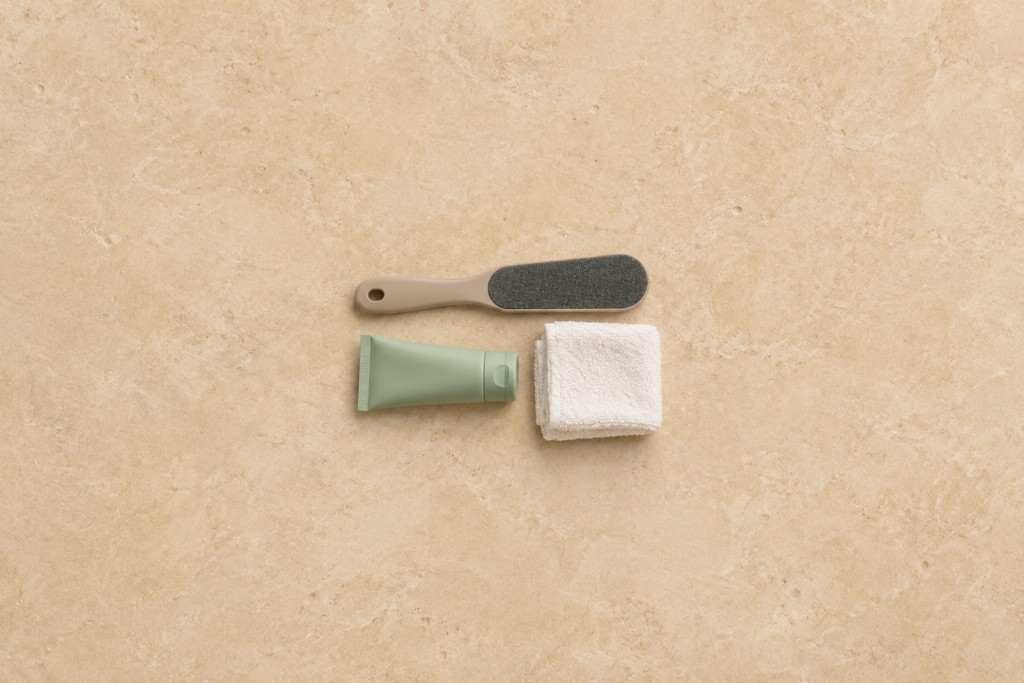
Keep the package or manufacturer’s directions handy. The examples use specific products so you can see what to look for on yours.
Tip: If the directions and warnings are in separate blocks, read both before you start.
Some words describe where a product goes. Others tell you what to do with it.
The intended patch of skin or body area.
Removing dead cells from the skin’s surface.
A slipper-shaped applicator for a foot mask.
The time a product stays against your skin.
These terms tell you whether to wash away the formula or let it stay on the skin.
How often the directions call for a fresh application.
Tip: Read the unit beside a number. For a mask with a wear time, look for minutes.
Use the directions to find the application area. Read the cautions alongside them before you start.
A warning can settle the question before you need the directions for use.
Read the first step before you turn on the tap. Some directions call for water and some recommend starting dry.
Decide whether you need to wet or dry your feet before you reach for the tool.
Think about what your hands need to do once the product touches your feet. That might be a stroke with a file or fastening a strap on a mask.
For a timed mask, have a clock where you can see it before the slippers go on.
There can be a step for the residue.
The finishing line tells you whether to reach for water, reach for a towel or simply work the residue in.
Look for a repeat-use instruction under the directions. If you react to the product, that changes the decision about another application.
If you’re unsure what the directions say about another use, pause and clarify them before repeating it.
These hypothetical examples show what happens to your next step when you switch files or have a condition that affects use.
Imagine you’ve towel-dried your feet and reached for a new Londontown Glass Foot File. You’re used to going back to soak before using your old Tweezerman stone.
With the glass file, you’re already at its preferred starting point. Going back to the tub would carry over a step from the stone.
Imagine you have diabetes and find a thick spot on your heel. Before reaching for the file on the counter, ask your foot doctor about the spot instead of trying to remove a suspected callus yourself.
Diabetes can reduce feeling in the feet, so a person may miss an injury even if filing feels fine. Reduced blood flow can make an injury harder to heal. That’s why discomfort alone is a poor guide in this situation.
Package names can suggest a purpose. Look at the cautions and directions to decide how to use the product.
Londontown recommends dry feet for its glass file. Look for a separate direction before treating wet use as an option.
Aveeno’s one-pair mask comes off at 10 minutes. The Dr. Scholl’s one-pair mask comes off at 30 minutes.
The Dr. Scholl’s one-pair mask packaging names dry, cracked skin. Its caution panel tells you to keep the mask off damaged or broken skin.
The American Academy of Dermatology warns that overdoing exfoliation can leave skin red or irritated.
The FDA says an ingredient’s natural origin doesn’t establish safety. Follow any repeat-use instruction on your foot cosmetic’s own label.
Tip: If you need to decide whether to use it, read the cautions before the name or claims.
The details can be as small as where lotion goes or what a package means by a small amount.
Compare the full product name and version with the manufacturer’s directions. If you still can’t verify the match, ask the manufacturer before using it.
Yes. The FDA advises washing your hands before using a cosmetic.
Stay put in the Dr. Scholl’s one-pair mask. The package warns that walking in it could cause a fall.
Use each slipper in the Aveeno one-pair mask once.
The National Institute of Diabetes and Digestive and Kidney Diseases advises people with diabetes to keep lotion and cream out of the spaces between their toes. Moisture there may contribute to infection.
The U.S. directions for O’Keeffe’s Healthy Feet Foot Cream in the tube say to use a small amount. They give no measurement.
Yes. The U.S. FDA accepts reports of unexpected reactions to cosmetic products, even if the reaction didn’t require medical treatment.
These examples cover mechanical exfoliation and moisturizing cosmetics. The FDA warns that certain chemical peels can cause serious skin injuries and calls for appropriate professional supervision for those products.
Tip: Keep the package handy if you need to ask the maker about a step. Use the name on it to identify the version.
Read the directions in two passes. First, find where the product goes and whether a warning rules out using it. Then follow the directions through to the step that finishes the application.
If one of those passes leaves you with a question, use the full product name to look up that step. Before you open the mask or pick up the file, you should be able to point to the line that answers it.
Browse the Foot Care archives by format.
Open the Foot Care Lists archive.
Open the Foot Care Comparisons archive.
Explore buying guides.
Choose a retailer
Prices checked regularly. We may earn a commission at no cost to you.