
How Travel Bags & Backpacks Compare with Common Alternatives

Start with the same belongings, destination and task. A commuter pack puts the load on the rider. A pannier puts it on a compatible bike rack. Some laptop cases are designed to hold the computer while you work. The comparison turns on what happens to the belongings at the moment you need them.

By: Review Streets Research Lab
Updated: November 24, 2026
Explainer · 11–13 min read
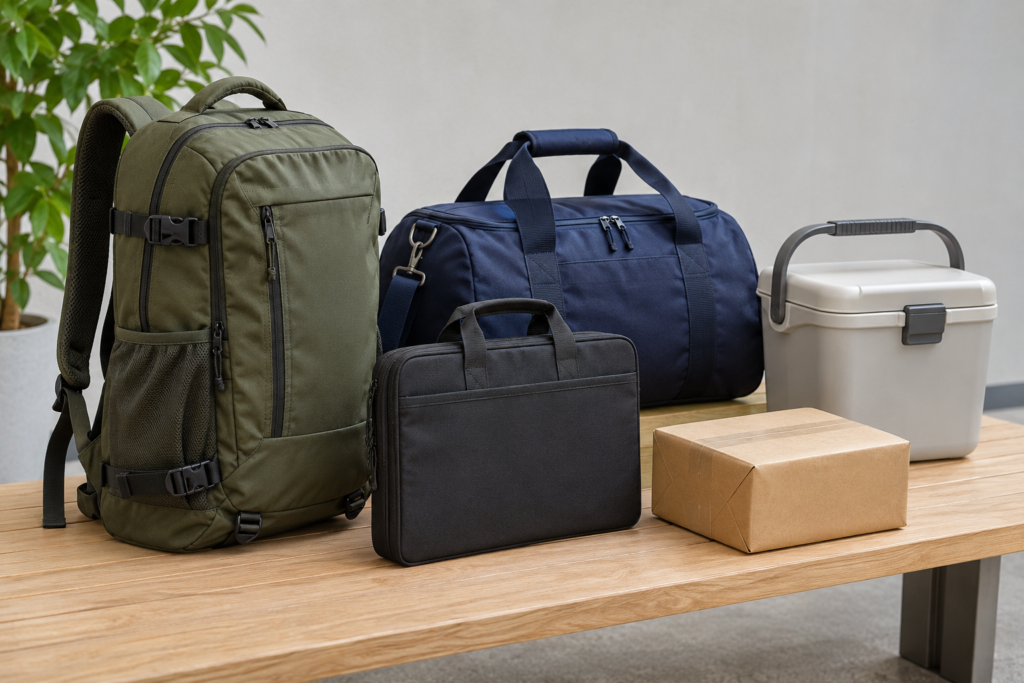
A travel backpack, duffel, laptop case, cooler and cardboard parcel on a wooden bench.
What you’ll learn

Five ways to do the same travel job

Start with the moment someone needs the contents ready. The Osprey Metron is a bike commute pack. In its example, the rider still has a courtyard to cross after parking.

  • How a pannier can ride on a rack and continue on foot by its shoulder strap.
  • Who supports the load when a commuter pack stays on through a stop.
  • Which motion repeats when friends reopen the Playmate lid.
  • What changes at the worktable when the laptop stays inside the open case.
  • How an addressed parcel brings the papers to the person named on it.
  • Why a daypack with its own stool frame goes where the seat is needed.
  • What a Priority Mail estimate leaves open about actual receipt.

Tip: Picture when the item has to be usable. In the laptop example, that comes after the walk, even though the backpack already has a place for the computer.

Terms to know

What the carrier is doing

The names below describe arrangements as well as objects. QL2.1 identifies one particular rack-mounting system. That level of detail matters when the example turns on how parts work together.

Matched carrying task

Two arrangements compared against the same load and the same end task. For the bike trip, picture the same notebook in a backpack designed for bike commuting or a pannier mounted on a compatible rack.

  • Payload: The actual items being carried. Jules’s sketchbook and pencils are one example. In one version they travel in a duffel intended for weekend trips.
  • Endpoint: What has to be ready, and for whom. In the mail example, the parcel names the recipient.
  • Conditions: The starting assumptions. For the ride, the already installed rack is assumed to be compatible with QL2.1.

Pannier

A bag that attaches to a compatible bicycle rack.

  • Connection: The QL2.1 hooks can close around the rack tube.
  • Support: The attached bag rests on rack support.
  • Away from the bike: This model includes a removable shoulder strap for walking the bag onward.

Roll-top closure

A flexible opening that rolls closed. The ICEMULE model uses a clip to keep it rolled.

  • Mouth: The opening material forms the roll.
  • Retainer: The clip keeps the roll closed.
  • Access: The released mouth can unfold for access.

Work-in-case clamshell

A case designed to open around a device that stays inside for use.

  • Shape: The clamshell opens around the device.
  • Work position: The keyboard remains exposed for use.
  • Scope: The model here names the 16-inch MacBook Pro.

Addressed parcel

A shipment sent to a named recipient at a specified address.

  • Sender: The person who supplies the destination details.
  • Recipient: The person or company the shipment is addressed to.
  • Timing: For Priority Mail, the mailing time can affect the expected arrival date.

Integrated seat

A seat built into the carrying object.

  • Frame: The trekking pack’s frame serves as the stool.
  • Surface: The pad is built into the daypack.
  • Counterpart: The separate Walkstool folds for transport.

Tip: Follow parts through the trip. A folding stool can ride in a travel duffel and be positioned separately at the stop.

On the bike

Who carries the load after parking?

Imagine Eli riding to a print studio with a notebook, a pencil pouch and a small envelope. The ride ends across the courtyard from the studio. The modest load fits in either carrier and stays inside from door to door. Take the bicycle’s already installed rack as compatible with ORTLIEB’s QL2.1 system.

  • Eli’s appointment is at the worktable. The bicycle stays at the courtyard entrance for that final walk. In the backpack version, the pack is already on his shoulders.
  • Eli wears the Osprey Metron 24 Pack, a bike commuter backpack with a harness and an adjustable chest strap. He keeps it on when he parks.
  • In the second version, the compatible rack supports a single ORTLIEB Back-Roller F5508 with QL2.1 mounting. The parking spot is the same.
  • When Eli takes the pannier off, its release handle opens the hooks on the back of the bag. He shoulders the still-packed bag using its included strap.
  • At the table, Eli wants the envelope first because it has a drawing for the studio manager. The worn pack and the shoulder-carried pannier both let him bring the whole load to the table in its original bag.

The worn pack stays on Eli across the stop. The pannier transfers from rack to rider. The difference happens at the bike stand, partway through getting the work materials to the table.

At the picnic table

What opening motion repeats between servings?

Picture Maya walking to the same picnic table with a modest batch of pre-chilled, sealed cans that fit either cooler. The cooler starts closed in both versions. Some friends take a drink right away. The others will have theirs after a game, so she closes the carrier between rounds. The ICEMULE Pro 23L is a backpack cooler. The alternative is the Igloo Playmate Elite 16 Qt.

  • Maya wears the ICEMULE by its shoulder straps. At the table, she unclips and unfolds the mouth for the first round, then rolls and clips it closed again.
  • Maya carries the Playmate by its molded handle. At the table, the button releases the tent lid, which can swing to either side. Maya has laid game cards to the left. She can swing the lid right and close it again after serving.
  • The last people finish the game and come over for their drinks. Maya reopens the clipped mouth or swings the lid back out of the way, then recloses the carrier.

Both groups get the same drinks in the same order. The closure determines which motion Maya repeats.

At the worktable

Where is the laptop while you work?

Picture Dana stopping at a shared table to edit a caption. The trip and the document are the same. She has a bare 2024 16-inch MacBook Pro. One carrier is the Thule Aion 28L Travel Backpack. The other is the Thule Gauntlet attaché, model 3205415. Assume the computer is physically suitable for both.

  • The machine rides in the Aion’s padded sleeve. At the table Dana chooses to lift it out. She sets the backpack aside before opening the document.
  • Thule supports working in this Gauntlet with a compatible laptop inside. Dana opens the attaché on the table and edits the caption there.
  • A colleague is waiting for the caption. Dana wants the laptop right in front of her. After taking it out of the Aion, she sets the backpack on the empty chair. The open Gauntlet stays with the laptop at the table.

Dana knows the stop is over when the caption is ready. In the backpack version, the separate computer goes back into its sleeve. In the attaché it is already inside.

At the destination

Can the papers arrive on their own?

Imagine Noor taking the same train to a workshop in either version. Lin, the coordinator, needs the original printed handouts to lay at each place. The trip is within the contiguous United States and Lin agrees to receive the stack of eligible plain papers at the destination office. Assume the papers fit in the pack. The travel backpack is a Cotopaxi Allpa 35L.

  • In the Allpa version Noor carries the originals on the train and on the final walk, then hands them to Lin in person. Lin might already have set out the name cards.
  • Noor can send the originals ahead, addressed to Lin at the office. Ordinary USPS Priority Mail is the service in this example. With that separate route, either the parcel or the traveler could arrive first.
  • Lin can put out the handouts once the originals are in hand. The parcel’s arrival is independent of the train.

At the workshop door, Noor’s arrival has to precede the handoff in person. Lin can receive the mailed papers separately.

At the sketch stop

Does the seat go wherever the bag goes?

Imagine Jules taking the same walk with a sketchbook and pencil case to draw a railing post from a chosen sitting spot. The Fjällräven Singi Stubben is a trekking daypack with a stool frame. The alternative uses a Patagonia Black Hole Duffel 40L, style 49339, to carry a seat. Both seats suit the stop. Assume the sketch kit and the separate folded Walkstool Comfort 45 fit in the duffel together.

  • In both versions, Jules takes out the sketchbook and pencil case before sitting. The Stubben’s frame and pad serve as the seat. Jules puts the daypack opposite the railing post.
  • The Walkstool comes out of the duffel and serves as a separate seat. Jules can put it opposite the post and leave the duffel beside a wall.
  • Suppose Jules reconsiders the angle before sketching. With the Stubben, the new sitting spot is also the new spot for the daypack. The independent stool can move on its own.

Jules can begin the same drawing from the same spot. The seat’s construction determines whether the carrier has to be there too.

Reality check

Where the comparison ends

Getting there and finishing the job can be two different events. Priority Mail gives an expected date. In the workshop story, Lin needs the originals in hand.

Sometimes the carrier is part of the task

Imagine borrowing a stack of sample cards. One person needs the cards loose to pass around. Another needs them standing in their display holder. In the second request, bringing every card can still leave the job unfinished. The stool daypack also has a role at the stop.

The comparison changes if the traveler wants only to drop off the sketch kit. The sketching example assumes Jules is staying to draw while seated. That is when the frame and seat pad become relevant.

An expected date leaves the order open

Suppose the workshop starts after lunch and Lin puts out name cards before Noor’s train arrives. If the mailed originals reach Lin during setup, the handouts can go out before Noor arrives. That is one possible morning in the illustration.

The expected Priority Mail date depends on the origin, destination and time of mailing. In either version of the workshop story, Lin needs an actual handoff to put out those handouts.

Common misconceptions

What a product label can leave out

A familiar product name can leave out something that matters. QL2.1 is the name of a specific ORTLIEB rack-mounting system. That is where the bike example gets its attachment detail.

Must a rack pannier stay with a parked bike?

This Back-Roller comes with a detachable strap for carrying it off the bike. The studio door can still be part of Eli’s trip.

Must a backpack cooler have a zipper?

The Pro 23L secures its rolled opening with a clip.

Is a laptop bag just for the trip to the table?

This Gauntlet is designed for use with a compatible laptop still inside. Dana’s case stays involved after the walk.

Does my arrival mean mailed papers are ready?

The Priority Mail date is an estimate. Lin needs actual receipt of the separately routed papers.

Can any upright backpack serve as a seat?

Standing upright describes the bag’s position. Fjällräven documents a stool frame and a seat pad on this particular daypack.

Tip: ICEMULE lists the Pro 23L among its backpack coolers. How it opens is a separate question about the exact model.

Questions that come up

What if one detail changes?

A different notebook would change what Eli brings to the meeting. A different rack system changes the connection the example relies on. These follow-ups turn on which condition changes.

Can I carry over the QL2.1 example to another Quick-Lock version?

This Back-Roller uses QL2.1. Another version calls for its own attachment and carrying information.

What changes if everyone takes a can at once?

The roll and lid still open differently. One shared serving makes the second opening unnecessary.

Could the laptop case be the whole setup for the walk?

The handles and removable shoulder strap let Dana carry the attaché as the only bag in the one-laptop example.

Does the laptop example carry over to another computer?

Thule names the 16-inch MacBook Pro for this case. Even with the same screen size, another computer brings fresh questions about fit and use inside the case.

Can the traveler also be the person who sends the parcel?

The postal instructions distinguish sender and addressee. Noor is the sender in this example and also takes the trip. Lin is the addressee.

What if Noor also needs the originals on the train?

That adds a job for the one stack. While the originals travel by mail to Lin, that same stack is unavailable to Noor on the train.

Does the sketching example include opening the bag while seated?

Jules takes the kit out before sitting. Fjällräven documents the daypack’s stool frame. Reaching into the bag while seated would be a different use.

Would another seat fit in the same bag?

The scenario assumes room for the sketch kit alongside the folded Comfort 45. Another seat changes the load, so there is a fresh fit question.

Tip: In Maya’s setup, the Playmate lid still moves in either direction. The cards explain why she swings it right. The serving schedule explains why she opens it again.

Bottom line

Put the two carrying sequences side by side and mark any action that happens in only one. Eli’s pannier goes from the rack to its shoulder strap. His worktable is still across the courtyard.

An alternative can also change where the bag goes during the task. When the seat is built into the daypack, the carrying object has to be at the sitting spot. In that version, moving for a better view moves the bag as well.

Related reading

Travel bags and backpacks archives

Explore the travel bags and backpacks section by article format.

Lists

Browse the lists archive for travel bags and backpacks.

Comparisons

Visit the travel bags and backpacks comparisons archive.

Buying guides

Open the travel bags and backpacks buying guides archive.