How Travel Clothing & Footwear Compare with Common Alternatives

On a city ride, an everyday flat-soled shoe can do the same job as an SPD touring shoe on Shimano's dual-face PD-EH500. Start with a specific trip task, then hold the rest of the setup steady and see what the swap changes.

By: Review Streets Research Lab
Updated: November 25, 2026
Explainer · 10–13 min read
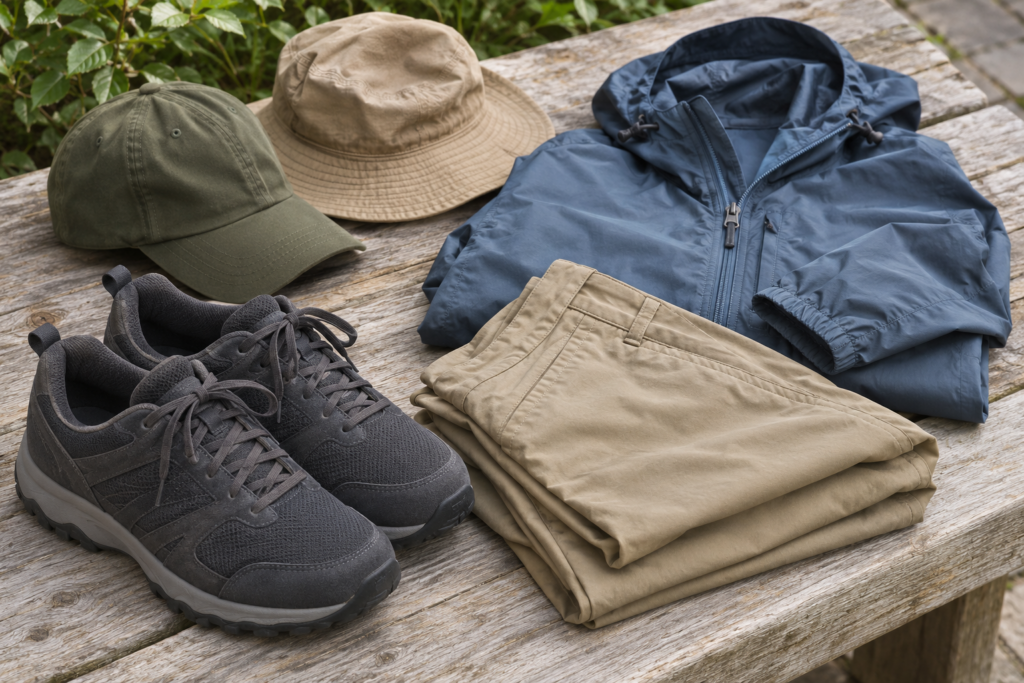
Dark sneakers, folded tan trousers, a blue jacket, a baseball cap and a brimmed hat on a wooden bench.
Start here

What changes when you swap one item?

When a belt carries a race bib, which part of the outfit takes on the new job? Apply that question to the five examples.

  • Frame a single trip task, such as adding an outer layer over hiking trousers already on.
  • Identify the pedal and shoe models in Shimano's city touring guide.
  • Compare a garment made for changing underneath with an individual changing cubicle.
  • Distinguish what holds a bib from where the event requires it to appear.
  • Trace one hem around both legs or separate ends for each leg.
  • Follow the cap's front visor as your angle to the light changes.
  • Spot details that need their own evidence, such as the layout of a particular swim venue.

Tip: Phrase the task as a sentence. Try changing out of swimwear at a place designated for changing, then add what stays the same in both versions of your example.

Terms

Six terms used in the comparisons

Some terms name a part of the equipment or clothing, such as the lower edge a kilt's hem girth measures.

SPD cleat

A fitting on a cycling shoe that engages the SPD side of a pedal.

  • Shoe side: The cleat is the part that belongs on the shoe.
  • Pedal side: SPD names the matching pedal interface as well.
  • On a model sheet: An SPD designation such as the one on Shimano's EX3 gives you a system name to work with.

Flat pedal platform

A pedal surface that supports a flat-soled shoe.

  • Contact: The sole bears directly on the platform.
  • Shoe example: Shimano describes this use with ordinary flat-soled footwear.
  • One face: Flat can describe one side of a pedal that has two different faces.

Changing robe

An outer garment made with room to change clothes inside it.

  • Around the wearer: The robe's fabric provides the screen while it is on.
  • Separate roles: The robe surrounds the outfit being put on.
  • Named example: Dryrobe's Advance model lists space for changing as a design feature.

Race bib

The card carrying the number assigned to an entrant for the run in the Dunedin example.

  • Issue: The packet lists it among the identifiers handed out at check-in.
  • Display: The runner wears it for the run segment.
  • Support: Clothing can serve as the support for the card.

Hem

The finished edge at the bottom of the garment or one of its parts.

  • On the kilt: The listed hem girth goes around one lower edge.
  • On pants: Each leg ends in its own lower edge.
  • What the term answers: Hem girth measures the garment itself. Its position on the wearer is a separate question.

Headwear brim

The part of a hat or cap that projects outward from its crown.

  • Cap term: The cap's protruding piece is called a visor.
  • Hat example: A booney brim can run around the head.
  • Reading a photo: In a picture of a cap with a curved visor, follow the edge of the crown until you reach the part that sticks out.

Tip: If two parts work together, name them separately. That makes the bib and the hardware that holds it easier to keep track of when an arrangement changes.

City ride

One bike with two ways for the shoe to meet the pedal

Imagine an afternoon city ride. The bike already has correctly installed Shimano PD-EH500 pedals, and the rider is eligible and able to use either face. The choice is between ordinary flat-soled shoes and EX3 shoes with compatible SPD cleats.

  • Hold the route, rider and bicycle steady. Think of two versions of a ride from a bridge to a square, with the PD-EH500 already on the bike in each. Compare just the point where the shoe meets it.
  • Shimano gives the PD-EH500 a flat surface on one side and an SPD engagement point on the reverse.
  • For the cycling shoe, Shimano's city touring pairing guide lists the PD-EH500 and SH-EX300. Shimano also describes the EX3 as an SPD shoe for city riding. With a compatible cleat on the shoe, the shoe meets the pedal at the SPD connection.
  • In the everyday branch, the flat sole rests directly on the model's platform face.
  • Now mentally swap the bike. The fitted pedal with two faces was part of the original premise. With a different pedal on the drawing, the shoe names can stay the same while the counterpart has to be established again.

One bike can accommodate two footwear choices under these conditions. To carry the comparison to another bike, start by identifying its hardware.

After a swim

Changing robe or individual cubicle

Imagine changing into a shirt and trousers after a swim. At this fictional venue, assume an individual cubicle is available and a separate area explicitly permits changing in a robe. In both versions the same swimmer changes into the same clothes.

  • The task starts once the swim is over. At that moment, the swimmer has two possible settings for the change: inside the robe or in an individual space supplied by the venue.
  • Dryrobe makes the Advance roomy enough for a clothing change inside the worn garment.
  • Better's listing for Wycombe Rye Lido identifies individual changing cubicles. That documents one half of the fictional setup. The separate, permitted robe area is an assumption for our imaginary venue.

Ask what will screen the clothing change at that stop. The robe provides the fabric around the change.

Race day

One run bib with two places to attach it

Picture the run leg of the Dunedin Sprint Triathlon of May 17, 2026. You have one bib and wear the same shirt in both versions. The event packet required the number to stay in front.

  • Start with what another person sees. Under the packet's rule, they look for the number at the runner's front whichever piece holds it.
  • In the first arrangement, safety pins fasten the bib directly to the running shirt.
  • In the other arrangement, a race belt carries the number over the same shirt. SPIbelt's Endurance Series has its own bib fittings.

The choice changes which piece carries the card and leaves the specified display position in front. For a different race or edition, read its own instructions for both details.

Outer layers

One kilt opening or two outer pant legs

Imagine a traveler stopped partway through a walk. The task is to put an outer layer over their hiking trousers. Keep the traveler, stop and trousers the same. Compare the outfits once each outer layer is in place.

  • Decathlon's layering example puts one pair of trousers over the hiking pair. Picture the inner trousers in one color and the outer piece in another, so the boundary of the added fabric is easy to follow.
  • The Zpacks DCF Rain Kilt is cone-shaped and ends in one hem that surrounds both trouser legs. Picture one outline in the outer color, with the two legs of the inner trousers inside it.
  • The Patagonia Torrentshell 3L Rain Pants have two outer legs, each with its own cuff. In the same drawing, using the outer color gives you two separate outlines, one for each leg.

This comparison stops with the completed outfit. The lower edge shows where the outer fabric is shared and where it divides between the legs. That distinction is visible even in a simple outline.

At a lookout

Front visor or brim around the head

Imagine standing at a lookout with sunlight coming from ahead. Keep your head level and turn until light comes from your side. Make the same turn in both versions, changing the object's orientation to the light.

  • On the BUFF Pack Speed Cap, the visor projects at the front. BUFF's product report and a first-party search excerpt support that orientation. Picture an arrow pointing out from your forehead along the projection.
  • On the BUFF Explore Booney Hat, the projecting brim goes around the crown. The listing identifies a wide brim and the excerpt supports the perimeter shape.
  • Now make the turn. The cap's visor turns with your head and still points straight ahead, with the light now coming from your side. With the surrounding brim, there is still a projecting edge on the side that now faces the light.

In an overhead sketch, trace the projections after the turn. Tracing the shadow would also take a fuller account of the light angle and object geometry.

The limits

What the example can settle

A pedal pairing guide and a venue's changing-facility listing answer different questions about a trip.

When the bike listing names the pedal

Imagine a trip description that includes the Shimano code PD-EH500. Before packing shoes, you have a specific part to look up. Shimano also lists it in its city touring pairing guide.

A listing with only a photo and the words city touring leaves the equipment question open. To use this comparison you still need to identify the fitted PD-EH500 or establish the other pedal's actual faces.

A robe and a venue's changing area can go together

Better describes an open indoor area and an outdoor changing space at West Reservoir Centre and encourages swimmers to use robes or towels when changing. In that documented setting the place and the worn garment can be two parts of the same arrangement.

Check venue permission for a robe change separately.

Common assumptions

Where the comparison can go wrong

A description like city touring footwear can be accurate and still leave the question you have unanswered.

Does touring tell me which pedal a shoe matches?

Shimano presents the EX3 as a city and weekend touring shoe and identifies its system as SPD. It is the second detail that you need for a pedal comparison.

Does a listing for a changing area mean there will be a cubicle?

Better's Wycombe Rye Lido description lists both individual cubicles and group changing space. The broader label leaves the layout open.

Does a race belt let me put the number at my side?

The 2026 IRONMAN 70.3 Dallas Little Elm guide accepted a runner's belt and still required a clearly visible bib at the front during the run. The packet answers how and where separately.

Does the rainwear label tell me where an outer layer ends?

Zpacks describes its kilt as intended to extend roughly from the waist to the knee. Patagonia describes its pants with cuffs and an inseam. The two descriptions give you more than the shared category name.

Will a brim that goes all the way around cast the same shadow whichever way I face?

Changing an object's orientation to the light can change the shape and size of its shadow. The outline of a booney brim tells you where the brim projects. The scene's geometry also matters for the shadow.

Tip: Read a race packet's display and attachment instructions as answers to separate questions.

Follow-ups

Questions about the five swaps

The details can matter down to the letters after SPD. Start here if a specific term or missing fact is holding up your comparison.

Are SPD and SPD-SL two names for one mount?

Shimano distinguishes a two-hole SPD system from a three-hole SPD-SL system. Keep the full name when checking a product listing.

How much can a picture of my trip bike tell me?

For this comparison, look for a photograph sharp enough to identify the PD-EH500 pedal or show both faces clearly.

If there are showers, what can I infer about the changing space?

Read the facility entry for the specific place. For instance, Better lists rinse-off showers separately from the open indoor and outdoor changing spaces at West Reservoir Centre.

What if I arrive ready for the swim?

Better encourages swimmers to arrive ready when possible at West Reservoir Centre. In that case the outfit change to plan for comes after the swim.

Did the run bib and the bicycle frame number refer to one piece?

The 2026 Dunedin packet listed them separately. One was the number for the bicycle frame and the other was worn for the run. It listed a helmet number separately, too.

Can a running belt come with bib fittings already on it?

SPIbelt says its Endurance Series includes the fittings. For another belt, look for the fittings on that model's own listing.

Where do rain overtrousers sit in the layering example?

Decathlon describes outer trousers worn over the hiking trousers you already have on. That is the role of the outer layer in the illustration.

Can I work out a hat shadow's reach from the name of its brim?

Shadow size depends in part on the angle between the light and the object. A distance would require the actual geometry of the scene.

Tip: Keep the model or series name alongside the detail it qualifies, as in the Endurance Series' built-in bib fittings.

Bottom line

Compare one job at a time. If the job is adding an outer layer over the trousers you already have on, picture the outfit with only that outer piece changed. Give yourself one difference to explain.

On your next trip, write down the detail that decides which options you can compare. For a clothes change after a swim, start with whether the venue describes individual cubicles.

Keep reading

Travel Clothing & Footwear

Continue with the format that fits your question.

Lists

Start with a list if you want to survey the category.

Comparisons

Choose a comparison if you already have two alternatives in mind.

Buying Guides

Turn to a buying guide when you want to work through selection criteria.

At a glance

Five parts that change

  • The fitted Shimano pedal provides a flat face for an ordinary flat-soled shoe and an SPD face for the cleated shoe.
  • A robe supplies the fabric around the change. A cubicle supplies a place for it.
  • Dunedin's 2026 race packet required the run bib in front with either attachment.
  • The kilt ends in a single shared hem. The pants have an end for each leg.
  • The visor projects forward. The booney brim also extends to the sides.