How Travel Clothing & Footwear Fit Into Modern Travel Setups

Travel clothing and footwear fit into a setup through the job each piece does for another. A zip-in liner can have a specified orientation, a toe shoe gives each toe its own space, and suit separates coordinate by design. Other pairings change how a garment is supported or how its front stays closed.

By: Review Streets Research Lab
Updated: November 24, 2026
Explainer · 10–12 min read
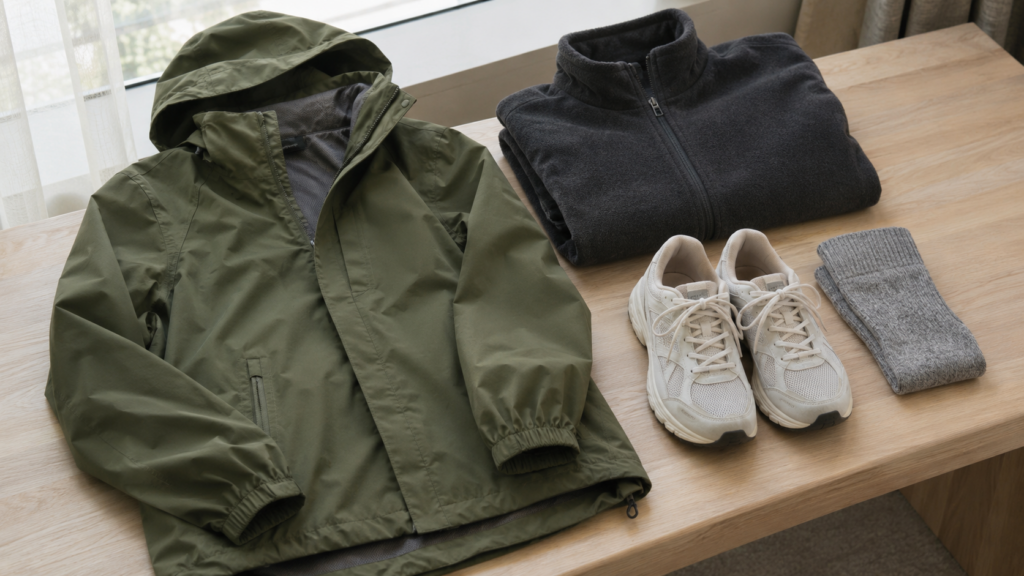
Olive jacket, folded charcoal fleece, off-white walking shoes and a gray sock on a wooden bench.
What you’ll learn

What each piece contributes

A useful way into any of these examples is to name the specific job of the second piece. Suit separates provide an example of two garments that go together through their design.

  • Recognize when two parts can be worn separately or together.
  • Follow the change from separate jackets to a zipped-in liner.
  • Follow a sock sleeve into a shoe pocket.
  • Read a product listing for evidence that two garments are intended as a suit.
  • Distinguish adjustment at the waistband from support that comes from above.
  • Understand what holds the overlap of a simple inn robe.
  • See how two local robe arrangements assign closure.

Tip: Start with a verb. For suit separates the verb is match. It directs your attention to the relationship between the garments.

Terms to know

The names of the pieces

Some terms tell you where a piece goes. Others tell you what it does. Shell, for example, names the outer garment in the jacket setup. Trouser braces, by comparison, support the trousers.

Outer shell

The outside jacket in Columbia’s Interchange arrangement.

  • Position: In the combined outfit it goes over the inner jacket.
  • On its own: Columbia describes it as a jacket that can also be worn separately.
  • Joining feature: Columbia describes zipping the inner jacket into the shell.

Reversible liner

An inner jacket you can turn either way out when worn alone.

  • Faces: The Powderkeg has a fleece face and a smooth one.
  • Separate piece: In the Interchange design the inner jacket can come away from the outer jacket.
  • Joined position: Worn together, the inner jacket sits under the shell.

Toe sleeve and toe pocket

The sock’s fabric sleeve and the shoe’s separate space for a toe.

  • The sleeve: The fabric enclosure is part of the sock and surrounds the toe.
  • The pocket: Each FiveFingers pocket belongs to the shoe.
  • Optional piece: Vibram describes toe socks as optional additions to FiveFingers.

Matched suit separates

A jacket and trousers designed to make a suit even though they are separate garments.

  • Listings: Bluffworks lists the 2.0 jacket and trousers as individual products.
  • Fabric line: The original Gramercy pieces share a name derived from their fabric.
  • Colorway: The catalog uses a shade name to identify a color of each piece.

Trouser braces

Straps worn over the shoulders to hold up trousers. In the US and Canada these are called suspenders.

  • Straps: Páramo’s named braces use elastic straps.
  • Connection: The EU Men’s Enduro Tour Trousers have dedicated loops for braces.
  • Waistband: The trousers’ clipped belt is for waist adjustment.

Obi

A sash or belt worn with a yukata, the cotton kimono described in the Japan Travel and Tourism Association’s guide.

  • Placement: The basic dressing guide places the sash outside the robe.
  • Separate piece: Kinosaki’s plain-inn sash ties around the robe.
  • Visible choice: The listing for Kinosaki’s IROHA shop describes choosing a sash to coordinate with the robe.

Tip: Picture the fabric around a toe when you read sleeve. If a description mentions both the sock and the shoe, keep track of which word belongs to which piece.

The jacket

The liner’s orientation

The Powderkeg II Remastered Interchange Jacket is Columbia style 2097221. Columbia’s broader Interchange guide describes three arrangements for the two pieces. Picture the liner on a morning at a lodge.

  • Both jackets can be worn separately.
  • Leave the inner jacket behind and you have the shell-only arrangement.
  • Choose the liner on its own, and either side can show. In this example you wear it down to breakfast with the fleece facing out.
  • Zipped in, the fleece faces the shell and the smooth side faces the wearer.
  • Now picture the same traveler returning to the lodge. With the two pieces zipped together, the fleece face is covered.

In Columbia’s zip-in description, outward means away from the body, toward the shell.

The footwear

A fabric sleeve inside a shoe pocket

Vibram describes its FiveFingers Socks Ghost as suitable for toe shoes.

  • Start with the sock. Its sleeve is the bit of fabric that encloses a single toe. In an illustration before a walk, picture the sock spread flat next to the shoe. You can use the big toe as the one to follow.
  • In this illustration, the sock-covered toe occupies one pocket. Vibram lists the V-Trail 2.0 as a FiveFingers model. The example illustrates the pairing at the shoe-family level.
  • Extend that picture to the other toes. Each sleeve stays with its toe, and each toe has its own pocket in the shoe. Picture two outlines at each toe, one inside the other.

The fabric goes around the toe. The space around both belongs to the shoe.

The suit

Two pieces of a suit

Bluffworks names its original Gramercy blazer and trousers after their shared fabric. Its 2.0 launch notes describe a coordinated suit. You can look up either piece on its own.

  • The 2.0 pair is based on Gramercy fabric. The jacket and trousers each have a catalog entry.
  • Imagine a traveler getting dressed before a work presentation. The blazer is already hanging in the hotel room, and the trousers are still in a bag. The catalog entries to look for are Gramercy Blazer 2.0 and Gramercy Pants 2.0 in Boulevard Blue.
  • Give the same traveler a different outfit for the following morning. Bluffworks describes pairing the 2.0 blazer with jeans too. The blazer can be worn separately from the trousers it was designed to match.

The connection here is how the garments look together. The individual listings let you identify both pieces of that intended combination.

The trousers

Support from above the waistband

On Páramo’s EU Men’s Enduro Tour Trousers, a clipped belt adjusts the waist. Páramo Braces add a way for the trousers to hang from the shoulders. Here it helps to picture the trousers and follow the straps up.

  • The trousers have their own brace loops, alongside the separate clipped belt.
  • The EU brace listing names Enduro Tour and specifies three hook-and-loop fixings on the braces, two at the front and one behind. The two listings describe opposite sides of that connection.
  • Suppose a traveler sees both pieces laid out at their accommodation and wants to understand what the straps add. With the braces in use, support comes from the shoulders to the trousers. The trousers’ clipped belt is for waist adjustment.

The two features act in different directions. Support comes from above, and waist adjustment happens around the body.

The inn robe

The sash over the wrap

Visit Kinosaki describes a sash that holds the front of a plain inn yukata.

  • The Japan Travel and Tourism Association describes the overlap from the wearer’s point of view. The left panel goes over the right. The sash sits outside the overlap.
  • Imagine getting dressed at a Kinosaki Onsen inn. The guest holds the robe closed while wrapping and tying the sash.
  • A Visit Kinosaki listing describes choosing a robe at IROHA and then selecting an obi to go with it. In that listing the sash also has a visual role.

The plain inn robe supplies the panels and the sash keeps them together.

Reality check

What the finished outfit can hide

Knowing the intended suit pairing leaves a question about the pieces in hand. Knowing which sash you see leaves a question about what is holding the cloth closed.

A color label and an actual shade

Imagine two garments arriving in separate deliveries, with a traveler looking up each one before hanging them together. For Gramercy 2.0 the shared catalog color can identify the intended blazer and trousers. Identifying the named pair and seeing the two garments side by side answer different questions.

Bluffworks’s founder reported shade differences between blazers and trousers after a dyeing problem in a 2025 Gramercy 2.0 run. The company held units back. The historical example shows how a catalog match and the actual pieces can diverge.

The thinner cord has its own job

Visit Kinosaki’s color-yukata directions give the closing job first to a thin cord at the hips. The obi goes on above the waist afterward.

Imagine a guest who has only seen a picture of the finished outfit. The sash may be the visible piece even when the cord is already holding the panels.

Common mix-ups

Small words with a specific meaning

Here are some plausible readings of the terms you might see on a label or in a dressing guide. For example, a suit separate has a particular purpose within a garment line.

Can either liner face go outward when zipped in?

Columbia describes one orientation for the zipped-in Powderkeg liner. Either face can show when worn separately.

Are Ghost toe socks made only for shoes with toe pockets?

Vibram also lists standard shoes as an intended use for Ghost socks.

Does an intended suit pairing settle the shade of the pieces in hand?

A production run can depart from the intended shade relationship, as Bluffworks reported in the case above.

Does the Enduro Tour waist belt do the same job as the braces?

The belt adjusts the waist setting. The braces support the trousers from the shoulders.

Is the visible sash simply decorative in the basic yukata arrangement?

In the Japan Travel and Tourism Association’s basic directions, the sash fastens the overlapping front.

Tip: Pay attention to what a description actually names. A catalog shade labels a color for the listed piece. A shoe category in a sock description names the type of shoe the maker intends the sock for.

Frequently asked questions

Details that change the reading

Some follow-up questions come down to how specifically the pieces are identified. For the Páramo braces, the maker names individual trouser lines.

Which Powderkeg zipper closes the front?

Columbia lists a two-way front zipper for the closure. It lists Zip-in Interchange separately for joining the liner to the shell.

Can a liner from a different Interchange jacket be assumed to connect?

Interchange describes Columbia’s general two-jacket design. Style 2097221 documentation covers its own shell and liner. A different liner would need its own compatibility evidence.

Do FiveFingers toe pockets require toe socks?

Vibram describes wearing FiveFingers directly on the foot. The maker also describes use with toe socks. In either case the individual pockets are a feature of the shoe.

Do two pieces labeled Asphalt Black belong to the same Bluffworks suit?

The catalog uses that color name in both Presidio and Gramercy 2.0. The shared shade name by itself leaves the intended relationship between pieces from different lines unresolved.

Can photos tell me whether the original Gramercy and 2.0 are a matched set?

Bluffworks describes visual similarities in photos as well as changes for 2.0. The version name provides information the photo leaves open.

Does Páramo name a brace counterpart beyond Enduro Tour?

Yes. The maker’s EU braces page also names Cascada II as compatible.

Do the basic men’s and women’s directions reverse the yukata panels?

The Japan Travel and Tourism Association gives the same overlap for both, with the wearer’s left side over the right. Kinosaki’s basic guide puts the sash at women’s waists and men’s hips.

Where can the basic inn sash’s bow sit?

Visit Kinosaki’s plain-inn directions allow the bow in front or at the back.

Tip: The brace listing names a counterpart. The trouser page identifies its brace loops. The second description can be worth finding when the first leaves a question about what you’re looking at.

Bottom line

Start with the job the second piece does. If that job is to make a suit, look for the maker’s intended pairing. If it’s to help hold up a pair of trousers, the attachment to the garment is part of the answer.

Look at what each piece does on its own before you consider the combination. With a jacket that already functions on its own, adding a liner creates a different arrangement. Once you know what changed, you have a specific question to look up for the pieces you actually have.

Related reading

Travel clothing and footwear archives

Choose a category by the kind of reading you want to do next. The three links lead to separate formats for travel clothing and footwear.