How Travel Clothing & Footwear Work

Some travel footwear opens at a hinge to change how your foot enters. A dial-operated fastening adjusts straps around the foot. Convertible pants release a section at a zipper. A jacket pleat opens to expose extra fabric, and folding tubular neckwear changes where its fabric sits.

By: Review Streets Research Lab
Updated: November 24, 2026
Explainer · 10–13 min read
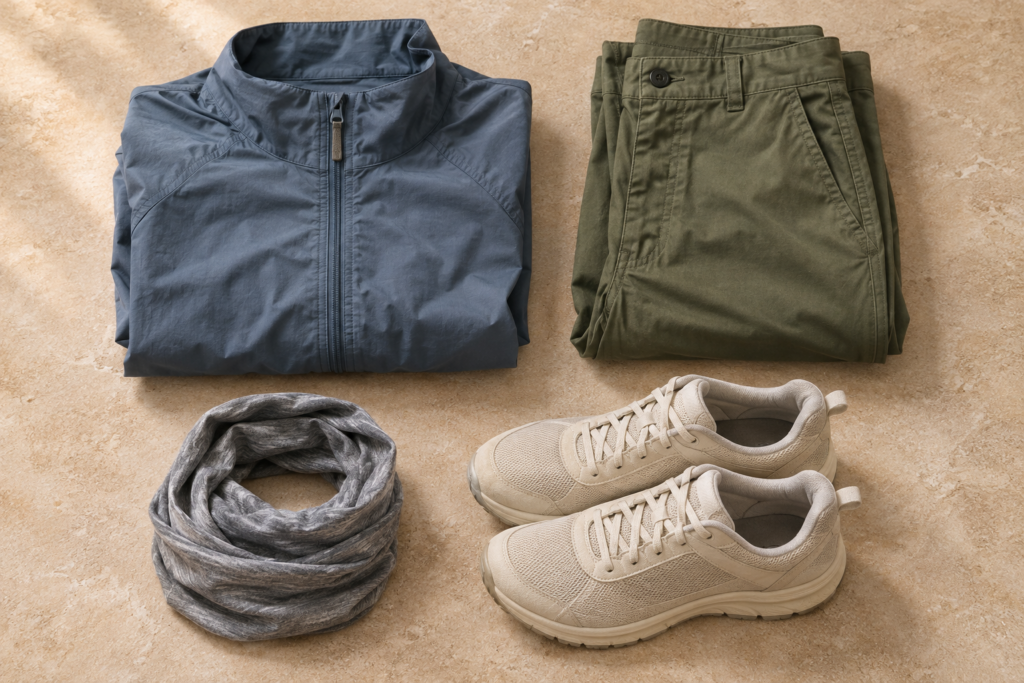
A blue jacket, olive trousers, a gray neck gaiter and cream walking shoes on a stone surface.
Start here

What you’ll learn

L.L.Bean calls the folds on the back of its Insulated Utility Jacket release pleats. That name hints at a physical change. This explainer follows five examples from feature name to movement.

  • What it means for a hinged shoe to have two stable positions.
  • Where pressure goes to close the Go FlyEase and where it goes to open it again.
  • What the two fastening areas on the Jackal II BOA refer to.
  • Why an opening down a detachable pant leg changes the path it can take.
  • Where an action-back pattern hides fabric.
  • How the front and back edges of a tube can sit at different heights.
  • What a reel patent shows about how turning becomes winding.

Tip: Picture the object before and after the movement. For a zipper, follow what happens to the two rows as the slider passes.

Vocabulary

Six parts and patterns worth knowing

In Nike’s patent, the collar is the rim around the foot opening. Knowing which part a term refers to makes the movement easier to picture.

Bi-stable hinge

A joint designed around two positions that it can stay in.

  • Entry: The Nike Go FlyEase can wait in its open shape while the shoe is empty.
  • Wear: Fully closed is the other resting position on the Go FlyEase.
  • Partner part: Nike calls the accompanying part the midsole tensioner.

Reel closure

A fastening that winds lace onto a rotating part inside the closure.

  • Dial: The dial is the knob the wearer turns.
  • Spool: The spool is the part that collects the lace inside the reel.
  • Slack: Slack is the loose length available again when lace comes off the spool.

Adjustment zone

An area of the shoe where a fastening changes how the upper is drawn around the foot.

  • Rear: La Sportiva describes one area of adjustment at the heel.
  • Front: The maker places the other adjustment area farther forward on the shoe.
  • Controls: The men’s Jackal II BOA uses two L6 dials for the fastening.

Zipper slider

The moving piece that joins or separates the two rows of interlocking pieces along a zipper.

  • Elements: Elements are the individual pieces that mesh. You can think of them as teeth.
  • Tape: Tape is the fabric strip that supports a row of elements on each side.
  • Channel: YKK describes a Y-shaped passage inside the slider. The branches bring the rows together in one direction and send them apart in the other.

Action back

A jacket back with a fold that can open to make more fabric available across the shoulders.

  • Pair: The bi-swing pattern illustrated in Threads shows one pleat on each side of the back.
  • Underlay: The fabric beneath the visible fold in the Threads pattern.
  • Neighboring part: Schott’s 184SML A-2 jacket lists an underarm insert as a separate part of its construction.

Tubular neckwear

A continuous fabric tube with two open ends that can be rearranged on the body.

  • Construction: BUFF describes its Original EcoStretch neckwear as seamless.
  • Stretch: The same BUFF model is specified as having four-way stretch.
  • Placement: Wyldr illustrates a configuration that places the tube’s front and rear at different levels.

Tip: Ask whether a term names a part or the place it acts. Heel and forefoot are descriptions of where the Jackal’s straps work.

Shoe entry

How a hinged shoe opens and closes

The Nike Go FlyEase changes shape at a hinge. Nike’s product materials describe the shoe’s two resting positions. A separate Nike patent illustrates how a hinged shoe can work.

  • The cycle begins with the shoe standing open. Its hinge and tensioner hold that shape before your foot makes contact.
  • In the Nike patent, the sole pivots and separates the front and rear portions of the collar, the rim around the foot opening. That gap gives the illustrated shoe a wider entrance.
  • Stepping onto the Go FlyEase applies pressure on the front entry surface. That downward push moves the shoe into its closed position around the foot.
  • Once closed, the Go FlyEase can stay in that shape. The patent shows one way to hold either endpoint with a tensioned band near the pivot.
  • Downward pressure on the projection at the heel reopens the Go FlyEase. In the patent, pressure from the opposite foot pivots the sole back to its open shape.

The same downward action can produce either result. On the Go FlyEase, where you press determines whether the opening closes or opens.

Shoe fastening

How dials tighten different areas

BOA identifies two L6 dials on the men’s La Sportiva Jackal II BOA. La Sportiva describes the fastening as a combination of dials and straps that lets the heel and forefoot be adjusted. BOA’s reel patent gives a separate view of the mechanical idea behind winding lace.

  • In the patent design, turning the knob makes the spool take up lace. As the spool collects more, less length remains available outside the reel for the fastening.
  • On the Jackal II BOA, the straps act on the upper. La Sportiva identifies where they act and leaves the route from each dial to each strap unspecified.
  • For an L6, BOA gives a push to engage the dial and a turn to tighten. Lifting the dial releases the fastening. In the patent’s release design, the spool can turn back when the lace is pulled. The pull draws the lace out and makes slack available.

Think of tightening and releasing in terms of available lace. On the Jackal, the straps make the result local to the fastening area.

Convertible pants

How a lower pant leg comes away

On the men’s REI Co-op Sahara Convertible Pants, one zipper goes around the thigh and another runs up from the hem. Each changes a different edge of the detachable section.

  • Opening the thigh zipper frees the lower section and leaves the shorts above it. With the side zipper shut, the detached section is still a tube around the lower leg.
  • The vertical opening breaks the loop of fabric around the leg. Once detached at the thigh, the section can move sideways, which explains how REI describes removing it with shoes on.
  • On the women’s Sahara Convertible Pants, REI documents a color cue at the thigh. It helps match the detached section to its upper edge for reattachment.

The lower section can be detached at the top and still be wrapped around the lower leg. Separation and sideways removal are two different changes.

Jacket construction

How a back pleat makes fabric available

L.L.Bean lists release pleats on the back of its Insulated Utility Jacket. A separate pattern by Kenneth D. King in Threads shows a fold on each side of the back. Leather jacket maker Firelady explains the opening motion.

  • In King’s pattern, each fold runs from the upper back toward the waist, passing over a shoulder blade. The underlay gives the fold depth.
  • Reaching forward can spread the folds and expose their tucked fabric across the back.
  • As the arms lower, the material can tuck back into the folds.

The folded material provides the extra width even if the fabric itself stays the same length.

Tubular neckwear

How the edges of a fabric tube move

BUFF describes folding and stretching its tubular neckwear to rearrange it. Wyldr’s Original Hoo-rag directions show what moving a front or rear edge can do.

  • Wyldr starts with the tube slipped over the head and gathered at the neck. Its material collects into a low ring of fabric.
  • GOT Sports shows how to make a band by folding one open edge over the other on its own tube. The cloth overlaps where it folds back, leaving a shorter strip of fabric visible.
  • In another Wyldr configuration, the rear sits up near the top of the head and the front stops near the bridge of the nose. BUFF documents twisting as another way to rearrange its Original EcoStretch line.

Folding changes how much height is visible. Lifting one part of an edge changes where that height sits.

Reality check

What you can see from the outside

A still view tells you where the parts are. A second view can show what moved. A single view of the Threads pattern could show the outer fold with the underlay hidden.

An empty shoe on a level floor

Imagine pausing at the end of a bench to look at the hinged shoe in Nike’s patent. On a level floor, its open shape can balance on its own. The heel section has already pivoted before a foot enters.

In a still view of that patent example at rest, you could see an empty shoe with the opening already in place. To see what brings it to that position, you’d need to observe the motion itself.

The view from behind a jacket

Imagine two pictures of a person holding a folded map, first at their side and then out in front. In the Threads pattern, the second view can reveal material beneath each pleat.

The pictures can show the changing span across the back. The way the fold returns to rest is a separate detail of the construction.

Myths

What the feature name can tell you

Feature names raise practical questions. Even within FlyEase, Nike documents more than one kind of entry mechanism.

Does the FlyEase name identify one entry mechanism?

Nike assigns the two-position hinge to its Go FlyEase. Its Japanese overview gives the Tempo Next% FlyEase a collapsible heel and a single pull for the fastening.

Does turning a BOA dial backward always loosen it?

BOA specifies lifting the L6 to release it. The Li2 supports loosening in increments, so that control belongs to a different named dial.

Can every zip-off pant leg come away around a shoe?

On the women’s Sahara, REI attributes that path to the separate zipper up from the hem. The zip-off designation tells you the section detaches. The side opening tells you how it can move away.

Does a seam near the back of an armhole show there is fabric to unfold?

A seam can simply join panels. An expansion pleat has material behind its edge that can unfold.

Do the band and hood use separate pieces of tubular neckwear?

GOT Sports lists both shapes for a single tube. The forms come from changing how that one piece is arranged.

Tip: On the Sahara, the thigh and side zips follow different edges. Read a feature name with the location of the part in mind.

Common questions

A closer look at the details

The small details are often where an explanation gets more specific. BOA’s Jackal pages, for example, identify individual components as well as the shoe.

How much can a patent tell me about a shoe?

Nike’s patent shows how band tension can help hold the two positions in an illustrated design. For the retail Go FlyEase, Nike’s product design page is the account of what the wearer presses to open or close it.

Is the lace on the men’s dual-dial Jackal made of metal?

BOA lists TX6 textile lace for the men’s Jackal II BOA. That’s the component name in BOA’s specification for this version.

How do I know which BOA dial a shoe version uses?

BOA’s separate entry for the women’s Jackal II BOA names its two L6 dials. A dial count alone would leave out that model designation.

Can a conversion zipper open partway while the lower leg stays attached?

KÜHL documents that option on the Renegade Convertible Pant. Its zipper starts behind the knee, and the wearer can leave the lower section joined while opening part of the circumference.

What stays attached when a zip-off section is fully removed?

On Outdoor Research’s Ferrosi Convertible Pant, the lower legs become separate pieces. The upper part remains as shorts and the lower pieces can be zipped back on later.

Does every action-back pleat use elastic to return to shape?

The Threads author shows elastic stays as an optional variation. In that version they pull sideways on the inner parts of the pleats, helping bring the folds back in when the arms lower.

Are an underarm gusset and a back pleat the same part?

Carhartt’s Camden Cryder jacket and Schott’s 184SML A-2 each list the two features separately. The underarm gusset is the insert at the underarm junction. The back fold sits behind the shoulder.

Do I need a precise fold to give a tube a band shape?

GOT Sports describes gathering its tube for a band shape. The material can be bunched together and repositioned as a strip without arranging a series of even folds.

Tip: The women’s Jackal listing gives a component name for that version. Keep the name of the source close to the detail it actually establishes.

Bottom line

Follow the part that moves. For a reel closure, that may be the lace coming off a spool. It could be one edge of a tube moving up around the head. That gives you a more precise description of what the feature does.

Start with the state you can see, then ask what has to move to reach the next one. When a tube overlaps at the fold, more cloth lies within the height of the strip. Following that extra change explains a detail the name alone leaves open.

Keep reading

Travel clothing and footwear by format

Explore the travel clothing and footwear category in the format that serves your next question.