
Passive sound attenuation
A physical obstruction reduces the sound that reaches the listener.
- Route: The obstruction sits along the incoming sound path.
- Power: The barrier does its part by being in place.
- Example: Loop’s Quiet 2 needs no charging.
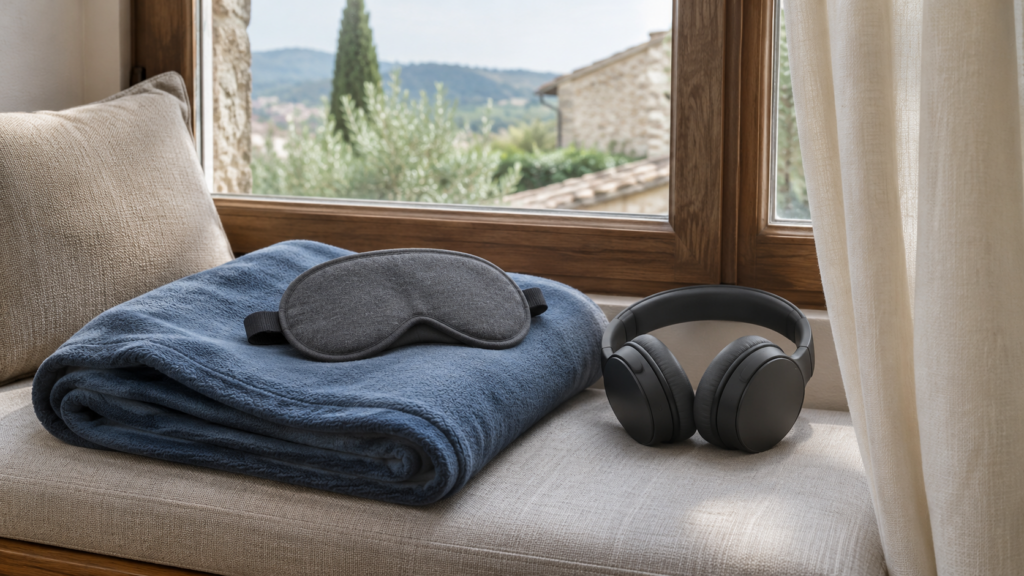
Travel comfort products can do the same job as a familiar alternative while changing where or how the work happens. A plug works as a barrier, while powered headphones add electronic noise reduction even when nothing is playing. An eye mask addresses light at the wearer, while a portable curtain addresses it at the window.
Imagine describing a travel problem to someone who has never seen your gear. You would probably start with the place, what you are doing there and the thing you want to change. Keep that description as you go from one approach to the next.
Tip: Give both versions the same one-sentence brief. If the sentence has to change as soon as you switch products, set aside that second question until you can compare it on its own.
Some of these words name a material, others an action or a relationship. That distinction matters when you are trying to follow what changes in a specific example.
A physical obstruction reduces the sound that reaches the listener.
A powered system produces sound that opposes some incoming noise.
The term describes material intended to prevent light from passing through it.
In the blanket example, this means cloth laid over the shoulders and hanging from there.
An enclosure that takes shape as it holds air.
A support for the feet that hangs from above.
Tip: When two descriptions use similar words, ask what the word is actually describing. Read it next to the noun it belongs to before carrying it over to the entire setup.
Imagine writing out the last leg of a trip on paper at a terminal table. The ventilation hums. The chair, the sound and the piece of paper stay the same in both versions of the scene. There’s no podcast or music to follow.
Suppose the traveler stops to cross out the wrong gate. That pause changes nothing about the comparison. The plug works without power. The headphones still need power with nothing playing.
Picture two adults taking the same short pause with their eyes closed in a room on a trip. Both want to limit the daylight from one window. Assume it has suitable glass.
If the two travelers swap seats halfway through the pause, the drawing still has two people and one window. The masks go with the people. The window stays the point of treatment for the curtain.
Imagine sitting at a sheltered stop with a cup on the table. Both shoulders are covered in each version. The cup is in the same spot and you’ll reach for it with the same arm. The comparison is about where that arm goes.
A still picture of two covered shoulders leaves out the arm entirely. Seen from the side, the shoulder drape meets at the neck and the jacket’s cloth extends around the arm.
At an imaginary campsite, you’re preparing to lie down. In both versions your head will rest over the same spot on the same mat. Before reclining, you want to adjust the pillow’s firmness. The surface under you can stay exactly where it is.
A note that just says “adjusted the pillow” could describe either version. Naming the valve or cord identifies what you changed.
Imagine taking a seat at a borrowed workspace, with room below the desk to support both feet. Keep the seat and the desk fixed. The two arrangements are alternatives for the same seated task. For the sling comparison, assume the two-leg UPLIFT V2 Standard desk already has the appropriate ACC047 attachment points in place.
Trace the weight with a finger on a side-view drawing, starting at the heel. In one drawing you reach the floor first. In the other you reach the desk.
A fair comparison can still have a narrow reach. Try changing one detail after the comparison is finished. That tells you which part of the explanation you can carry into a different room.
Go back to the room where the two travelers close their eyes. This time, imagine a door to a bright hall standing open. The original window and the two chairs are just where they were. The doorway adds a second source to the example.
A treatment against the window glass still acts at that window. In the imagined room light also arrives by the doorway. The result for one opening answers a smaller question than what happens across the room.
Imagine comparing two stops on the same trip. At the campsite you put the air-filled Aeros Ultralight on a mat. The next night you put the foam-filled Pillow Cinch on a bed. You have changed both the pillow and the surface beneath it.
If the two arrangements feel different, that comparison leaves the reason open. To focus on the pillow, picture swapping the pillows in the same spot on the same mat at the campsite. The surface can then stay outside the difference you’re trying to explain.
A phrase on a product page can be accurate in a small sense while inviting a much bigger inference. These examples show where the wording ends.
Loop describes the Quiet 2 as turning everyday sound down and allowing some of it through. Here, “reduction” describes a change in what reaches you, with some sound still present.
Sleepout’s material claim concerns transmission through the cloth itself. Read it as a description of the fabric. A verdict on the whole room would answer a broader question.
Gravel uses that description for the neck closure in its resting arrangement. A sleeve describes where the cloth is around the arm. Those phrases answer different questions.
Sea to Summit gives the Aeros Ultralight a fabric face. The air fills the chamber. The fabric meets your head.
UPLIFT lists the Under Desk Hammock separately. The foot-sling instructions distinguish the two products and depict them together.
Tip: Read the label alongside the part it describes. A phrase about one component answers a narrower question than the same phrase applied to the entire setup.
Once the main task is fixed, small changes are easier to sort out. These follow-ups start with something specific you might see in a manual, on the label or in the room.
Aware Mode uses the headphones’ outer microphones to feed surrounding sound into the earcups. Switching to it changes a premise of the example even with the same hum in the room.
The QC-HEADPHONEARN manual documents using cancellation with the mobile device disconnected. A connected phone can also sit idle. Connection and playback describe different things.
Sleepout recognizes that a larger window may call for more than one portable panel. The number of daylight openings can stay fixed while the number of panels changes.
The blanket has a separate foot pocket. The example follows an arm toward a cup. To understand the pocket, move the focus to a different part of the body and give that comparison its own task.
Therm-a-Rest’s Compressible Pillow Cinch contains foam. The company also uses adjustable air padding in the Air Head Lite. If a packing note only says “the Therm-a-Rest,” the name by itself leaves the fill question open.
Sea to Summit describes the packed Aeros shape in terms of releasing air. The Pillow Cinch packs into itself with the foam still there.
Yes. The Therm-a-Rest pillow guide lists the Air Head Pillow with both air and synthetic insulation. A description of the padding can leave a second material unmentioned.
The sling can come away while the attachment points stay at the desk.
Tip: When coming back to a description later, jot down the exact model and the state you meant. A company name or a familiar setting can be too broad to reconstruct the example.
Make both versions start with the same short sentence about the job. You’re in this place, doing this thing, with this part of the situation you want to change. Then add a second sentence that explains where the product acts. If that sentence changes when you swap the product, you have found something specific to compare.
Keep both sentences visible when you read about another product. You have a place to put specific details and a way to spot when the description assumes a different room, posture or task.
Start with the kind of article you want to read next.
Browse the list archive to see several options together.
Open the comparison archive for articles that put alternatives side by side.
Browse the buying guide archive when you want to turn an explanation into a set of purchase criteria.
Choose a retailer
Prices checked regularly. We may earn a commission at no cost to you.