How Travel Comfort Fit Into Modern Travel Setups

A travel comfort setup can begin with something you bring or something already at your destination. At The Peninsula Manila, guests can request a pillow through Housekeeping. In a separate example, a blanket fills a pillowcase. In each, the traveler can see where the missing part comes from.

By: Review Streets Research Lab
Updated: November 25, 2026
Explainer · 9–12 min read
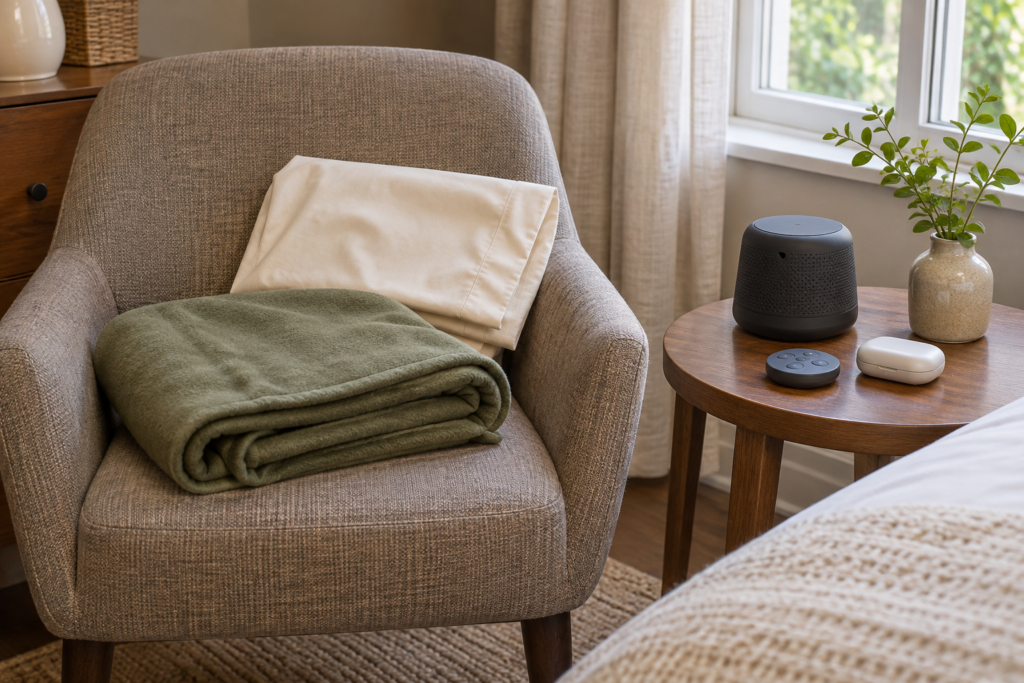
A folded green blanket and cream pillowcase on an armchair beside a sound machine, control pad and earbud case.
What you’ll learn

The other half of a comfort setup

Start with a room you have just entered. The Peninsula Manila lists pillows available on request.

  • Identify an open-front bleacher as the host.
  • Follow a snoring cue from case to earbuds.
  • Notice what changes when the blanket becomes pillow fill.
  • Distinguish the chair’s bench connection from its moving backrest.
  • Trace a message to Housekeeping and distinguish the request from the item you’re asking for.
  • See how two speakers can take their settings from one pad.
  • Use a plug-in speaker to spot a job that falls to the room itself.

Tip: Start with a quick picture of the room you’ll be in. On the A30, the case detects snoring.

Definitions

Six terms for the pieces and their jobs

The terms here name jobs as well as objects. A blanket can be the fill even though the item already has a familiar name.

Counterpart

A counterpart supplies something the other part needs. For the original Rock-Cliner, the bleacher provides the surface under the seat base.

  • The piece: The snoring detector in the case travels with you in this example.
  • The person: For a request to Housekeeping, the counterpart is the team you’re trying to reach.
  • The role: A shared pad controls both speakers. The verb explains what the two kinds of equipment have to do with each other.

Adaptive masking

A30 earbuds play other audio to mask snoring the case detects. That playback adapts to the detected sound.

  • Event: Snoring is the trigger in this example.
  • Detector: The case detects it. That is the input side.
  • Playback: The earbuds play the response, the output.

Pillow fill

Fill gives a pillow its bulk. With Rumpl’s case, a blanket can form that interior.

  • Case: The Stuffable Pillowcase comes without an insert.
  • Contents: The blanket goes inside. Think of the contents as temporary.
  • In use: An enclosed blanket is spoken for.

Seat base

The seat base is the lower part of the chair in this example. On the original Rock-Cliner it sits on the bleacher.

  • Underneath: The bleacher hosts the chair. It’s the part already there in this example.
  • Connection: The chair’s hook engages beneath the bench.
  • Backrest: The backrest can recline. Picture it above the base when you draw the two parts.

Amenity request

An amenity request is a message asking a host for an item or service, such as asking Housekeeping for a pillow.

  • Item: A guest can specify the pillow type in the request.
  • Channel: PenChat is one route for the request. A channel is the way the message travels.
  • Recipient: Housekeeping is the intended recipient.

Synchronized speakers

The word synchronized describes timing. In the Manta pairing, both speakers play the same audio together.

  • Outputs: The base and Booster are the two sound sources.
  • Input: One pad controls both units.
  • Position: The pad can sit apart from the speakers.

Tip: In a sketch of the room, mark the Manta pad separately from the speakers. That makes it easy to see which piece you need to reach.

Sleep accessories

The case that senses snoring

A case can look like the piece you’re done with once the earbuds are out. With the US Sleep A30 from Soundcore, the case has a sensing job.

  • The A30 has a case and earbuds. In the upcoming room example, picture those pieces separately.
  • The event is snoring the case detects as it happens. Imagine hearing a sound yourself and deciding to start a track. In that story you supply the cue. Here the detected sound supplies it.
  • The earbuds play audio that adapts to the detection. Follow the response to the traveler’s end of the setup. Picture a companion who continues snoring throughout the sequence.
  • Soundcore advises placing the case near the source of snoring.
  • Imagine two travelers sharing a room with a desk by the door and a table between the beds. One goes to leave the case with the keys. Once they know where the snoring is coming from, they can consider which spot would put the case near that sound.

Pack the case with the earbuds. The case detects the snoring.

Travel blankets and pillows

When a blanket becomes pillow fill

Imagine arriving at a road-trip cabin with one blanket and an empty case. Rumpl’s arrangement puts the blanket inside the case. Give the blanket a job in the cabin before you picture what the pillow will contain.

  • The pairing uses a Rumpl 1-Person Original Puffy as fill in the Stuffable Pillowcase. The two names tell you what to look for in a description of the setup. The blanket supplies the bulk.
  • Picture the blanket spread out at the cabin. Once the blanket is enclosed in the case, it’s doing the fill job. Taking it out again leaves an empty case in this example.
  • If you use the blanket as a cover later, the empty case can stay on the bed. To use it as a pillow again, put fill back inside.

Put the fill in the case when you’re ready to set out the pillow.

Seat comfort accessories

The chair in the stands

The original GCI Rock-Cliner sits on an open-front bleacher. In the stands, it may be easier to picture the spectator than the seat beneath them. Start with the bench.

  • GCI describes the chair resting on an open-front bleacher, with an L-shaped hook engaging below the seat. The name “stadium chair” alone leaves out that contact point.
  • GCI describes options to rock, recline or set the back upright. When the imaginary spectator leans back between innings, that movement takes place at the chair.
  • Assume a suitable open-front bleacher and venue permission. For the example, picture the chair’s back locked upright. The spectator still has the same spot in the stands.

The bench gives the chair its place, and the chair supplies the movement. A spectator could know exactly where they’ll sit and still have a separate question about what they’ll sit on.

Hotel room amenities

A request from the guestroom

Picture a guest in an assigned room at The Peninsula Manila, where the directory lists pillows by request. The guest’s first decision is which item to ask for.

  • The compendium names foam and feather among its pillows. In the illustration, the guest writes a short message that includes their preference.
  • The 2025 compendium points guests to Housekeeping on the room phone or to PenChat via the directory’s QR code.
  • In the illustration, the guest uses PenChat to ask Housekeeping and puts the phone down. That is where the scene ends, at the point where the guest has sent a message.

The request goes to Housekeeping. Supplying the chosen pillow, if available, is a separate step for the hotel.

Sleep accessories

The shared control

In the Manta Dual Speaker arrangement, one pad controls both speakers. Imagine wanting to reach the controls from one spot in a temporary room. Give the pad its own place in that picture.

  • The Manta White Noise Machine Dual Speaker package has a base speaker, one Booster and a control pad. The last item belongs in the sketch even when you’re concentrating on where sound will come from.
  • Choose a sound on the shared pad and the paired speakers play that selection in sync. A traveler working from a room sketch can trace the decision from the pad.
  • Imagine a bedside table and two other suitable surfaces. The pad can sit by the bed while a paired speaker plays from each of the two other spots.

Once you’ve picked the pad’s spot, you can change what both speakers play from there.

Reality check

What you can see and what you still need to find out

The A30 case belongs near the snoring source. A traveler planning from home might know the shape of the room and still have a detail left to fill in.

What you can know before you arrive

In a hypothetical overnight room, you might know where the beds are and still have no idea where the snoring will come from. Soundcore calls for the case to be near the source. A floor plan alone can leave that place undecided.

Suppose a ticket only says “bleachers.” The original Rock-Cliner uses an open-front bench. The ticket description in this example gives you no view of the seat edge.

What makes the arrangement possible

Rumpl also lists spare soft clothing as fill. Suppose the travelers have enough of it to fill the case at the cabin. They can use their clothes as the fill in that version of the setup.

The Manta Booster needs plug-in power. Your first choice of surface might suit the room layout. Whether the Booster can play there also depends on power being available at that spot.

Myths and misconceptions

Assumptions that change the setup

Calling something “a pillow” can hide a part you still need, as with Rumpl’s case with no insert. The assumptions below each depend on a detail you can pin down.

“The A30 case can go anywhere in the room.”

Soundcore advises keeping the case close to the source of snoring. Its position is part of the detection setup.

“The case from Rumpl comes ready to use as a pillow.”

Rumpl supplies the case by itself. The fill comes from a separate item.

“The Rock-Cliner is documented for any fixed seat.”

GCI documents the original Rock-Cliner on an open-front bleacher.

“Those pillows in the Manila guest directory will already be in the room.”

The directory lists these as pillow choices a guest can request.

“Two Manta speakers mean two separate sound choices.”

Both speakers use a single shared selection. Picture two people each wanting to choose a track and the limitation becomes clear.

Tip: Follow the shared selection to both speakers. The Booster gives that same sound another place to play.

Frequently asked questions

Details worth looking up

A shorthand name can raise one last question. Original Puffy names a blanket family, so the specific name on the product still matters.

Is the snoring feature specific to the A30 Special?

Soundcore’s US listing gives the A30 Special and the standard A30 the same features, including the response to detected snoring.

Can you try a different Sleep A30 masking sound?

Yes. Soundcore’s support page suggests trying a different masking sound if the one playing seems poorly suited to the situation.

Which Rumpl Original Puffy is meant here?

1-Person Original Puffy. The pillowcase FAQ names Rumpl’s 1-Person blankets as fill.

What does the spectator actually sit on in the Rock-Cliner setup?

The chair has its own fabric seat on a raised frame, above the host bench.

Where does The Peninsula Manila publish its pillow request instructions?

The property’s Guest Services Directory webpage links to the 2025 compendium. Look in the pillow entry for the contact options.

Does PenChat require a dedicated hotel app?

A guest with a supported messaging app can use that same app to reach the hotel team through PenChat.

Can someone start with the Manta base and add a speaker later?

Yes, within the documented pairing. Manta says the compatible base setup supports one companion Booster.

What does the Manta Booster need where it plays?

The Booster uses plug-in power during playback. In a drawing of the room, leave a note about power beside the spot you’ve drawn for it.

Tip: Use the pillow entry to name the option in your request.

Bottom line

If all you find at the cabin is an empty pillowcase, look for what can fill it. The blanket supplies the bulk in this example.

The A30 case detects snoring. The earbuds play the response. When you picture how the setup works, give the case a place in the room.

Next steps

More on travel comfort

Choose the format that fits whatever you want to learn next.