
Eye cup
A shaped cover that sits around an eye and leaves space inside.
- Rim: The outer boundary of the cup near the face.
- Recess: The hollow inside the cup that gives the eyelid and lashes room.
- Placement: The cup’s location on the strap.
Travel comfort products work by changing a physical condition. An eye mask can interrupt a route for light while leaving room to blink. Other designs move liquid through fabric, present a different surface to the sitter, change the height of a support, or shape fan sound. The change in each case starts with a particular part.
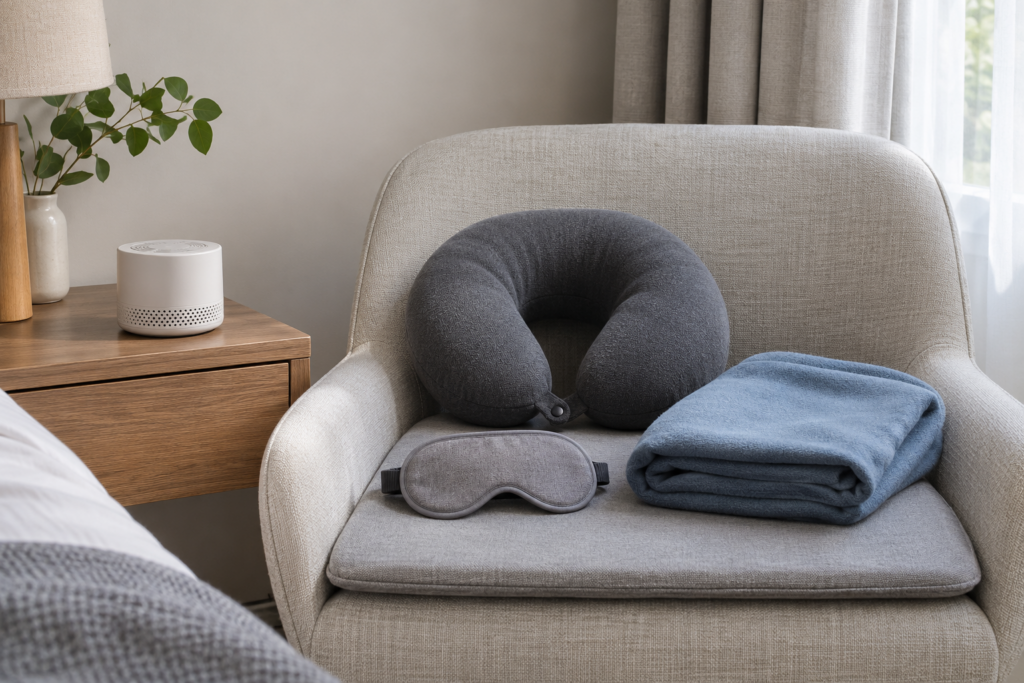
The five examples trace a change to a particular part. Start with the position of the mask’s eye cups, then work outward from there.
Tip: Name the smallest change you can observe. On a textile, liquid reaching a new spot gives you one starting point.
Some terms name parts you could point to, such as the collar on a sound machine. Others name events you follow over time, such as liquid moving through a textile.
A shaped cover that sits around an eye and leaves space inside.
A small pathway that can carry liquid when the liquid wets its surfaces.
The travel of liquid through a textile.
An arrangement of flexible walls with openings between them.
A shape-holding part inside a pillow’s textile wrap.
The enclosure around the sound-generating part of the device.
Tip: On a first look at the support drawing, match each name with its part. Then follow what moves.
Think of the Manta Original’s eye cups from two viewpoints. From the side, you’re interested in the depth of the recess. Face-on, you can trace the rim around the eye area.
Room to blink describes the space beneath the cup. Light at the edge concerns the rim.
COCOON identifies four-channel COOLMAX EcoMade fiber in its Travel Blanket. A sketch at the scale of a strand helps connect that detail to what happens in the cloth.
Liquid can move within fabric while some of it evaporates. The channel sketch accounts for movement. The drying question requires following liquid all the way out of the fabric.
Suppose an adult sets a Purple Double Seat Cushion on a desk chair while away from home. Turning it over exposes one of two GelFlex Grid faces in the same assembled pad. The useful frame of reference is the surface that will meet the sitter.
Turning the assembly over keeps both faces in place and changes which surface meets the sitter. Their own impression is a separate observation.
On the U.S. Trtl Pillow Plus, the dials adjust the height of the support inside the pillow. Start with the support as an object in its own right.
A turn at a control shows up as a change in the support’s extent. That physical change is the observation to connect to the dial.
Picture a Dohm Classic on a nightstand in a U.S. guest room. Its fan generates sound and its housing shapes airflow.
The housing can change the fan’s sound. That answers a question about the machine’s output before you ask anything about the other sounds in the room.
The two scenarios follow a limited observation. On the mask, start with a gap at one edge.
Imagine seeing a sliver of light inside the mask in a lamplit room. Assume you also find a rim gap near the nose. Light could enter through that gap.
Closing the gap removes that route. In the example, ask whether the sliver changes. Other possible rim gaps would need their own evidence.
Suppose a drop lands on a travel blanket draped over a chair and the damp patch widens. The outline tells you liquid reached more of the cloth. How much is still there is another question, since spreading and evaporation can occur together.
Picture the damp section resting in a fold. Some of the wet surface may be covered, changing the area available for evaporation. The difference in water vapor pressure between the wet surface and the surrounding air also matters. A glance at the patch tells you little about either condition.
Each shortcut asks one detail to explain more than it can. For a mask, light can arrive around an edge.
An edge gap can admit light regardless of the covering’s color. Looking at the cloth answers only how dark it appears.
A wider patch shows spread and leaves open how much liquid evaporated. Water loss calls for an observation about how much remains.
The Purple cushion stays assembled. A flip brings the other layer up.
The hook-and-loop fastener closes the wrap. The dials change the height of the insert.
The label leaves the source open. The Dohm Classic makes its sound with a fan.
Tip: Ask what an adjustment acts on. An instruction about support height points you to the insert as the part to watch.
Some questions can be answered by finding a mounting point. Others turn on what the corresponding maker’s instructions establish.
The cup locations determine their spacing. The strap also has a separate tension adjustment.
Four counts the grooves on one COOLMAX EcoMade strand. Picture the tip of a fiber in your hand.
The way the fabric is put together matters, too. In one study, changing the weave changed the pathways and early water transfer in the woven samples.
Opening size gives you one part of the geometry. Purple describes a firmness difference for its two cushion faces. A prediction for another pad needs evidence for that construction.
Trtl locates them at the front and back of the support. The scarf covers them when fastened.
The Coolside drawing offers one implementation of the motion. Trtl’s instructions establish how the retail height control is operated. The exact pieces inside the retail support remain a separate question.
Yes. You can turn the cap or collar without moving the switch. Its position alone gives no measurement of fan speed.
Brightness describes sound character. Loudness concerns level and needs separate evidence.
Tip: Start with the current instructions for the exact model. Trtl’s identify where the dials sit and which fastening closes the wrap.
The height of a pillow support is a specific physical result. Saying that you extended it describes the adjustment. Saying that it felt better describes your response.
Return to the desk chair. Turning the pad over changes the face presented to the sitter. A question about how the person feels calls for a new observation. Once you can say what changed in the object, you know what remains to be explained.
Explore the category by article format.
Browse the category’s list-format archive.
Open the category’s archive for side-by-side formats.
Find the category’s purchase-oriented archive.
Choose a retailer
Prices checked regularly. We may earn a commission at no cost to you.