How Travel Electronics Compare with Common Alternatives

Travel electronics can do the same job through a different setup, from powering two devices with one charger or two to sharing an episode through a speaker or two headsets. The comparison comes down to what you share, where the signal goes or when you need a connection.

By: Review Streets Research Lab
Updated: November 27, 2026
Explainer · 10–12 min read
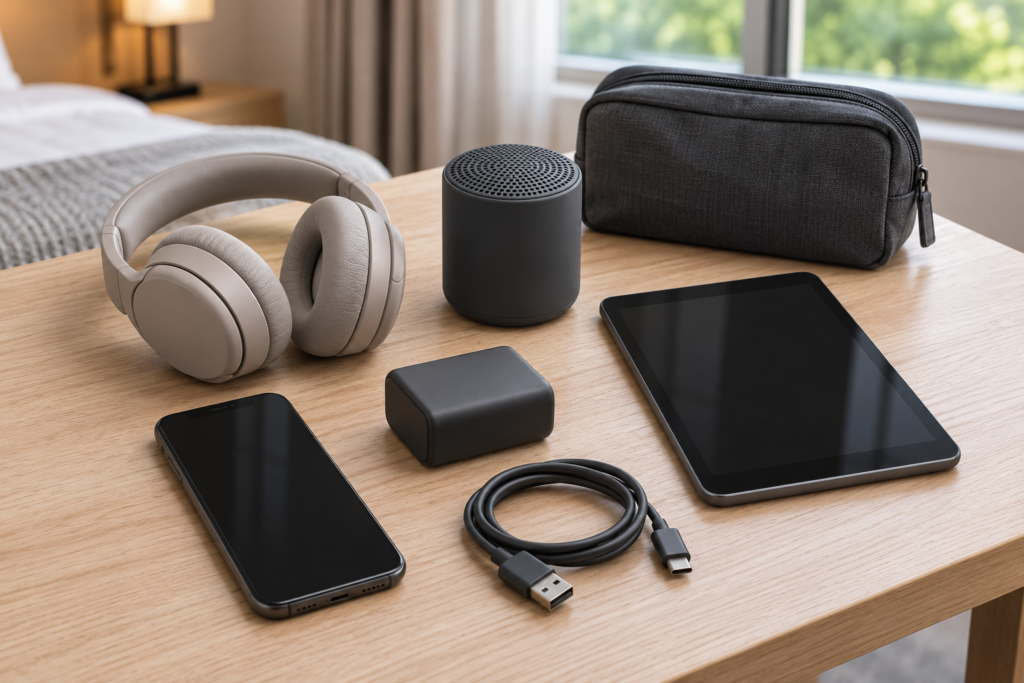
Headphones, a portable speaker, a phone, a tablet, a charger, and a loose cable on a guest-room desk.
What you’ll learn

Five tasks, two ways to do each

In the listening comparison, one phone plays the same recording for two people. Keeping those details fixed makes it easier to see what the setup changes.

  • How one Apple adapter divides output.
  • When removing one charging cable affects another device.
  • Why one recording can have separate listening levels.
  • How two calling services use the same connection.
  • Where the words on a video come from.
  • Where Netflix gets the episode when you press Play.
  • Why streaming availability and download eligibility differ.

Tip: If both people want their own listening level, include that in the task. It’s more specific than “listen together.”

Key terms

Terms used in the comparisons

In the charging example, a ceiling is a limit on available power. The other comparisons have a few terms worth pinning down, too.

Shared charging output

Power that one adapter can divide among multiple ports.

  • Supply: One adapter supplies the two charging ports.
  • Allocation: The connected devices affect the split.
  • Ceiling: Actual draw depends on what a device requests within that limit.

Dedicated charging output

Power from one adapter assigned to one device.

  • One output: The Anker example has one USB-C output.
  • One device per adapter: Each cable leads back to its device’s own adapter.
  • Separate supplies: Independently powered units each have their own limit.

Playback destination

The audio output that receives what your phone is playing.

  • Destination device: The iPhone can play through a paired Bluetooth audio accessory.
  • Room output: A single speaker plays aloud to both listeners.
  • Sharing: Supported sharing can send one recording to two compatible headset sets.

Calling service

The service that places a call and connects it to a recipient.

  • Mobile line: T-Mobile Wi-Fi Calling uses the phone number the caller already has with the carrier.
  • Reachable address: The recipient sets the number or email address where FaceTime can reach them.
  • Network: Wi-Fi can carry a carrier call or a FaceTime call.

Caption track

A set of written captions with timing information tied to a particular video.

  • Creator’s text: A creator can upload the wording to YouTube.
  • Timing: Each timestamp marks when a line appears.
  • Device captions: Live Caption generates text from the phone’s audio playback.

Offline download

A copy that the app saves ahead of time for playback without an internet connection.

  • Location: Netflix keeps a download on the device that made it.
  • Space: The copy needs enough free storage on that device.
  • Expiry: A saved copy has a limited viewing window.

Tip: “Offline” describes how the saved copy plays, while storage describes what it needs before you can watch.

Charging

One charger or two for the same devices

Imagine you’re back in a hotel room and both travelers need to plug in before heading out again. The devices are an iPhone 16 and an iPad Air (4th generation), with the same compatible USB-C charging leads in either setup. Both stay connected during the same part of the stop.

  • One option is the Apple 35W Dual USB-C Port Power Adapter in one suitable powered outlet. The alternative is two Anker A2637 adapters, one for each device, with each adapter in its own suitable powered outlet.
  • The Apple adapter automatically splits the available power based on the two devices’ needs.
  • For an iPhone and iPad charging together, Apple lists a ceiling of 17.5 W for each device. A ceiling leaves room for a device to request less.
  • Each Anker A2637 has one USB-C output and a 20 W rating. Neither device shares that output with the other.
  • Now suppose the phone’s owner is ready to leave. To make more power available to the iPad when needed, Apple specifies removing the phone and its unused cable from the adapter. With the Ankers, the iPad’s own adapter retains the same available-output limit when the phone is disconnected.

The traveler’s departure can free up shared capacity. With separate adapters, the iPad already has its own dedicated supply. In either case, actual draw depends on the device.

Audio

A speaker or two headsets for one episode

Picture two people in a private room where playing a speaker aloud is allowed. They want to hear the same saved spoken episode. Their iPhone 16 already runs iOS 27. Keep the phone, recording and listeners the same throughout.

  • One already-paired JBL Clip 5 plays the recording aloud as the single output for the room.
  • With Beats Audio Sharing, that phone sends the recording to two sets of Beats Solo 4 headphones already paired for sharing.
  • The separate levels are set on the iPhone. The person holding it can adjust one headset without touching the other setting.

If someone asks for the next part of the episode a little louder, the speaker changes what plays into the room. Audio Sharing lets the host make that change for just one headset.

Calling

A carrier call or a FaceTime Audio call

Suppose you want to return an ordinary, nonemergency call to someone in the U.S. from a hotel in the U.S. In this example, your iPhone supports T-Mobile Wi-Fi Calling and the line is active and enabled, with the required registered address current. The hotel’s working Wi-Fi has at least 2 Mbps of internet speed in each direction and uses neither satellite internet nor a phone hotspot.

  • The recipient has a reachable U.S. number and a configured FaceTime address. You use the same capable iPhone and hotel connection for either call.
  • The Wi-Fi Calling route uses your existing mobile number. Even on hotel Wi-Fi, the call goes through T-Mobile’s service.
  • With FaceTime Audio, choose the recipient’s number or email address that’s enabled for FaceTime. Identical digits can identify two different routes.

A contact entry might show just one number when both calls are possible. What matters is where that person can receive the call you’re placing.

Captions

A creator’s caption track or words generated on a Pixel

Suppose you’re watching an English station-orientation video and want to read the spoken directions. The creator has supplied an English caption track. The video is already playing on a Pixel 8 with supported current software, in a YouTube session that supports Live Caption. The English language pack is already installed.

  • Enable CC and select the English track the creator supplied. The cues in that file determine when each line appears.
  • In the other setup, leave the video’s track off and use Live Caption to generate text from the speech playing on the phone. Google notes that some media and apps may not support Live Caption.
  • The player control determines whether YouTube displays the caption track. Live Caption adds words at the phone level, where it gets the speech from playback.

If you want to read the directions in the creator’s own caption wording, use that video’s track. For speech-based text from the same voice-over, the Pixel can produce its own.

Video

Streaming a Netflix episode or playing its download

Suppose a delay gives you time to watch one Netflix episode during a U.S. trip. You have one iPad with the current app and compatible iPadOS. The title is available both ways. The download is complete on this iPad, still eligible and unexpired, and you’re signed in to the same Netflix account.

  • Streaming brings the episode over the internet as you watch. With the download, the app already has it on the iPad.
  • The saved copy needs a connection earlier, when you download it. It also needs enough space alongside what’s already stored.
  • Being able to stream a title establishes only one kind of availability. If you have no usable copy, the still-streamable episode needs a working connection at the gate.

At the gate, you may have time to watch regardless of what the connection is doing. A usable copy lets you use that time even if you can’t get online.

Reality check

What the setups can establish

A charger’s rating leaves charging time open. A Wi-Fi connection leaves service eligibility open.

Power available and time to charge

A rating describes available power. A device using USB Power Delivery can request less than the supply allows.

Apple notes that settings and environmental conditions affect iPhone charging time. Estimating how much charge you’d gain before leaving the room would require knowing more than the adapter’s capacity.

Internet access and what’s on the other end

A working Wi-Fi connection still leaves the T-Mobile line’s eligibility to account for. The FaceTime call depends on whether the recipient is reachable through FaceTime.

A working connection can serve online playback. A copy prepared earlier has its own limits, including storage when you save it and expiry after you do.

Common assumptions

Five claims to test

Streaming availability covers one way to watch. Download eligibility is a separate question. The next five questions look at what happens when one detail is taken as evidence for another.

Does each port offer the wattage printed on a dual charger?

On the Apple adapter, the phone and tablet split the available output. The rating belongs to the whole supply.

Does a shared recording mean a shared volume setting?

With supported Audio Sharing, the host can set two headset volumes for the same recording.

Does joining hotel Wi-Fi give you T-Mobile Wi-Fi Calling?

Wi-Fi supplies the connection. T-Mobile still requires a supported phone and active service. FaceTime reachability is configured separately.

Does a YouTube CC button identify a creator-supplied track?

The control indicates available captions in the player. YouTube can generate an automatic caption track. Creators can also supply captions. Seeing the control alone leaves the source of the text open.

Does every episode you can stream have a download?

Netflix can have rights to stream a title without rights to offer it as a download.

Tip: For offline viewing, find out whether the title is downloadable before clearing space for it.

FAQ

Follow-up questions

From a charger’s label to a saved episode, these questions cover details the worked examples leave open. One is how download quality affects storage.

Can a higher charger rating tell me how many minutes charging will take?

A rating gives the output limit, while actual draw depends on what the device requests. Settings and conditions can also affect charging time.

If my iPhone remembers two Bluetooth accessories, is it sharing audio to both?

Remembered pairings give you a choice of playback destination. Simultaneous output to both sets in the example uses Audio Sharing.

Can I use the same person’s number for a carrier Wi-Fi call and a FaceTime Audio call?

Yes, in the example. The carrier call uses the person’s dialable number. FaceTime Audio can use that same number if the recipient has made it reachable through FaceTime.

Does Live Caption need internet while I watch?

Once the language pack is installed, Live Caption can turn speech from the phone’s playback into text without internet. Getting the video to play is a separate step.

Can a creator’s captions include anything besides dialogue?

Yes. The creator can include a label for an event such as applause.

What still matters once the Netflix episode is on my tablet?

Use the device that saved it. Stay signed in to Netflix. The copy also has to be within its viewing window. Some expired titles may no longer be available to renew.

Why can an episode still stream after I’ve reached its download limit?

A download limit can apply to a particular title while leaving streaming available, if the title is still offered online and you can connect.

Does download quality change how much room the episode needs?

Yes. Netflix’s higher download-quality setting needs more storage than Standard. The space that matters for the saved copy is the free space on the device that will hold it.

Tip: When something needs internet, ask which part needs it. Delivering a stream and generating captions from playback can have different requirements.

Takeaway

Start with one job you can describe in a sentence. Then ask what has to be present at the moment you do it. For streaming, that’s a working connection during the show. For offline viewing, it’s a usable copy already on the device.

For concurrent charging, ask whose available power could change if the other person disconnects. That question describes the actual stop better than asking which charger is more powerful in general.

Related reading

Explore travel electronics

Browse travel electronics by article format.

At a glance

What each choice changes

  • One dual-port adapter shares output. Two independently powered single-port adapters each have their own limit.
  • One speaker gives both people a common output. A supported headset pair allows separate levels on the phone.
  • One Wi-Fi connection can serve either call. One route uses a carrier line and the other uses a FaceTime address.
  • The video can supply timed text. The phone can generate text from the speech it plays.
  • A stream relies on the current connection. A usable download is already on the tablet.