
Hydration & Fueling Gear Buying Guide for Hot Weather Training
Hot-weather gear cannot make unsafe conditions safe. The first decisions concern current weather, workload, acclimatization, shade, breaks, communication, health factors, and when activity should change or stop. Containers and carriers come later: their job is to keep the individual's established plan accessible without adding leaks, excess heat, difficult handling, or questionable food storage.
Check current public-health and local guidance, and use qualified medical or nutrition guidance when personal conditions or symptoms matter. Verify potable refill sources and storage directions for every consumable. Test closures with wet hands, inspect how the carrier affects ventilation and skin, and create an emergency response for heat-related symptoms. Confusion, fainting, or other severe signs require urgent action, not another equipment adjustment.
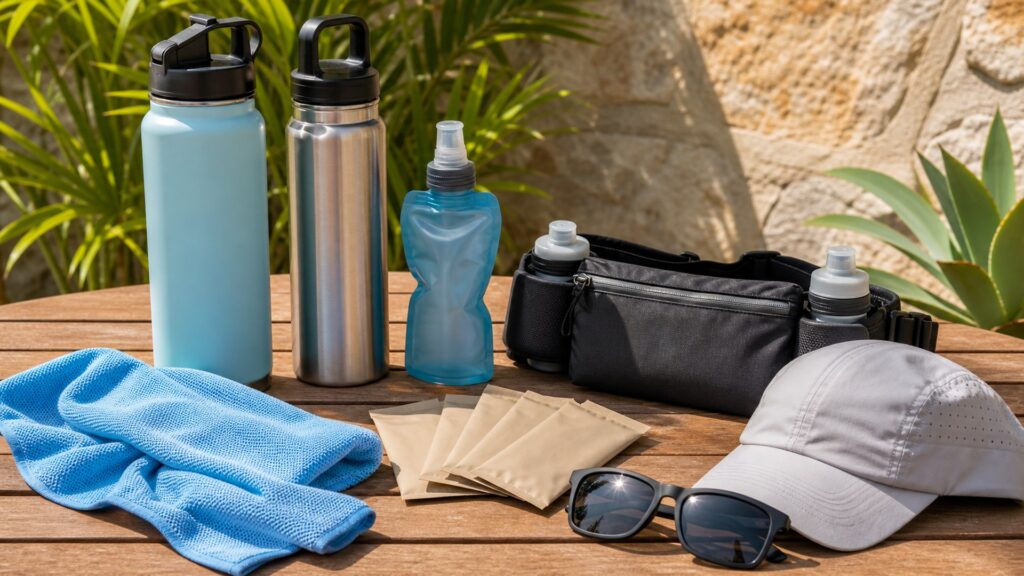
Buying framework
Put heat-risk decisions before equipment
Gear selection follows current conditions, an individualized plan, reliable support, food safety, and explicit stop and emergency actions.
Check conditions for the actual window: Review current temperature, humidity or heat index, sun exposure, wind, air quality where relevant, route surface, shade, and forecast changes. Reassess when the time, location, or workload changes.
Define work, rest, and support: Record activity intensity, duration, acclimatization, shaded breaks, supervision, communications, and nearby assistance. Follow current workplace, event, facility, or public-health guidance applicable to the setting.
Apply the individual plan: Use guidance appropriate to the athlete's health, medications, activity, and conditions. A bottle marking or product serving cannot independently determine what one person should consume.
Map potable refills and protected storage: Confirm every source, opening time, access rule, and backup. Keep food and drink within label storage directions and consider exposure before, during, and after the workout.
Write stop and emergency actions: Identify symptoms and circumstances that trigger stopping, cooling, assistance, or emergency services. Make the phone, identification, location details, and companion plan accessible before starting.
Who this is for
Match equipment to exposure and support
Direct-sun routes, humid conditions, dry heat, supported venues, and heat-sensitive users create different carrying and monitoring needs.
Direct-sun outdoor user: Check shade intervals, hot contact surfaces, container placement, exposed food, and whether the carrier covers a large body area. Include the approach and return trip in total exposure.
Humid-condition athlete: Sweat may remain on skin and fabric, making grip, chafing, closures, and drying harder. Test actual clothing and ensure mouthpieces, labels, and pocket contents remain controlled when damp.
Dry-heat participant: Do not let rapid sweat evaporation hide risk. Verify current guidance, support spacing, container heat exposure, wind, dust protection, and the reliability of remote communications.
Supported facility or event user: Confirm the facility's current cooling, water, aid, and emergency provisions. Know what remains personally required and whether queues, closures, or changed operations affect access.
Person with added health considerations: Seek appropriate professional guidance for medical conditions, medications, previous heat illness, or concerning symptoms. Choose gear only after the personal boundaries and response plan are clear.
What to pay attention to
Translate hot-weather features into observable tasks
Compare capacity, insulation, access, ventilation, labels, storage, and cleaning under realistic heat, sweat, and support conditions.
Capacity between verified sources: Use the individualized plan and longest dependable refill gap, then evaluate carried mass, fit, movement, and contingency. More volume does not replace breaks, cooling, monitoring, or emergency planning.
Insulation and temperature claims: Read what the product actually claims and under which conditions. Test whether added bulk fits the carrier and remember that insulation does not make temperature-sensitive food indefinitely safe.
Sweaty-hand operation: Wet hands should still distinguish, open, use, close, and replace each item. Check textured grips, cap force, valve control, zipper pulls, phone access, and retained wrapper storage.
Carrier coverage and friction: Observe contact at the neck, chest, waist, back, and shoulders, plus airflow around covered areas. Recheck fit as fabric becomes wet and containers become partly empty.
Potable refill workflow: Verify water source and rehearse filling without touching mouthpieces to taps, hands, or dirty surfaces. Follow any container, treatment, and local instructions relevant to the source.
Food labels and exposure: Keep ingredients, allergens, preparation, storage, and date information available. Track how long food leaves controlled storage and discard items when applicable safety guidance says they are unsuitable.
Cleaning and drying: Heat and residue increase the importance of prompt care. Open allowable components, clean valves, caps, hoses, seals, pockets, and utensils, then provide airflow until hidden surfaces are dry.
Avoid these traps
Do not use equipment to rationalize excess heat exposure
Common failures are ignoring changing conditions, carrying more instead of adding support, trusting insulation blindly, and lacking an emergency response.
Treating a large reservoir as protection: Capacity addresses only one logistics question. It does not control environmental heat, workload, acclimatization, rest, shade, medical factors, or access to help.
Checking weather only the night before: Hot-weather conditions and warnings can change. Recheck close to the activity and during long exposure, then apply the predetermined change, delay, relocation, or stop criteria.
Hiding supplies under packed layers: A carrier can contain enough yet make the next item inaccessible. Arrange essentials for wet-hand identification and access without unloading the system in direct sun.
Assuming cold-looking food is safe: Touch and appearance do not establish safe storage. Follow the product label and current food-safety guidance for time, temperature, handling, and disposal.
Responding to severe symptoms with a drink only: Concerning heat-related signs require the appropriate cooling and medical or emergency response. The written plan should identify who acts, how location is shared, and when emergency services are contacted.
Decision guidance
Run a heat-aware logistics rehearsal
Compare gear only in conditions permitted by the current plan, with support, communications, sweaty-hand tasks, partial loads, and cleanup represented.
Create a conditions card: Record current measures and warnings, time window, shade, workload, breaks, support, personal guidance, stop criteria, emergency contacts, and the nearest appropriate help.
Stage the full exposed load: Include containers, practiced food, phone, identification, sun and weather equipment, layers, waste storage, and any required safety items. Check what heats, leaks, rubs, or blocks airflow.
Test wet-hand access safely: In a controlled setting, wet hands and clothing as representative, then locate each essential item, operate its closure, use it, and secure it again. Move difficult actions to a break or support point.
Simulate a changed condition: Practice the planned response to a warning, failed refill, damaged container, lost shade, separated companion, or concerning symptom. Confirm the response does not depend on unavailable gear.
Complete same-day care: Inventory leftovers and exposure, handle food according to guidance, wash contacted parts, dry carriers and interiors, inspect heat or friction damage, and restore emergency information.
Ownership & compatibility
Keep heat-exposed gear clean and trustworthy
Sun, sweat, residue, and storage temperatures affect containers, food pockets, labels, electronics, elastic, and adhesives.
Inspect material changes: Look for distortion, cracking, tackiness, fading that affects markings, hardened seals, loose adhesive, stretched elastic, and damaged insulation. Follow manufacturer storage and replacement instructions.
Wash sweat and residue promptly: Clean body-contact fabric, closures, bottle threads, valves, hoses, and food compartments as directed. Keep cleaning chemicals and methods compatible with the product and drinking surfaces.
Dry before enclosed storage: Open pockets and permitted components, drain tubing, separate seals when directed, and establish airflow. Inspect beneath folds and insulation instead of judging dryness from the exterior.
Review emergency access: Keep phone protection, identification, location-sharing method, contacts, and response instructions current. Retest access after changing pockets, clothing, carriers, or companions.
Retire compromised items: Stop using a container or carrier that cannot seal, retain, clean, dry, identify, or tolerate its documented environment. Do not repair a heat-damaged food-contact item without approved instructions.
FAQ
Questions about gear in hot conditions
These answers keep equipment advice within the larger heat-risk plan.
Does a larger bottle make hot-weather training safe?
Should insulated bottles be used?
How should refill points be checked?
What gear works with sweaty hands?
Can food stay in a hot car?
Does a hydration vest make the body hotter?
What symptoms mean the workout should stop?
How often should heat-exposed gear be inspected?
What belongs in the emergency plan?
Bottom line
Let conditions govern the gear
Approve equipment only after the heat plan, support, access, food handling, and emergency response work together.
Assess first: Use current conditions, workload, personal factors, breaks, and applicable guidance to decide whether and how to proceed.
Verify support: Confirm potable sources, shade, communications, storage, and the response when any one becomes unavailable.
Test wet: Prove fit, airflow, identification, closure, and return actions with representative sweat and partial loads.
Respond, then reset: Follow the emergency plan when needed; afterward, handle leftovers, clean, dry, and inspect every exposed component.
Reading Shortcuts
Choose hot-weather gear inside a current risk-management plan.
Decision Reminders
Equipment is secondary to heat-risk decisions.
- Conditions: Recheck weather, workload, warnings, shade, and support.
- Person: Apply individual guidance and known health or medication considerations.
- Access: Prove every essential action with wet hands and clothing.
- Response: Keep stop, cooling, communication, and emergency actions explicit.
Glossary Snippets
Hot-weather planning terms used here.
When a Top 10 Helps
Use rankings only after conditions, support, and individual boundaries are established.
- Risk filter: Reject any arrangement that obstructs cooling, monitoring, communication, stopping, or access to help.
- Handling filter: Rank only gear proven for wet-hand access, secure carry, label visibility, and prompt cleaning.
No gear ranking can declare a hot-weather session safe, prescribe intake, or replace medical or emergency guidance.
When a Comparison Helps
Compare finalists with the same conditions card, full load, clothing, support assumptions, wet-hand tasks, and cleanup.
- During exposure: Compare fit, coverage, friction, access, temperature exposure, communication, and response readiness.
- After exposure: Compare leftover handling, washing, drying, material inspection, label preservation, and restocking.
Choose the simplest equipment that serves the approved plan without being mistaken for protection from heat illness.