
Ignition Components Buying Guide for High-Mileage Vehicle Repairs
High-mileage ignition repair is an evidence problem before it is a parts problem. Electrode wear can coexist with oil-contaminated wells, weak compression, injector imbalance, brittle connectors, voltage problems, and earlier repairs that changed the diagnostic picture.
Preserve every component by cylinder, compare the removed pattern, test the engine and circuit behind the misfire, and repair the environment that damaged the insulation. The completed job should establish a measured baseline for the next recurrence or maintenance interval.
Buying framework
Diagnose age-related evidence before replacing ignition parts
A high-mileage misfire can combine normal electrode wear with oil entry, compression loss, brittle wiring, charging weakness, or earlier repair errors. Preserve cylinder-specific evidence before creating a parts list.
Reconstruct the cylinder history: Capture codes, freeze-frame, misfire counters, cold and hot symptoms, load, fuel events, prior plug or coil work, oil use, and warning-lamp behavior. A fault that always remains on one cylinder deserves a different test path from one that follows a swapped coil.
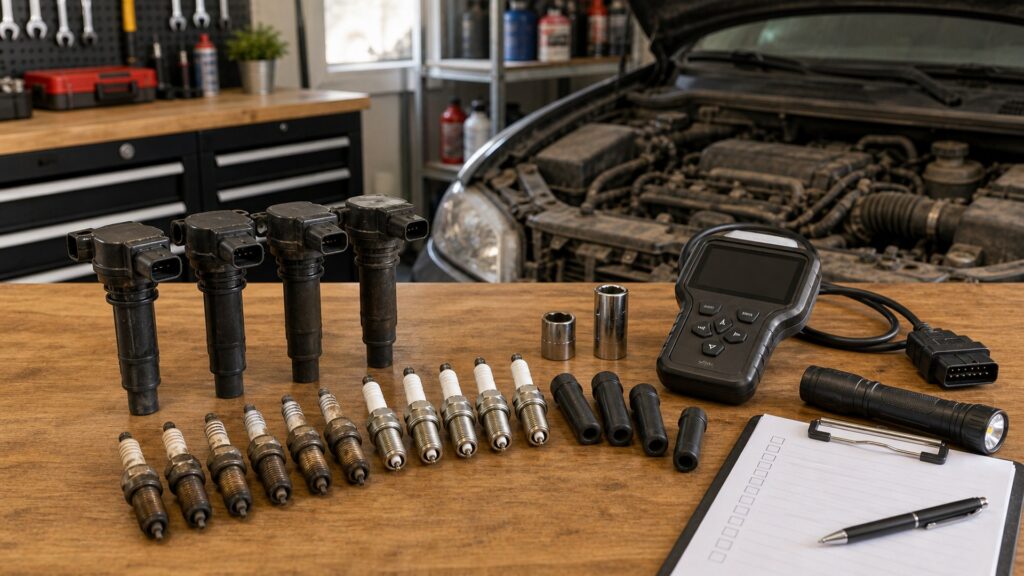
Remove and label parts methodically: Clean debris from the wells, then keep each plug, coil, boot, and wire identified by cylinder or tower. Compare gap, deposits, tracking, cracking, corrosion, oil, coolant, and terminal contact before cleaning changes the evidence.
Test the engine behind the ignition system: Use the vehicle procedure to evaluate compression, leak-down, injector contribution, vacuum leakage, fuel trim, and charging voltage when plugs and coils do not fully explain the pattern. A fresh plug can temporarily disguise a mechanical or fueling fault.
Correct the environment that aged the parts: Repair plug-tube seals, cover leaks, cowl water entry, damaged heat shielding, strained harnesses, weak grounds, and abnormal system voltage. Replacing insulation without removing oil, water, heat, or voltage stress invites a repeat failure.
Create a measurable repair baseline: Record plug numbers, gaps, coil tests, cylinder findings, torque source, connector repairs, and all post-repair counters. Verify cold start, hot restart, idle, acceleration, and the original load condition before treating the repair as complete.
Who this is for
High-mileage patterns require different repair depth
Uniform wear, one abnormal cylinder, contaminated wells, heat-related interruption, and missing history each place the diagnostic burden somewhere different.
Engines with uniformly worn plugs: When every plug shows comparable gap growth and deposits near the scheduled interval, a correct full set can restore the maintenance baseline. Still inspect boots, wells, threads, coils, and charging behavior rather than assuming age alone explains every symptom.
Vehicles with one persistent cylinder fault: A single-cylinder pattern needs comparison with neighboring cylinders and tests for plug, coil, injector, compression, wiring, and intake leakage. Do not replace an entire ignition set merely because broad access makes a parts package convenient.
Oil-contaminated plug-well engines: Oil around a coil boot can swell rubber, promote tracking, weaken terminal contact, and conceal the actual tube-seal failure. Price the leak repair, cleanup, affected insulation, and recheck together instead of installing dry-looking new coils into wet wells.
Heat-sensitive intermittent failures: Components, connectors, and harness conductors can open or leak only after heat soak. Save temperature and operating conditions, use approved thermal or electrical tests, and avoid condemning a coil from one cold-shop measurement.
Unknown-history used vehicles: Establish part numbers, plug condition, gap pattern, cylinder labeling, compression context, oil use, battery health, and previous wiring repairs before choosing scope. The goal is a trustworthy baseline, not automatic replacement of every aged-looking component.
What to pay attention to
Evidence that separates wear from another engine fault
High-mileage ignition selection depends on position-specific findings, mechanical context, contamination, insulation condition, circuit integrity, and stable supply voltage.
Combustion evidence
Labeled plugs, cylinder sealing, deposits, injector contribution, oil use, and fuel trim.
Electrical evidence
Coils, boots, harnesses, grounds, cranking voltage, charging stability, counters, and heat behavior.
Cylinder history: Map current and stored codes, freeze-frame, counters, prior repairs, and whether the symptom moves with an approved component swap. Position history prevents a recurring mechanical fault from being misread as several unrelated coil failures.
Removed spark-plug pattern: Compare electrodes, insulators, shell deposits, cracks, tracking, gap, wetness, and color across labeled cylinders. One outlier can indicate oil, coolant, fuel, compression, injector, or ignition imbalance that a uniform replacement set will not correct.
Compression and sealing context: Follow appropriate compression, relative-compression, running, or leak-down procedures when one cylinder remains weak. Interpret results with engine design, temperature, cranking speed, and neighboring cylinders rather than relying on a generic pressure number.
Oil and coolant entry: Identify whether contamination came through tube seals, cover gaskets, guides, rings, head sealing, intake paths, or a spill. External well oil damages boots differently from deposits formed inside the combustion chamber.
Coil and boot aging: Inspect case cracks, potting damage, swelling, spring corrosion, tower condition, carbon tracks, secondary leakage, and evidence of excessive plug gap. Replace the proven damaged pieces and correct the stress that produced the failure.
Harness and connector integrity: Look for brittle insulation, backed-out terminals, weak locks, rubbed conductors, ground corrosion, heat damage, and unsupported splices. Flex or load testing must follow service information so diagnosis does not create a new intermittent fault.
Battery and charging supply: Check cranking voltage, grounds, charging stability, and stored undervoltage events. Low or unstable supply can distort misfire diagnosis, coil charging, module behavior, and post-repair verification even when the high-voltage parts are correct.
Avoid these traps
High-mileage shortcuts that hide the root cause
The fastest-looking parts change often discards the very evidence needed to distinguish wear from a persistent cylinder or system fault.
Replacing every coil because one failed: Common age does not prove a common defect. Test the failed cylinder, compare companion coils, consider access and failure history, and explain any broader replacement choice without presenting it as a diagnostic certainty.
Throwing away unlabeled plugs: Once cylinder positions are lost, a unique oil, coolant, gap, or deposit pattern cannot be tied back to compression, injector, or coil data. Label and photograph parts before deciding what they mean.
Calling oil on the boot an ignition-only problem: A new boot may misfire again if the tube seal continues leaking. Repair the source, clean the well safely, inspect connector and coil damage, and verify that contamination has not entered the cylinder.
Using a colder plug to mask deposits: Heat range changes firing-end temperature and can create fouling or overheating when unsupported. Use the approved current plug and diagnose oil consumption, fueling, cooling, calibration, or mechanical wear behind abnormal deposits.
Clearing data before the road test: Save freeze-frame, counters, trims, and pending faults before clearing. Recreate the original heat and load conditions legally and safely; a smooth idle in the bay does not prove a load-dependent repair.
Decision guidance
Match parts scope to the high-mileage failure pattern
Choose the smallest complete repair that corrects measured wear, contamination, circuit damage, and related engine faults while creating a defensible baseline.
If all plugs show comparable scheduled wear: Install the exact approved plug set, inspect wells and boots, preserve gap and deposit notes, and use specified torque. Replace coils only for documented condition, an explicit service strategy, or an access decision the owner understands.
If the misfire stays with one cylinder: Test plug, coil, injector, compression, wiring, and local intake sealing in the prescribed order. Do not keep adding ignition parts after the evidence remains fixed to the cylinder.
If the fault follows a coil during approved testing: Confirm connector, boot, plug, well, supply, and swap method before replacing the verified coil. Retest both the original and donor cylinders so a disturbed connection is not mistaken for a conclusive move.
If plugs reveal oil, coolant, or abnormal deposits: Preserve the pattern and diagnose the fluid or combustion source before normal service. A new plug may be useful after repair, but it should not be presented as the cause correction.
If connectors or threads are deteriorated: Use supported terminal, pigtail, routing, and thread-repair procedures with appropriate tools. Stop when cylinder-head damage, inaccessible wiring, energized diagnosis, or programming exceeds the available equipment and experience.
Ownership & compatibility
Turn the repair into a high-mileage reference point
Positioned parts, measured results, and related repairs make a later recurrence far easier to interpret.
Keep a cylinder map: Record every plug, coil, boot, wire, code, counter, gap, deposit, and repair by cylinder or tower. Attach photographs before cleaning so later changes can be compared against the original pattern.
Document root-cause work: List compression findings, injector checks, oil or water leak repairs, harness work, grounds, battery condition, and charging results alongside the ignition parts. This prevents the surrounding repair from disappearing behind a parts receipt.
Monitor defined conditions: Recheck cold start, hot soak, idle, acceleration, fuel trims, counters, and warning behavior under the original conditions. Stop for a flashing lamp or severe misfire that could overheat the catalytic converter.
Set the next inspection: Use the approved plug interval plus actual oil use, leak history, operating severity, and diagnostic trends. Schedule an earlier inspection only for a documented reason rather than permanently shortening every future interval.
FAQ
High-mileage ignition repair FAQ
Answers about worn plugs, coils, deposits, compression, contamination, wiring, and verification on older engines.
Should every coil be replaced on a high-mileage engine?
What does one oily spark plug mean?
Can worn spark plugs damage ignition coils?
Why does a misfire return after new plugs?
Are deposits enough to choose a different heat range?
How should removed plugs be stored for diagnosis?
Can a resistance test prove an ignition coil is good?
When is compression testing warranted?
What proves a high-mileage ignition repair worked?
Bottom line
Repair the aged engine, not only the visible ignition part
High mileage increases the value of cylinder-specific evidence and related-system diagnosis; it does not justify replacing every component without proof.
Map the history: Keep codes, counters, prior repairs, and cylinder positions together.
Read removed parts: Compare labeled plugs, boots, coils, deposits, gaps, and contamination.
Test the engine context: Check compression, fueling, leaks, wiring, grounds, and voltage where evidence points.
Verify the original event: Retest cold, hot, idle, load, warnings, and counters before release.
Reading Shortcuts
Confirm application and condition first.
Decision Reminders
Checks to complete before committing.
- Confirm the exact application: Cross-check vehicle, engine, housing, and original part.
- Preserve removed-part clues: Contamination and damage can identify another fault.
- Keep the work clean: Keep downstream openings protected.
- Follow the procedure: Respect pressure, fluids, torque, priming, and resets.
- Inspect interfaces: Seals, caps, connectors, threads, and fittings must agree.
- Verify before release: Check leaks, warnings, starting, idle, and road behavior.
Glossary Snippets
Terms used in this decision.
When to Use a Top 10 Review
Use rankings after application and service scope are documented.
- Application confirmed: Filter with exact engine and interface evidence.
- Duty identified: Compare parts for the real interval and environment.
- Evidence published: Rank construction, testing, traceability, and support.
- Job scope complete: Include seals, fluids, tools, and verification.
Already down to 2–3 options? A Comparison is usually faster.
When to Use a Comparison
Compare finalists for the same verified application.
- Interfaces: Match dimensions, seals, valves, fittings, and connectors.
- Performance evidence: Compare documented efficiency, capacity, and service claims.
- Included content: List every seal, cap, sensor, boot, and fitting.
- Installed outcome: Price fluids, labor, priming, disposal, and downtime.
Still building a shortlist? Start with a Top 10.