
Ignition Components Buying Guide for Repair Shop Estimate Reviews
Ignition repair estimates often look comparable only because the totals sit at the bottom of the page. One quote may include diagnosis, exact plugs, intake gaskets, a verified coil, leak repair, and post-repair testing while another uses a broad tune-up line with none of that detail.
Normalize the complaint, findings, parts, labor, related repairs, fees, authorization, and warranty before choosing. A defensible estimate explains why each operation belongs and how the shop will prove that the original misfire or maintenance need has been resolved.
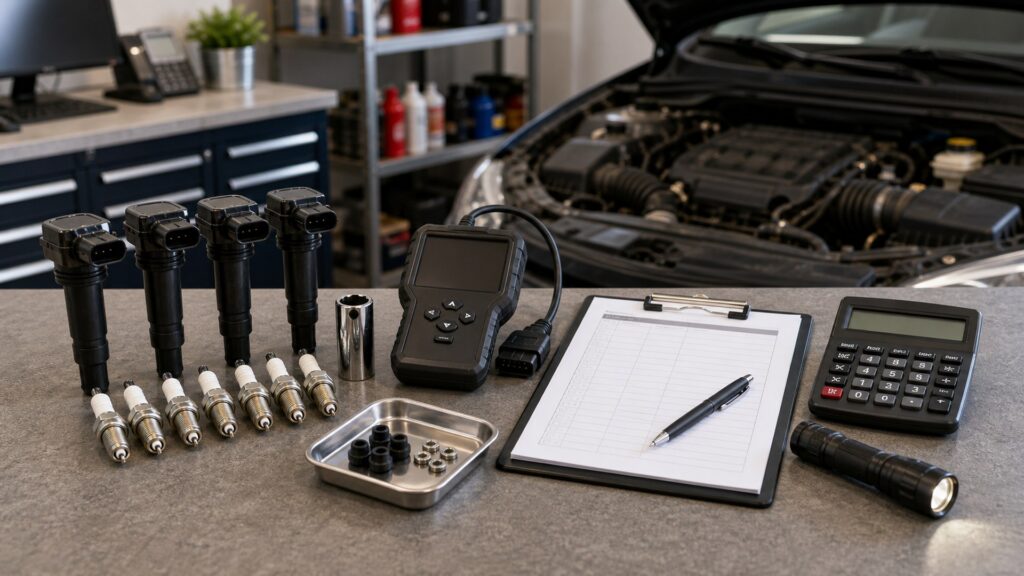
Buying framework
Normalize the estimate before comparing the total
Ignition estimates can mix diagnosis, scheduled maintenance, verified component failure, access work, leak repair, programming, and shop fees. Separate those layers so competing quotes describe the same job.
Start with the complaint and findings: Ask for the symptoms, operating conditions, codes, freeze-frame, counters, tests performed, and technician conclusion. A line reading misfire diagnosis is incomplete unless it explains which ignition, fuel, mechanical, or wiring evidence supports the recommendation.
Classify every proposed operation: Label each line as diagnosis, scheduled plug service, verified coil or boot replacement, wiring repair, access removal, related leak work, programming, supplies, or contingency. This prevents routine maintenance from being confused with fault correction.
Identify exact parts and quantities: Require maker, part number, plug specification, coil or boot contents, connectors, intake gaskets, seals, and cylinder quantity. A premium parts description cannot be compared when the actual line, included pieces, or application remains unstated.
Separate access from repair labor: List cowl or intake removal, difficult banks, seized-plug risk, thread-repair contingency, connector access, reassembly, and duplicated labor shared with leak or gasket work. Compare billed hours only after the operations are aligned.
Define authorization and release: Set the approved diagnostic ceiling, call-before-exceeding amount, old-parts return, programming, relearns, road test, warranty, and final evidence. No additional coil, injector, compression, or thread work should appear without a documented finding and approval.
Who this is for
Estimate structure changes with the ignition complaint
Scheduled service, one-cylinder misfire, broad coil proposals, wiring damage, and fluid-contaminated wells require different evidence and billing categories.
Scheduled spark-plug customers: The estimate should identify the approved plug set, access gaskets, cleaning, torque procedure, inspection, and verification. Diagnostic labor needs its own justification when the vehicle has no complaint and the work is purely scheduled maintenance.
Single-cylinder misfire customers: Look for cylinder-specific codes, counters, plug and coil tests, injector or compression context, and an explanation of why the proposed part corrects the fault. A code number alone does not substantiate a coil line.
Owners quoted every ignition coil: Ask whether broader replacement is required, recommended for access, chosen because of failure history, or simply packaged by policy. Compare the cost of verified single-part repair, full access repetition, and warranty coverage transparently.
Vehicles needing connector or harness work: The quote should name pigtails, terminals, conductor repair, seals, routing, diagnostic time, and pinout verification. Generic electrical repair language makes it impossible to compare workmanship, materials, or responsibility for an intermittent fault.
Engines with oil-filled plug wells: Separate cover or tube-seal repair, cleanup, damaged boots or coils, scheduled plugs, access overlap, and leak verification. Installing ignition parts without correcting the fluid source is an incomplete estimate, not a lower-priced equivalent.
What to pay attention to
Eight estimate fields that determine comparable scope
A useful quote shows why service is needed, what exact parts are included, how access and diagnosis are billed, and how the shop will verify and warrant the result.
Technical scope
Complaint, tests, exact parts, related causes, programming, and release evidence.
Commercial scope
Labor overlap, supplies, taxes, authorization ceilings, old parts, and warranty responsibility.
Service reason: Distinguish scheduled maintenance, stored-code investigation, active misfire, no-start, intermittent heat fault, water entry, oil contamination, or customer-requested preventive work. Each reason supports a different diagnostic and parts scope.
Diagnostic operations: Identify scan review, freeze-frame, counters, circuit checks, approved swaps, scope or current tests, compression, injector evaluation, smoke testing, and road diagnosis. A diagnostic fee should correspond to work that narrows the cause.
Exact ignition parts: List plug number and material, coil brand and quantity, boots, springs, wires, connectors, modules, seals, and access gaskets. Require current application confirmation rather than accepting an undefined tune-up or premium coil package.
Labor and access: Show base plug or coil labor, intake and cowl work, transverse-bank access, harness repair, programming, road testing, and any labor overlap. Clarify whether seized plugs, broken fasteners, or thread damage require a new authorization.
Related-system repairs: Keep cover gaskets, tube seals, cowl drainage, injector work, compression findings, vacuum leakage, battery or charging faults, and catalyst concerns separate. The shop should explain which are causes, consequences, or unrelated recommendations.
Programming and relearns: State whether coil or module coding, battery support, adaptation, throttle or idle relearn, code clearing, monitor completion, or a drive cycle applies. Do not pay a programming line that cannot be tied to the vehicle procedure.
Warranty, fees, and authorization: Record parts and labor term, shop supplies, taxes, owner-supplied-parts exclusions, diagnostic responsibility, return requirements, and call-before-exceeding rules. Know who pays repeat access if the same verified fault returns.
Avoid these traps
Estimate comparisons that reward incomplete work
A lower total can hide missing diagnosis, unlisted parts, duplicated access, omitted leak repair, or a weak warranty; a higher total can also conceal unjustified parts replacement.
Comparing totals before line items: Two estimates are not comparable when one includes diagnosis, gaskets, leak repair, programming, and verification while another lists only coils. Normalize parts, labor, fees, and release work first.
Treating the code as the diagnosis: A cylinder misfire code does not identify coil, plug, injector, compression, wiring, or vacuum cause. Ask which test and finding supports each part line before authorizing replacement.
Accepting premium without a part number: Premium can refer to electrode material, warranty, packaging, or margin. Require exact numbers and quantities so fitment, construction, seller price, and warranty can be independently checked.
Paying duplicated access unnoticed: Intake, cowl, or bank access may overlap plug, coil, leak, and connector operations. Ask the shop to show labor sharing rather than comparing flat hours that repeat the same removal.
Authorizing open-ended parts substitution: Set a diagnostic and price ceiling, require a call with new evidence, and preserve old parts. A parts-cannon sequence should not continue simply because the next component is nearby.
Decision guidance
Choose the estimate with the clearest causal chain
The best quote links complaint to tests, findings to exact parts, parts to complete access, and release checks to a defined warranty.
If both shops agree on scheduled plugs: Compare exact plug number, access gaskets, labor, inspection, torque procedure, and verification. Treat coil replacement as a separate optional or condition-based line unless the schedule or observed damage supports it.
If one shop recommends a single coil: Ask for cylinder evidence, plug and boot condition, connector checks, and the test that isolated the coil. Favor the quote that also retests the original condition and documents pending faults and counters.
If one shop recommends all coils: Compare access cost, age, failure history, part quality, labor overlap, and warranty. The broader scope may be reasonable, but it should be presented as risk management rather than a proven simultaneous failure.
If oil or water is found in wells: Select a scope that corrects the entry path, cleans safely, replaces damaged insulation, and verifies the leak and misfire. A cheaper ignition-only estimate leaves the causal condition active.
If the diagnosis remains uncertain: Authorize a bounded next test, not a speculative part. Ask what result will confirm or exclude compression, injector, wiring, control, or vacuum causes and how the estimate changes after that evidence.
Ownership & compatibility
Keep the final invoice useful for future diagnosis
The completed record should show the original complaint, measured cause, exact repair, authorization changes, and post-repair result.
Save the diagnostic narrative: Keep codes, freeze-frame, counters, test results, technician conclusion, and rejected alternatives. A one-line paid invoice loses the reasoning needed if the misfire returns.
Record exact installed content: List part numbers, quantities, cylinder locations, plugs, coils, boots, wires, pigtails, seals, gaskets, and programming. Note returned parts and any core or evidence retained by the shop.
Reconcile estimate to invoice: Review added labor, supplies, taxes, contingencies, and authorization timestamps before payment. Confirm that overlapping access and declined work are represented accurately.
Store warranty and release results: Keep cold and hot verification, road test, counters, warnings, relearns, parts and labor terms, and contact instructions. Follow the authorization process before another shop disturbs a possible warranty repair.
FAQ
Ignition repair estimate FAQ
Answers about diagnostic fees, coil proposals, labor overlap, shop supplies, programming, old parts, and warranty.
Why is diagnostic labor separate from replacing the coil?
Does a misfire code justify a coil estimate?
Why would a shop recommend every ignition coil?
Should intake-removal labor be charged twice?
What should a plug-service estimate name?
Are shop supplies legitimate on ignition work?
When is programming required after ignition repair?
Can I ask for the old ignition parts back?
What makes one repair warranty better?
Bottom line
Buy the best-explained repair, not the shortest estimate
A credible ignition estimate aligns diagnosis, exact parts, access, related causes, authorization, verification, and warranty in one traceable scope.
Require the finding: Connect every recommended part to a test or scheduled requirement.
Normalize the scope: Separate diagnosis, parts, access, related repairs, fees, and programming.
Control changes: Set approval limits and require new evidence before expanding work.
Keep the release record: Save the final invoice, counters, road check, and warranty terms.
Reading Shortcuts
Confirm application and condition first.
Decision Reminders
Checks to complete before committing.
- Confirm the exact application: Cross-check vehicle, engine, housing, and original part.
- Preserve removed-part clues: Contamination and damage can identify another fault.
- Keep the work clean: Keep downstream openings protected.
- Follow the procedure: Respect pressure, fluids, torque, priming, and resets.
- Inspect interfaces: Seals, caps, connectors, threads, and fittings must agree.
- Verify before release: Check leaks, warnings, starting, idle, and road behavior.
Glossary Snippets
Terms used in this decision.
When to Use a Top 10 Review
Use rankings after application and service scope are documented.
- Application confirmed: Filter with exact engine and interface evidence.
- Duty identified: Compare parts for the real interval and environment.
- Evidence published: Rank construction, testing, traceability, and support.
- Job scope complete: Include seals, fluids, tools, and verification.
Already down to 2–3 options? A Comparison is usually faster.
When to Use a Comparison
Compare finalists for the same verified application.
- Interfaces: Match dimensions, seals, valves, fittings, and connectors.
- Performance evidence: Compare documented efficiency, capacity, and service claims.
- Included content: List every seal, cap, sensor, boot, and fitting.
- Installed outcome: Price fluids, labor, priming, disposal, and downtime.
Still building a shortlist? Start with a Top 10.