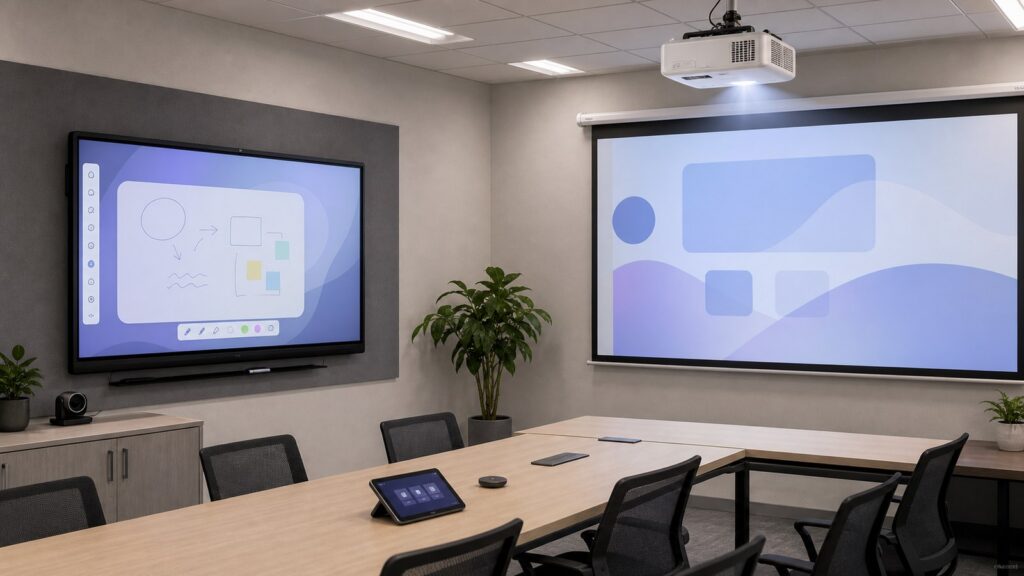
The display-versus-projector decision starts with how people use the room. We weighted touch collaboration, image size, brightness, maintenance, installation, portability, audio planning, viewing distance, support workload, and whether the room is used for active collaboration or simple presentation. Practically speaking.
Collaboration workflow: Interactive displays lead when users need to annotate, whiteboard, share content, and work directly on the screen. That is valuable in training rooms, classrooms, huddle rooms, and hybrid collaboration spaces where the display is part of the workflow. Practically speaking.
Image size: Projectors still have a strong argument when the business needs a very large image for a bigger room. A projector can scale beyond typical flat-panel sizes, but the buyer must manage throw distance, ambient light, screen surface, focus, and alignment.
Maintenance and support: Interactive displays are often easier to support day to day because the screen position and brightness are fixed. Projectors can require more attention around lamps or laser life, mounting, cable routing, filters, calibration, remote controls, and room lighting. Practically speaking.
Room flexibility: Portable projectors can move between rooms and support temporary setups. Interactive displays are better when the room deserves a permanent collaboration endpoint. Facilities teams should decide whether flexibility or repeatability matters more to daily use. That keeps rollout planning practical.
Total room design: Both choices may need audio, camera, conferencing, cabling, power, wireless sharing, and accessibility planning. A display is not automatically a complete room solution, and a projector is not automatically cheaper once the mount, screen, labor, and support are included. Today.
Final choice: Interactive displays earn the default edge for modern business rooms because collaboration, annotation, and consistent setup are increasingly important. Projectors remain the better fit for large presentation rooms or portable spaces where touch is not central. That keeps planning practical.