
Interior Comfort Buying Guide for All-Weather Interior Use
Weather changes the cabin before the climate system catches up. Summer sun heats seats, controls, and glass; winter stiffens materials and increases powered-accessory demand; rain and wet clothing raise humidity and window fog; shoulder seasons invite accessories to remain installed after their useful period. Comfort depends on managing those transitions.
Use the vehicle's HVAC, defrost, seat heat, ventilation, and parked-shade options as the baseline. Add only products whose temperature range, restraint compatibility, power demand, and storage method are known. Test them at the coldest and hottest realistic conditions, with wet clothing and occupied seats. Preserve windshield and mirror views, all air outlets, and a clear path to remove or secure seasonal items before driving.
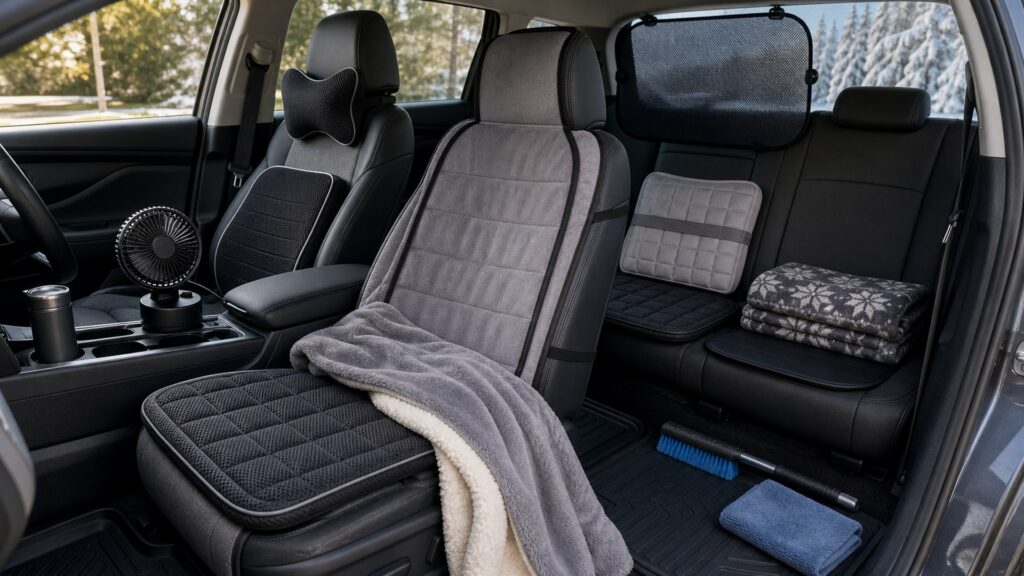
Buying framework
Set the all-weather cabin comfort baseline before buying
Convert the desired all-weather cabin comfort improvement into physical, functional, and maintenance requirements.
Build four seasonal scenarios: Describe hot parked entry, cold morning start, humid rain with wet occupants, and a mild transition day including trip length and parking.
Map factory climate tools: Record remote conditioning where equipped, HVAC modes, defrost, recirculation, heated and ventilated seats, heated wheel, vents, and window features.
Assign accessory limits: Document airbag and sensor restrictions, temperature range, surface heat, power rating, cord route, visibility state, drying need, and storage location.
Schedule spring and fall resets: Remove expired seasonal gear, inspect surfaces and wiring, clean and dry textiles, replace filters as required, and retest views and controls.
Who this is for
Match the solution to the all-weather cabin comfort user
Different bodies, occupants, routes, climates, and cabin layouts justify different all-weather cabin comfort priorities.
Hot-sun commuter: Parking choices, exterior shade, removable windshield protection, breathable contact surfaces, fast ventilation, and low-glare materials lead.
Cold-climate driver: Warm touchpoints, factory heat, gloves, flexible materials, safe power, and a clear defrost path matter before plush thickness.
Humid or rainy-region household: Moisture management, washable fabrics, wet-gear containment, fresh-air exchange, glass clearing, and complete drying reduce discomfort.
Four-season road traveler: Compact labeled storage and quick seasonal reconfiguration keep shades, blankets, pads, cables, and cleaning tools from becoming clutter.
What to pay attention to
Evidence that predicts all-weather cabin comfort performance
Specifications matter only when translated into what changes inside the exact vehicle during all-weather cabin comfort use.
Thermal and Moisture Control
Manage sunlight, hot surfaces, cold starts, humidity, fog, wet clothing, airflow, and drying without creating new condensation or blocked vents.
Seasonal Accessory Behavior
Test material stiffness and heat, powered loads, cords, shade securement, seat systems, storage, odor, and fit at weather extremes.
Hot-cabin behavior: Check surface temperature, odor, softening, adhesive release, color transfer, dashboard reflection, shade fit, and touch safety after sun exposure.
Cold-start behavior: Observe stiffness, brittleness, slow foam recovery, connector strain, controller operation, glove usability, and secure placement before motion.
Moisture handling: Compare breathability, absorption, waterproof barriers, drying time, odor, mold risk, and whether wet layers contact heaters, wiring, or sensors.
HVAC and defrost clearance: Keep dashboard, windshield, console, floor, and under-seat outlets unobstructed; accessory airflow should not compromise glass clearing.
Seasonal electrical load: Review socket and USB ratings, simultaneous heater or fan use, fuse capacity, plug temperature, automatic shutoff, and cold-battery conditions.
Weather-state storage: Parked shades, blankets, gloves, fans, cords, wet bags, and removed cushions need restrained locations that preserve cargo and passenger space.
Avoid these traps
Mistakes that compromise all-weather cabin comfort
Convenience becomes a defect when an add-on alters controls, restraints, airbags, visibility, airflow, or secure storage.
Driving with a parked windshield shade partly installed: Any obstruction can compromise forward vision and may detach; remove and secure parked-only products before vehicle movement.
Blocking defroster outlets with a dash accessory: Reduced glass-clearing airflow can worsen visibility exactly when humidity or ice is highest.
Layering a heated pad over an incompatible seat: Combined heat, insulation, sensors, wiring, and airbag restrictions can create damage or injury; follow both manufacturers' guidance.
Sealing wet fabric beneath a waterproof cover: Trapped moisture encourages odor and hidden deterioration; remove, clean, ventilate, and dry the original surface fully.
Decision guidance
Choose a defensible all-weather cabin comfort path
Select the least intrusive option that proves the required all-weather cabin comfort outcome under representative conditions.
For summer heat: Prioritize shade while parked, safe ventilation, breathable surfaces, and reflection control before adding powered cooling devices.
For winter cold: Use factory heating and defrost first, then evaluate a rated removable product with proven seat compatibility and circuit capacity.
For rain and humidity: Improve wet-item containment, air exchange, glass clearing, textile drying, and spill access rather than masking damp odor.
For four-season simplicity: Keep a small set of labeled products with distinct install and storage states, and remove each when conditions no longer justify it.
Ownership & compatibility
Maintain the all-weather cabin comfort result
Inspection, cleaning, adjustment, records, and replacement keep the original all-weather cabin comfort decision valid.
Inspect after extreme temperatures: Look for warped shades, curled pads, hardened straps, softened adhesive, hot plugs, cracked insulation, foam change, odor, and color transfer.
Dry the cabin deliberately: Remove wet gear, expose hidden surfaces, use safe airflow, clean residues, and investigate recurring moisture or fog beyond normal weather.
Complete seasonal changeover: Test every retained product, discard failures, update power and storage maps, restore vents and visibility, and document the next-weather configuration.
FAQ
Questions to resolve for all-weather cabin comfort
Use exact vehicle documentation and product instructions to settle these points.
What is the best way to reduce summer cabin heat?
Can a heated seat pad be used on factory heated seats?
Do cooling seat covers work with ventilated seats?
How can windshield fog be reduced in wet weather?
What materials remain comfortable in both heat and cold?
Where should wet coats and umbrellas be stored?
Can portable fans attach to dashboard vents?
Why do seasonal accessories smell after storage?
What belongs in a seasonal comfort reset?
Bottom line
Preserve safety while improving all-weather cabin comfort
A successful upgrade remains compatible, removable, understandable, and safe throughout ownership.
Plan by weather state: Separate summer sun, winter cold, humid rain, and seasonal transitions instead of buying one universal comfort claim.
Preserve climate and safety systems: Keep airbags, sensors, seats, defroster outlets, HVAC flow, glass, mirrors, controls, and electrical limits intact.
Reset twice a year: Remove stale accessories, inspect heat and moisture effects, dry materials, test power, and secure the next seasonal kit.
Reading Shortcuts
Move through the seasonal cabin comfort decision in order.
Decision Reminders
All-weather comfort requires distinct heat, cold, and moisture tests.
- Build four seasonal scenarios: Verify and record this requirement.
- Map factory climate tools: Verify and record this requirement.
- Assign accessory limits: Verify and record this requirement.
- Inspect after extreme temperatures: Verify and record this requirement.
- Dry the cabin deliberately: Verify and record this requirement.
- Complete seasonal changeover: Verify and record this requirement.
Glossary Snippets
Terms used in this comfort accessory plan.
When to Use a Top 10 Review
Use rankings only after the requirements are fixed.
- Plan by weather state: Use this as a shortlist filter.
- Preserve climate and safety systems: Use this as a shortlist filter.
- Reset twice a year: Use this as a shortlist filter.
- Exclude: Use this as a shortlist filter.
Already down to 2–3 options? A Comparison is usually the faster next step.
When to Use a Comparison
Compare finalists through the seating, belt, airbag, sensor, control-reach, visibility, airflow, securement, power, and removal trial; make solar heat load an explicit recorded result.
- Build four seasonal scenarios: Check both candidates against this requirement.
- Map factory climate tools: Record the result for each shortlisted option.
- Assign accessory limits: Use the same operating conditions for both tests.
- Schedule spring and fall resets: Keep the evidence with the final decision.
Still exploring? Start with a Top 10 to build a shortlist first.