
Interior Comfort Buying Guide for Family Vehicle Organization
Family comfort items travel through the cabin. A blanket moves from a child seat to the floor, a charging cable crosses a walkway, a shade remains on a window needed for a shoulder check, and an overloaded organizer presses against the front seat. The problem is not the individual product; it is the changing layout during ordinary transitions.
Create one passenger zone at a time. Keep child-restraint anchors and tether routes exactly as required, preserve side and curtain airbag areas, limit organizer loads, maintain rear airflow and window visibility, and secure every unused item. Walk through boarding, buckling, front-seat adjustment, third-row entry, cleanup, cargo conversion, and an emergency exit. Reset the layout whenever occupants or seats change.
Buying framework
Set the family cabin comfort baseline before buying
Convert the desired family cabin comfort improvement into physical, functional, and maintenance requirements.
Assign every seating zone: Record occupant age and size, restraint, belt and buckle, airbag areas, leg space, vent, window, charging need, comfort item, and storage limit.
Map family transitions: Observe door entry, child-seat loading, buckle help, stroller transfer, front-seat movement, third-row passage, snack cleanup, folding, and nighttime unloading.
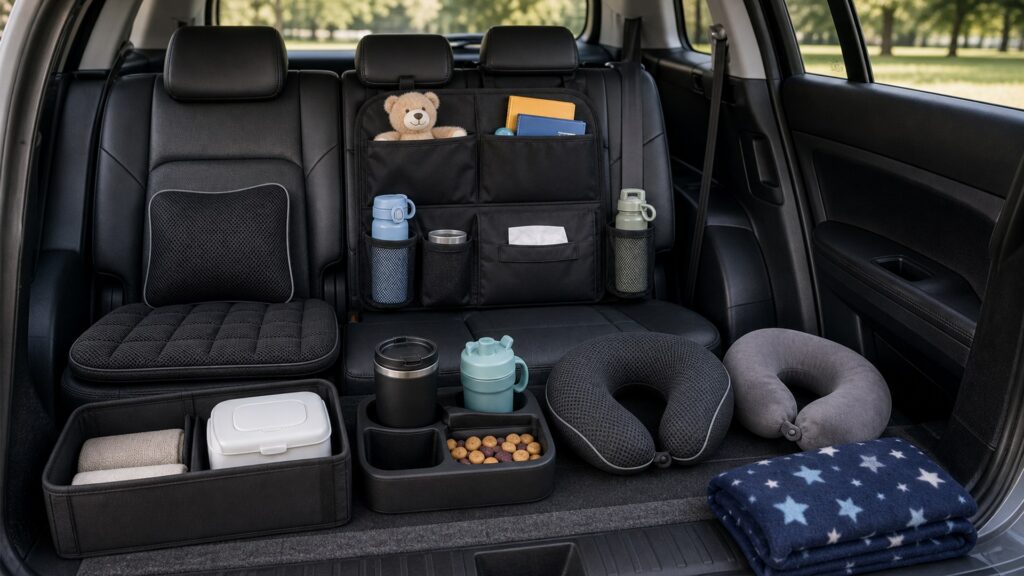
Create secure homes for items: Give pillows, blankets, tablets, cables, wipes, trash, and spill tools closed or restrained storage outside controls and deployment zones.
Write a reset checklist: Remove loose objects, restore shades and cables, inspect restraints and floor, reopen vents and exits, and confirm the driver's views before departure.
Who this is for
Match the solution to the family cabin comfort user
Different bodies, occupants, routes, climates, and cabin layouts justify different family cabin comfort priorities.
Infant or toddler household: Restraint instructions, support-leg or tether space, caregiver access, rear airflow, sun control, and spill handling outrank entertainment storage.
School-age family: Individual small-item storage, device power, shade discipline, washable surfaces, and clear buckle paths reduce cabin conflict.
Three-row vehicle owner: Entry aisles, sliding seats, vents, tethers, folded-seat states, and secure stowage for temporarily removed accessories require deliberate planning.
Pet-and-child household: Separate restraint and carrier zones, preserve airflow, control hair and moisture, and prevent leashes or supplies from becoming loose cabin hazards.
What to pay attention to
Evidence that predicts family cabin comfort performance
Specifications matter only when translated into what changes inside the exact vehicle during family cabin comfort use.
Passenger Zones
Assign comfort and storage around child restraints, belts, airbags, windows, vents, legs, third-row paths, and different ages without sharing loose items.
Cabin Transitions
Test boarding, buckling, front-seat movement, child-seat access, row folding, cargo changes, cleaning, and emergency exit with the system in place.
Restraint-space compatibility: No organizer, cushion, mat, or storage bin should alter required child-seat contact, lower anchors, tether routing, support legs, buckles, or seatback position.
Shade field of view: Rear shades need secure mounts and must preserve driver sight lines, passenger supervision needs, window operation, and curtain-airbag paths.
Seatback loading: Check attachment points, maximum intended weight, hard-object placement, front-seat airbag seams, adjustment, rear-knee clearance, and crash-time retention.
Cable management: Use short supported routes outside seat rails, buckles, child-seat paths, doors, walkways, pedals, heating surfaces, and pinch points.
Airflow distribution: Keep rear outlets open, avoid directing extreme air at one occupant, and retest flow when seats, blankets, carriers, or organizers move.
Cleaning resilience: Choose surfaces and storage that release food, sunscreen, pet residue, and drink spills without harsh chemicals or long damp periods.
Avoid these traps
Mistakes that compromise family cabin comfort
Convenience becomes a defect when an add-on alters controls, restraints, airbags, visibility, airflow, or secure storage.
Hanging hard objects at head level: Tablets, bottles, toys, or hooks can move violently; follow product loading rules and favor secured low-mass storage.
Routing a top tether around an organizer: The restraint manufacturer and vehicle specify the path; remove conflicting comfort storage rather than redirecting safety hardware.
Leaving cables across the third-row aisle: Passengers can trip or pull connectors during entry; reroute, shorten, or disconnect them before the path is used.
Treating every rear window as shade space: Some windows support driver visibility, curtain airbags, emergency exit, or defogging; verify the exact location and use state.
Decision guidance
Choose a defensible family cabin comfort path
Select the least intrusive option that proves the required family cabin comfort outcome under representative conditions.
Build around restraints first: Install and verify required child seats, belts, and passenger settings before allocating shade, storage, devices, or soft comfort items.
Use one organizer per defined need: Choose restrained capacity for a named item set instead of filling every seatback and door area with possible storage.
Choose removable climate aids: Select shades, blankets, or airflow accessories that store securely and can be reset quickly as weather and occupants change.
Protect transition paths: Remove or relocate any accessory that complicates boarding, buckle access, sliding seats, third-row movement, cargo conversion, or emergency exit.
Ownership & compatibility
Maintain the family cabin comfort result
Inspection, cleaning, adjustment, records, and replacement keep the original family cabin comfort decision valid.
Reset after each passenger change: Reassign zones, remove abandoned items, check shades and cables, restore vents and views, and verify restraint and buckle access.
Inspect organizer attachments: Watch stretched straps, broken clips, overloaded pockets, sharp contents, seatback abrasion, and encroachment on airbags or controls.
Update as children grow: Revisit restraints, legroom, reach, entertainment, airflow, storage, and independence whenever seating equipment or passenger size changes.
FAQ
Questions to resolve for family cabin comfort
Use exact vehicle documentation and product instructions to settle these points.
Can a seatback organizer touch a child restraint?
Are suction-cup window shades safe?
Where should charging cables run in a family car?
Can blankets remain on a child safety seat?
How much weight can a seatback organizer hold?
Should rear vents be covered to reduce drafts?
How can a third-row aisle stay comfortable?
Where should a spill kit be stored?
When should the family layout be redesigned?
Bottom line
Preserve safety while improving family cabin comfort
A successful upgrade remains compatible, removable, understandable, and safe throughout ownership.
Zone around people and restraints: Assign comfort, shade, airflow, charging, and storage only after every occupant's safety interfaces are clear.
Practice cabin transitions: Test boarding, buckling, sliding, third-row access, cleanup, folding, cargo changes, and emergency exit.
Reset before driving: Secure loose objects, shorten cables, clear vents and views, inspect organizers, and restore the driver's control environment.
Reading Shortcuts
Move through the family comfort zoning decision in order.
Decision Reminders
Family organization is safest when every transition has a reset.
- Assign every seating zone: Verify and record this requirement.
- Map family transitions: Verify and record this requirement.
- Create secure homes for items: Verify and record this requirement.
- Reset after each passenger change: Verify and record this requirement.
- Inspect organizer attachments: Verify and record this requirement.
- Update as children grow: Verify and record this requirement.
Glossary Snippets
Terms used in this comfort accessory plan.
When to Use a Top 10 Review
Use rankings only after the requirements are fixed.
- Zone around people and restraints: Use this as a shortlist filter.
- Practice cabin transitions: Use this as a shortlist filter.
- Reset before driving: Use this as a shortlist filter.
- Exclude: Use this as a shortlist filter.
Already down to 2–3 options? A Comparison is usually the faster next step.
When to Use a Comparison
Compare finalists through the seating, belt, airbag, sensor, control-reach, visibility, airflow, securement, power, and removal trial; make child-restraint clearance an explicit recorded result.
- Assign every seating zone: Check both candidates against this requirement.
- Map family transitions: Record the result for each shortlisted option.
- Create secure homes for items: Use the same operating conditions for both tests.
- Write a reset checklist: Keep the evidence with the final decision.
Still exploring? Start with a Top 10 to build a shortlist first.