
Interior Organization Buying Guide for All-Weather Interior Use
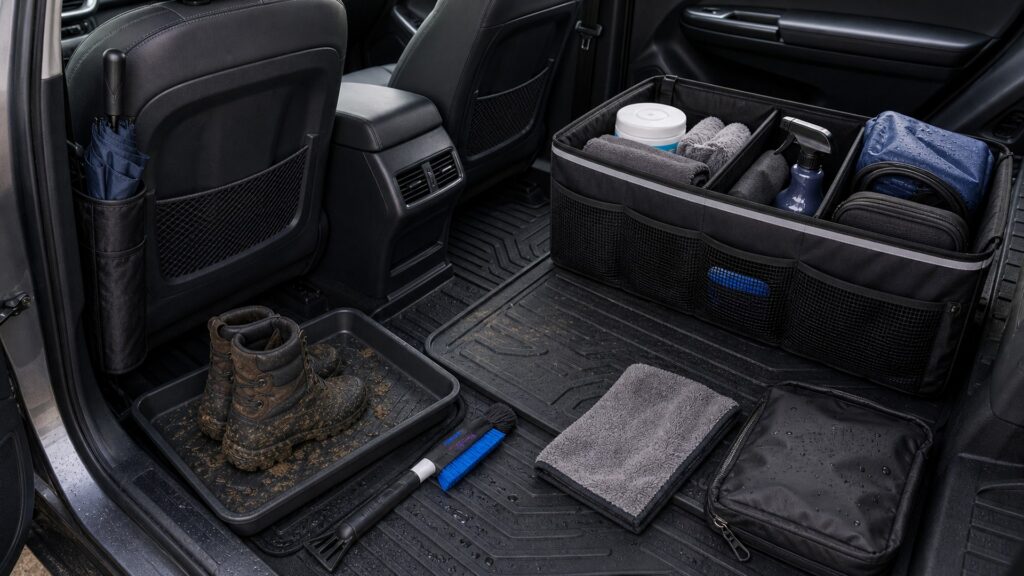
Weather changes both the inventory and the organizer. Winter adds gloves, scrapers, damp hats, salt, and stiff closures; rain adds umbrellas and wet clothing; summer heat can soften shells, release adhesive, and overheat stored electronics. A closed bin may contain mess while also preventing it from drying.
Build separate hot, cold, and wet-entry scenarios. Verify material limits, operate closures with gloves, inspect shape after safe temperature exposure, and load the actual water and grit likely to enter. Keep defroster and HVAC outlets clear and never store shades where they can impair driving visibility. Every wet container needs a removal, drain, cleaning, and drying path. At spring and fall changeovers, empty the cabin, reveal hidden surfaces, remove salt, and.
Buying framework
Define the all-weather organization job before shopping
Turn the all-weather organization goal into measurable zones, loads, access rules, and safety exclusions.
Weather inventory: List hot-season shades and hydration, cold-season gloves and scrapers, rain gear, wet textiles, pet supplies, cleaners, and emergency items.
Exposure scenarios: Define parked heat, freezing start, rainy passenger entry, snow and salt carry-in, mud, humidity, and the time available before drying.
Climate exclusions: Keep windshield and mirror views, defroster outlets, dashboard sensors, face and floor vents, under-seat ducts, and seat features unobstructed.
Seasonal capacity: Limit each weather module to named contents with enough room to close securely when gloves, textiles, or tools are wet and bulky.
Who this is for
Match storage to the people using it
Different occupants and routines place different demands on all-weather organization products.
Hot-climate commuter: Prioritize heat-stable low-glare storage, removal of sensitive contents, safe shade stowage, hydration control, and unblocked ventilation.
Snowbelt household: Cold-flex closures, glove-friendly handles, brine-resistant liners, wet-gear capacity, and frequent hidden-surface checks lead.
Rainy-region pet owner: Use removable washable containment for wet coats, umbrellas, paws, towels, and odor while preserving airflow and rapid drying.
Four-season traveler: Compact complete modules and a twice-yearly reset prevent weather supplies from accumulating into unsecured year-round clutter.
What to pay attention to
Evidence that predicts all-weather organization performance
Judge specifications by what they change in the exact vehicle during all-weather organization use.
Weather Exposure
Test organizer materials, closures, liners, and contents under realistic hot, cold, wet, muddy, salty, and humid conditions.
Cabin Climate Interaction
Preserve defrost, HVAC outlets, glass visibility, seat features, drainage, drying, and secure off-season storage.
Temperature behavior: Confirm documented material range and inspect shells, fabric, elastic, adhesive, foam, closures, and labels after realistic heat or cold.
Wet containment: Compare seam and liner leakage, upright stability, umbrella length, meltwater volume, removal path, and spill risk while carrying the load out.
Drying access: The entire organizer should open, separate, drain, clean, and dry while the underlying carpet or trim remains visible for inspection.
Salt and mud release: Choose surfaces whose corners, texture, stitching, and fasteners can be cleaned without trapping abrasive grit or concentrated brine.
Gloved operation: Test lids, zippers, handles, labels, cables, latches, and item retrieval with the winter hand protection actually used.
Off-season restraint: Clean and dry removed modules, store them without distortion, label contents, and secure or remove any kit kept aboard out of season.
Avoid these traps
Errors that undermine all-weather organization
A convenient container fails when it creates movement, interference, or distraction within the all-weather organization layout.
Sealing wet gloves in an airtight bin: Containment without drying promotes odor and hidden moisture; unload, open, clean, and dry after the trip.
Parking electronics inside an insulated organizer: Insulation can slow temperature change but does not control extreme cabin heat or cold; remove sensitive devices.
Blocking floor vents with a weather tote: Reduced airflow can impair comfort or glass-clearing performance; preserve every specified HVAC outlet.
Leaving the winter kit installed all summer: Unused scrapers, blankets, traction aids, and cords consume space and become loose inventory unless deliberately restrained.
Decision guidance
Choose a workable all-weather organization layout
Select the smallest arrangement that proves the required all-weather organization outcome.
Use a removable wet-gear module: Choose a stable closable tote with compatible liner and easy carry-out when wet equipment enters regularly.
Use narrow entry-point containment: An umbrella sleeve or small mat-adjacent pouch can work when it drains safely, remains secured, and clears seats and doors.
Use season-specific labeled kits: Swap complete hot, cold, or rain modules when each has a verified storage position and changeover checklist.
Remove temperature-sensitive contents: When manufacturer storage limits cannot be maintained, organization cannot make long-term vehicle storage appropriate.
Ownership & compatibility
Keep the all-weather organization system dependable
Inspection and deliberate resets preserve the original all-weather organization decision.
Dry after each wet event: Unload contents, drain and clean the organizer, expose the vehicle surface, ventilate, and return only completely dry materials.
Inspect after temperature extremes: Look for brittle clips, stretched fabric, warped shells, released adhesive, cracked insulation, illegible labels, and altered closure tension.
Perform spring and fall resets: Remove obsolete gear, clean salt and grit, test incoming modules, verify vents and views, and update emergency supplies.
FAQ
Questions to settle before purchase
Resolve these product-specific questions with the vehicle and accessory instructions.
How should I verify weather inventory in this vehicle?
How should I verify exposure scenarios in this vehicle?
How should I verify climate exclusions in this vehicle?
How should I verify seasonal capacity in this vehicle?
How should I verify temperature behavior in this vehicle?
How should I verify wet containment in this vehicle?
How should I verify drying access in this vehicle?
How should I verify salt and mud release in this vehicle?
How should I verify gloved operation in this vehicle?
Bottom line
Build a safer, calmer cabin
The best all-weather organization setup stays restrained, accessible, reversible, and easy to audit.
Map the real cabin: Measure the spaces, movements, loads, and exclusions that govern the all-weather organization goal.
Prove every transition: Rehearse the representative parked sequence with normal users and contents before accepting the all-weather organization arrangement.
Reset and inspect: Remove clutter, restore all-weather organization clearances, and retire damaged parts before the planned use degrades.
Reading Shortcuts
Move through the seasonal and wet-weather cabin organization decision in order.
Decision Reminders
All-weather storage succeeds only when wet contents can leave and every layer can dry.
- Weather inventory: Verify and record this requirement.
- Exposure scenarios: Verify and record this requirement.
- Climate exclusions: Verify and record this requirement.
- Dry after each wet event: Verify and record this requirement.
- Inspect after temperature extremes: Verify and record this requirement.
- Perform spring and fall resets: Verify and record this requirement.
Glossary Snippets
Terms used in this interior organization plan.
When to Use a Top 10 Review
Use rankings only after the requirements are fixed.
- Map the real cabin: Use this as a shortlist filter.
- Prove every transition: Use this as a shortlist filter.
- Reset and inspect: Use this as a shortlist filter.
- Exclude: Use this as a shortlist filter.
Already down to 2–3 options? A Comparison is usually the faster next step.
When to Use a Comparison
Compare finalists through the hot-soak, cold-start, wet-entry, defrost-airflow, drying, and seasonal-changeover trial; make hot soak an explicit recorded result.
- Weather inventory: Check both candidates against this requirement.
- Exposure scenarios: Record the result for each shortlisted option.
- Climate exclusions: Use the same operating conditions for both tests.
- Seasonal capacity: Keep the evidence with the final decision.
Still exploring? Start with a Top 10 to build a shortlist first.