
Interior Organization Buying Guide for Cabin Comfort Upgrades
Comfort upgrades rarely disappear when they are not in use. A cushion moves to an empty seat, a folded windshield shade lands on the floor, blankets cover buckles, and charging leads migrate across passengers. The accessory may be soft, but its storage state still affects safety, space, hygiene, and driver attention.
Define three states for each item: securely stored, deliberately handed off, and correctly deployed. Keep restraints, airbags, seat sensors, climate outlets, and driver controls clear in every state. Limit each occupant to a small named kit, separate clean textiles from damp or used ones, shorten cable slack, and choose containers that remain closed under motion. Rehearse a full passenger change so every comfort item returns to a.
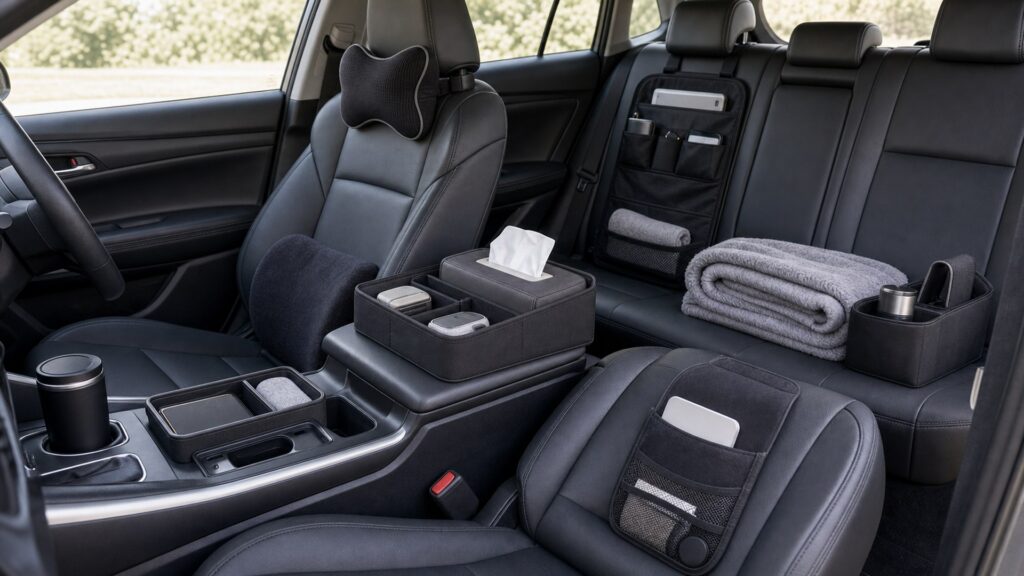
Buying framework
Define the comfort-support organization job before shopping
Turn the comfort-support organization goal into measurable zones, loads, access rules, and safety exclusions.
Comfort-item inventory: List cushions, blankets, shades, chargers, tissues, drinks, eye masks, fans, and seasonal aids with their assigned users.
Three-state map: Document where each accessory is stored, how it is transferred, and its allowed occupied position.
Restraint clearance: Keep comfort kits away from belts, buckles, anchors, tethers, side-airbag seams, seat sensors, and head-restraint movement.
Reset time: Measure how long occupants need to collect, clean, fold, close, and restrain their comfort items before the vehicle moves.
Who this is for
Match storage to the people using it
Different occupants and routines place different demands on comfort-support organization products.
Long-distance couple: Two compact personal kits can reduce handoffs while keeping front-seat controls, consoles, belts, and footwells uncluttered.
Family with young children: Caregiver access must coexist with exact restraint installation, buckle paths, tether routing, rear airflow, and secure soft-item stowage.
Ride-share operator: Choose washable low-profile passenger amenities that reset quickly, disclose no personal data, and cannot be left loose between riders.
Four-season commuter: A labeled weather module prevents gloves, shades, blankets, rain gear, and powered aids from accumulating year-round.
What to pay attention to
Evidence that predicts comfort-support organization performance
Judge specifications by what they change in the exact vehicle during comfort-support organization use.
Deploy and Stow
Give each comfort item a distinct in-use position, handoff method, and restrained storage location that works with occupied seats.
Climate and Hygiene
Preserve vents and seat features while separating clean, used, wet, allergen-bearing, and powered comfort equipment.
Soft-storage closure: Check whether bulky compressible goods remain inside when seats recline, doors close, rows fold, or the vehicle brakes.
Climate compatibility: Protect floor, console, dashboard, rear, and under-seat outlets plus heated and ventilated seating surfaces.
Charging caddy design: Separate connectors, provide short supported leads, allow heat inspection, and prevent cords from crossing bodies or walkways.
Clean/used separation: Use washable labeled storage so damp blankets, used tissues, food residue, and pet-contact textiles do not contaminate clean gear.
Passenger reach boundary: An occupant should retrieve an item while restrained without pulling an organizer down or asking the driver to turn and search.
Seasonal kit volume: Allocate finite storage to cold, heat, rain, or travel gear and remove the entire kit when conditions change.
Avoid these traps
Errors that undermine comfort-support organization
A convenient container fails when it creates movement, interference, or distraction within the comfort-support organization layout.
Calling a blanket harmless cargo: A loose blanket can cover a buckle, block a vent, obscure an item, enter the driver footwell, or complicate exit.
Hanging everything on front seatbacks: Bulk and hard contents reduce rear knee space, load attachments, affect front-seat movement, and may approach airbag seams.
Coiling hot cables inside fabric: Powered leads and connectors need inspection, airflow, suitable ratings, and separation from sharp, wet, or insulated contents.
Keeping used and clean textiles together: Moisture, food residue, allergens, and odor transfer make the entire comfort kit harder to maintain.
Decision guidance
Choose a workable comfort-support organization layout
Select the smallest arrangement that proves the required comfort-support organization outcome.
Create occupant pouches: Give each rider a small closable kit for low-mass personal comfort items when individual reach can remain safe.
Create a shared stop-only kit: Store less frequently used blankets or shades in a restrained location accessed only while parked.
Use a washable turnover module: For passenger service, select smooth removable storage with a short inspection, cleaning, drying, and restocking cycle.
Eliminate duplicate comfort gear: Where storage requires blocking vents or crowding restraints, reduce the kit instead of adding another organizer.
Ownership & compatibility
Keep the comfort-support organization system dependable
Inspection and deliberate resets preserve the original comfort-support organization decision.
Reset after every occupant change: Fold and close soft goods, collect waste, restore cable routes, reveal buckles, reopen vents, and secure unused pieces.
Wash on a documented cycle: Follow material care, dry completely, inspect seams and closures, and avoid returning damp textiles to enclosed storage.
Swap seasonal modules deliberately: Remove expired weather gear, test the incoming kit, clean the empty zone, and verify that storage remains restrained.
FAQ
Questions to settle before purchase
Resolve these product-specific questions with the vehicle and accessory instructions.
How should I verify comfort-item inventory in this vehicle?
How should I verify three-state map in this vehicle?
How should I verify restraint clearance in this vehicle?
How should I verify reset time in this vehicle?
How should I verify soft-storage closure in this vehicle?
How should I verify climate compatibility in this vehicle?
How should I verify charging caddy design in this vehicle?
How should I verify clean/used separation in this vehicle?
How should I verify passenger reach boundary in this vehicle?
Bottom line
Build a safer, calmer cabin
The best comfort-support organization setup stays restrained, accessible, reversible, and easy to audit.
Map the real cabin: Measure the spaces, movements, loads, and exclusions that govern the comfort-support organization goal.
Prove every transition: Rehearse the representative parked sequence with normal users and contents before accepting the comfort-support organization arrangement.
Reset and inspect: Remove clutter, restore comfort-support organization clearances, and retire damaged parts before the planned use degrades.
Reading Shortcuts
Move through the storage for cabin comfort upgrades decision in order.
Decision Reminders
Every comfort accessory needs a safe address when nobody is using it.
- Comfort-item inventory: Verify and record this requirement.
- Three-state map: Verify and record this requirement.
- Restraint clearance: Verify and record this requirement.
- Reset after every occupant change: Verify and record this requirement.
- Wash on a documented cycle: Verify and record this requirement.
- Swap seasonal modules deliberately: Verify and record this requirement.
Glossary Snippets
Terms used in this interior organization plan.
When to Use a Top 10 Review
Use rankings only after the requirements are fixed.
- Map the real cabin: Use this as a shortlist filter.
- Prove every transition: Use this as a shortlist filter.
- Reset and inspect: Use this as a shortlist filter.
- Exclude: Use this as a shortlist filter.
Already down to 2–3 options? A Comparison is usually the faster next step.
When to Use a Comparison
Compare finalists through the occupant-change, accessory deployment, stowage, HVAC-flow, and loose-object trial; make use state an explicit recorded result.
- Comfort-item inventory: Check both candidates against this requirement.
- Three-state map: Record the result for each shortlisted option.
- Restraint clearance: Use the same operating conditions for both tests.
- Reset time: Keep the evidence with the final decision.
Still exploring? Start with a Top 10 to build a shortlist first.