
Interior Organization Buying Guide for Family Vehicle Organization
Family organization is rebuilt several times a day. A school bag enters during pickup, a toddler drops a cup, a caregiver reaches for wipes, the second row slides for third-row access, and a stroller displaces cargo bins. Permanent pockets cannot solve transitions unless restraint hardware and movement paths remain clear.
Install child restraints exactly as their instructions and the vehicle manual require before assigning storage. Give each occupant a small zone suited to age and reach, while adults control dense, sharp, hot, chemical, or choking-hazard items. Secure bags and devices, expose every buckle, protect tether routes, and keep aisles open. Rehearse boarding, school unloading, spill response, row movement, cargo conversion, and emergency exit, then reset the cabin after.
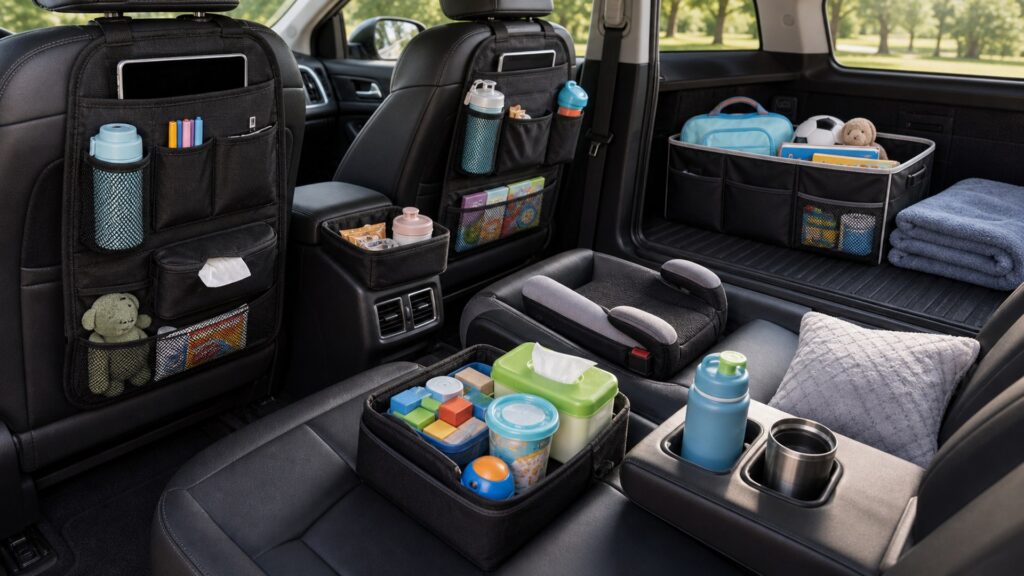
Buying framework
Define the family-zone organization job before shopping
Turn the family-zone organization goal into measurable zones, loads, access rules, and safety exclusions.
Restraint baseline: Document each child's restraint, seating position, lower-anchor or belt installation, top tether, support leg, buckle, and allowed front-seat contact.
Age-based inventory: Separate child-access items from caregiver-only food, medicine, batteries, tools, cleaners, dense devices, and choking hazards.
Occupant boundaries: Limit each rider's soft low-mass storage so it does not cross belts, airbags, neighboring seats, windows, vents, or walkways.
Transition rehearsal: Stage normal loading, buckle help, school pickup, sports equipment, stroller transfer, row sliding, snack cleanup, and emergency exit.
Who this is for
Match storage to the people using it
Different occupants and routines place different demands on family-zone organization products.
Infant household: Caregiver supplies require secure access while the rear-facing seat's installation, support rules, airbag separation, and front-seat limits remain controlling.
Preschool family: Use simple soft storage for a few approved items while adults manage food, batteries, medicines, cleaners, and electronic devices.
School-age siblings: Individual zones can reduce conflict, but backpacks, sports gear, and hard devices still need restrained transit locations.
Three-row mixed-age family: Prioritize the aisle, sliding-seat operation, tether locations, buckle identification, ventilation, and a repeatable cargo conversion sequence.
What to pay attention to
Evidence that predicts family-zone organization performance
Judge specifications by what they change in the exact vehicle during family-zone organization use.
Restraint-First Zoning
Install and verify child restraints, belts, buckles, anchors, tethers, support legs, and airbag rules before allocating storage.
Family Transitions
Rehearse boarding, handoffs, school bags, snacks, spills, third-row access, stroller loading, seat folding, and emergency exit.
Buckle visibility: Choose organizers and bins that leave the correct buckle and belt route obvious under coats, blankets, bags, and low light.
Seatback loading: Follow attachment and weight guidance, keep hard objects low and restrained, preserve front-seat adjustment, and protect rear knee space.
Food and spill control: Use closable washable containers, separate waste, keep cleanup supplies adult-controlled, and prevent liquid from reaching restraints or electronics.
Third-row passage: Maintain a clear step and handhold path without cables, hooks, bottles, shoes, bins, or temporarily displaced comfort items.
School and activity gear: Restrain backpacks, instruments, sports equipment, helmets, and devices in appropriate cargo zones rather than empty passenger seats.
Growth schedule: Set review points for new restraints, changed belt fit, taller legs, independent buckling, school demands, and altered passenger combinations.
Avoid these traps
Errors that undermine family-zone organization
A convenient container fails when it creates movement, interference, or distraction within the family-zone organization layout.
Routing organizer straps around restraint hardware: Attachment convenience never overrides the specified belt, anchor, tether, buckle, or support-leg path.
Giving children unrestricted pocket capacity: Extra volume invites hard, sharp, messy, or distracting objects and makes the safety reset harder to inspect.
Leaving backpacks on occupied rows: Dense school gear can move during abrupt braking and may block buckles, aisles, vents, or seat movement.
Postponing redesign as children grow: Legroom, belt fit, reach, interests, school gear, and responsibility change before an organizer appears physically worn.
Decision guidance
Choose a workable family-zone organization layout
Select the smallest arrangement that proves the required family-zone organization outcome.
Build one low-mass child zone: Choose a small closable organizer for a defined list that the occupant can use without compromising restraint or neighbor space.
Build one caregiver service kit: Keep wipes, spare clothing, bags, and approved supplies in secured adult-controlled storage reached while parked.
Move transition gear to cargo: Strollers, backpacks, sports bags, and dense devices need suitable restraint outside the passenger impact area.
Simplify for complex seating days: Remove optional organizers and accessories when extra passengers, unfamiliar restraints, or full cargo create uncertainty.
Ownership & compatibility
Keep the family-zone organization system dependable
Inspection and deliberate resets preserve the original family-zone organization decision.
Complete a post-trip family reset: Remove waste and food, collect loose objects, expose buckles, restore vents and aisles, and return supplies to secure homes.
Inspect restraint-adjacent storage: Check straps, pockets, seat contact, tether clearance, buckle access, hard contents, and child tampering every time seating changes.
Schedule growth reviews: Rebuild zones after a restraint transition, growth spurt, new school year, sport, sibling, pet, or third-row routine.
FAQ
Questions to settle before purchase
Resolve these product-specific questions with the vehicle and accessory instructions.
How should I verify restraint baseline in this vehicle?
How should I verify age-based inventory in this vehicle?
How should I verify occupant boundaries in this vehicle?
How should I verify transition rehearsal in this vehicle?
How should I verify buckle visibility in this vehicle?
How should I verify seatback loading in this vehicle?
How should I verify food and spill control in this vehicle?
How should I verify third-row passage in this vehicle?
How should I verify school and activity gear in this vehicle?
Bottom line
Build a safer, calmer cabin
The best family-zone organization setup stays restrained, accessible, reversible, and easy to audit.
Map the real cabin: Measure the spaces, movements, loads, and exclusions that govern the family-zone organization goal.
Prove every transition: Rehearse the representative parked sequence with normal users and contents before accepting the family-zone organization arrangement.
Reset and inspect: Remove clutter, restore family-zone organization clearances, and retire damaged parts before the planned use degrades.
Reading Shortcuts
Move through the family vehicle organization decision in order.
Decision Reminders
Install restraints first; family storage must adapt around them.
- Restraint baseline: Verify and record this requirement.
- Age-based inventory: Verify and record this requirement.
- Occupant boundaries: Verify and record this requirement.
- Complete a post-trip family reset: Verify and record this requirement.
- Inspect restraint-adjacent storage: Verify and record this requirement.
- Schedule growth reviews: Verify and record this requirement.
Glossary Snippets
Terms used in this interior organization plan.
When to Use a Top 10 Review
Use rankings only after the requirements are fixed.
- Map the real cabin: Use this as a shortlist filter.
- Prove every transition: Use this as a shortlist filter.
- Reset and inspect: Use this as a shortlist filter.
- Exclude: Use this as a shortlist filter.
Already down to 2–3 options? A Comparison is usually the faster next step.
When to Use a Comparison
Compare finalists through the school-run, buckle, third-row entry, spill cleanup, cargo conversion, and emergency-exit trial; make child restraint an explicit recorded result.
- Restraint baseline: Check both candidates against this requirement.
- Age-based inventory: Record the result for each shortlisted option.
- Occupant boundaries: Use the same operating conditions for both tests.
- Transition rehearsal: Keep the evidence with the final decision.
Still exploring? Start with a Top 10 to build a shortlist first.