
Interior Organization Buying Guide for Interior Organization Protection Needs
Storage does not automatically protect. A sealed pouch can retain a leak, but it can also conceal it. A console case shields electronics from scratches while increasing parked-cabin heat. A visible hard case may protect against bumps yet advertise valuable contents. Protection begins by naming the threat and the failure path.
Classify each object by liquid, temperature, sunlight, abrasion, chemical, battery, child-access, and theft risk. Keep risky products in original packaging when required, add compatible secondary containment, and place dense items in restrained zones. Do not treat cabin organizers as secure vaults or climate-controlled storage. Make every liner removable, inspect the surface beneath it, and rehearse leak cleanup without spreading contamination. If safe temperature or access cannot be.
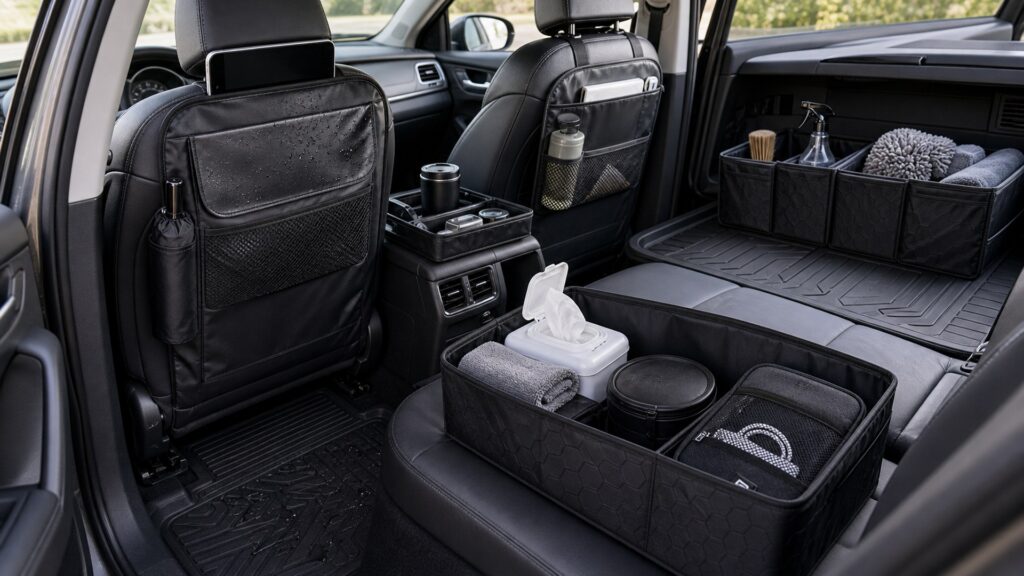
Buying framework
Define the protective storage job before shopping
Turn the protective storage goal into measurable zones, loads, access rules, and safety exclusions.
Threat inventory: For every stored object, identify leakage, heat, cold, sunlight, abrasion, odor, electrical, child-access, theft, and impact consequences.
Primary packaging: Retain required labels, caps, safety information, and manufacturer packaging rather than decanting products into anonymous cabin containers.
Barrier selection: Match waterproof, absorbent, padded, opaque, vented, insulated, or rigid construction to a specific risk without assuming one layer solves all.
Failure response: Plan how to stop access, remove the package, protect occupants, ventilate, clean, dry, and dispose of damaged material after an incident.
Who this is for
Match storage to the people using it
Different occupants and routines place different demands on protective storage products.
Parent carrying cleanup supplies: Keep labeled products secured from children, separated from food, temperature-compatible, and easy for an adult to remove while parked.
Outdoor traveler with wet gear: Use removable containment that prevents spread yet opens for prompt ventilation, washing, and full drying after the trip.
Device-heavy commuter: Provide padded restrained storage away from direct sun and crushing loads, but take heat-sensitive and high-value electronics when leaving.
Pet owner: Separate food, medicine, waste bags, wet textiles, and grooming tools while controlling hair, odor, claw abrasion, and animal access.
What to pay attention to
Evidence that predicts protective storage performance
Judge specifications by what they change in the exact vehicle during protective storage use.
Threat Mapping
Separate liquid, heat, sunlight, abrasion, odor, contamination, child access, theft visibility, and impact risks by object and cabin zone.
Protection Side Effects
Check trapped moisture, heat accumulation, battery isolation, chemical compatibility, hidden damage, difficult removal, and false security.
Secondary containment: Test seams, closure orientation, usable lip height, liner removal, compatibility with contents, and whether a leak can escape during driving.
Parked temperature: Compare the product's allowed storage range with realistic cabin heat and cold; organizers do not make unsuitable items safe to leave aboard.
Abrasion control: Check hard corners, grit, vibration, fasteners, and organizer movement against upholstery, trim, glass, electronics, and the stored item itself.
Child and pet access: Use placement and closures appropriate to the hazard, while recognizing that common zippers or lids may not provide reliable restriction.
Battery separation: Protect terminals, prevent crushing and puncture, isolate damaged cells, avoid heat, and follow device and battery storage instructions.
Privacy without concealment: Reduce casual visibility of ordinary items but remove high-value property; never hide a hazard so completely that owners stop inspecting it.
Avoid these traps
Errors that undermine protective storage
A convenient container fails when it creates movement, interference, or distraction within the protective storage layout.
Assuming a zipper makes storage childproof: Most convenience closures are not safety devices; hazardous contents need manufacturer-directed storage and removal from the cabin.
Leaving batteries in a sun-soaked organizer: Padding can retain heat and hide swelling or damage; obey temperature guidance and inspect devices before charging or use.
Using one bin for food and chemicals: Leaks, residue, and mistaken identity create avoidable exposure; keep categories physically separate in original labeled packaging.
Never lifting a protective liner: Hidden liquid, grit, dye transfer, heat damage, and corrosion can progress underneath an apparently clean surface.
Decision guidance
Choose a workable protective storage layout
Select the smallest arrangement that proves the required protective storage outcome.
Use a washable sacrificial liner: Choose it for ordinary dirt or minor spills when it is compatible, removable, restrained, and easy to inspect beneath.
Use dedicated secondary containment: Select a labeled compatible vessel for permitted liquids, with upright securement and a planned cleanup path.
Use padded storage for transit only: Protect electronics from movement during driving, then remove them from temperature and theft exposure when parked.
Do not store the hazardous item: When child access, temperature, leakage, or chemical restrictions cannot be controlled, the vehicle is the wrong storage location.
Ownership & compatibility
Keep the protective storage system dependable
Inspection and deliberate resets preserve the original protective storage decision.
Perform scheduled inspection reveals: Remove every liner and case, inspect all sides plus the original cavity, clean grit, and document leaks, heat, odor, or abrasion.
Respond immediately to leakage: Stop access, follow product safety information, remove compatible materials, clean and ventilate, and dry hidden layers completely.
Retire compromised barriers: Cracked shells, swollen batteries, failed seams, persistent odor, distorted lids, stained foam, or unknown chemical exposure end service.
FAQ
Questions to settle before purchase
Resolve these product-specific questions with the vehicle and accessory instructions.
How should I verify threat inventory in this vehicle?
How should I verify primary packaging in this vehicle?
How should I verify barrier selection in this vehicle?
How should I verify failure response in this vehicle?
How should I verify secondary containment in this vehicle?
How should I verify parked temperature in this vehicle?
How should I verify abrasion control in this vehicle?
How should I verify child and pet access in this vehicle?
How should I verify battery separation in this vehicle?
Bottom line
Build a safer, calmer cabin
The best protective storage setup stays restrained, accessible, reversible, and easy to audit.
Map the real cabin: Measure the spaces, movements, loads, and exclusions that govern the protective storage goal.
Prove every transition: Rehearse the representative parked sequence with normal users and contents before accepting the protective storage arrangement.
Reset and inspect: Remove clutter, restore protective storage clearances, and retire damaged parts before the planned use degrades.
Reading Shortcuts
Move through the protection-focused cabin organization decision in order.
Decision Reminders
A barrier is protective only when its own failure can be detected and managed.
- Threat inventory: Verify and record this requirement.
- Primary packaging: Verify and record this requirement.
- Barrier selection: Verify and record this requirement.
- Perform scheduled inspection reveals: Verify and record this requirement.
- Respond immediately to leakage: Verify and record this requirement.
- Retire compromised barriers: Verify and record this requirement.
Glossary Snippets
Terms used in this interior organization plan.
When to Use a Top 10 Review
Use rankings only after the requirements are fixed.
- Map the real cabin: Use this as a shortlist filter.
- Prove every transition: Use this as a shortlist filter.
- Reset and inspect: Use this as a shortlist filter.
- Exclude: Use this as a shortlist filter.
Already down to 2–3 options? A Comparison is usually the faster next step.
When to Use a Comparison
Compare finalists through the leak containment, heat exposure, abrasion, access-control, and hidden-surface inspection trial; make spill boundary an explicit recorded result.
- Threat inventory: Check both candidates against this requirement.
- Primary packaging: Record the result for each shortlisted option.
- Barrier selection: Use the same operating conditions for both tests.
- Failure response: Keep the evidence with the final decision.
Still exploring? Start with a Top 10 to build a shortlist first.