
Interior Organization Buying Guide: How to Choose the Right One
A well-organized cabin is not the one with the most pockets. It is the one in which every necessary object has a restrained location, the driver does not search while moving, passengers keep usable space, and emergency equipment remains reachable. Empty organizers also consume room and add attachment points.
Inventory the actual items first. Classify each by weight, hardness, leakage risk, user, and when it must be reached. Mark controls, airbags, belts, seat travel, vents, windows, walkways, and child-restraint space as exclusions. Then choose the fewest containers that close or retain their assigned loads. Test abrupt-stop movement conceptually, fold every used seat, and perform a regular clean-out so capacity never becomes permission to accumulate clutter.
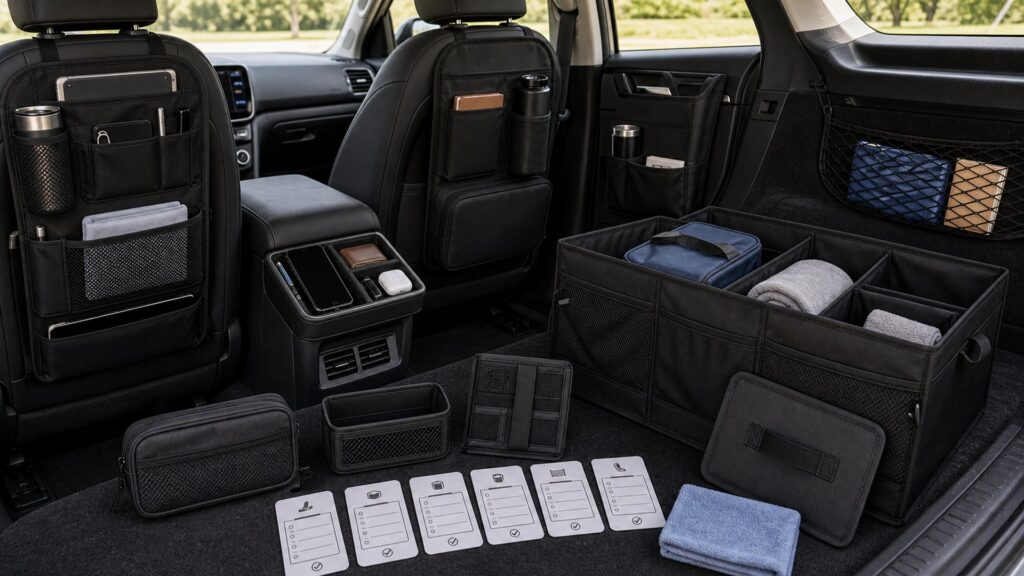
Buying framework
Define the whole-cabin organization job before shopping
Turn the whole-cabin organization goal into measurable zones, loads, access rules, and safety exclusions.
Item census: Empty the cabin and list every recurring object, its user, physical risk, required temperature, and reason for remaining aboard.
Access hierarchy: Separate driving essentials from stop-only, passenger, emergency, work, and seasonal gear before assigning any storage zone.
Exclusion map: Protect pedals, wheel, shifter, airbags, belts, rails, vents, windows, cameras, exits, and child-restraint interfaces from organizer encroachment.
Capacity budget: Size containers for an approved item list and leave margin for closure rather than filling every available surface.
Who this is for
Match storage to the people using it
Different occupants and routines place different demands on whole-cabin organization products.
Minimal commuter: A small closed console arrangement and secure charging route may cover essentials without adding seatback or floor storage.
Family vehicle manager: Use occupant-specific low-mass zones, protected restraint space, spill handling, and a repeatable unload routine.
Mobile professional: Separate documents and devices from dense tools, batteries, samples, or chemicals that need stronger cargo restraint and temperature control.
Multi-purpose SUV owner: Modular labeled containers must remain secured in passenger, folded-row, grocery, recreation, and emergency configurations.
What to pay attention to
Evidence that predicts whole-cabin organization performance
Judge specifications by what they change in the exact vehicle during whole-cabin organization use.
Item Risk
Classify every object by mass, hardness, leakage, heat sensitivity, child access, and consequence if it escapes during abrupt motion.
Cabin Workflow
Place approved items according to retrieval timing, occupant ownership, cleaning, seat conversion, cargo loading, and emergency access.
Anchor behavior: Inspect the stated attachment method, vehicle contact point, strap direction, loaded movement, and effect of seat adjustment.
Closure retention: Test zippers, lids, elastic, flaps, dividers, and pocket openings with the real mass, shape, and orientation of contents.
Material and cleanability: Match liners and fabrics to spills, food, sunscreen, pet hair, temperature, cleaning chemistry, and complete drying.
Driver retrieval load: Frequently used objects should not require leaning, twisting, looking away, opening complex closures, or reaching into passenger space.
Conversion compatibility: Move rows, fold seats, raise cargo floors, open the spare compartment, and relocate modules without creating loose overflow.
Empty organizer cost: Count the product's own weight, bulk, hard edges, noise, blocked space, and maintenance before crediting its advertised volume.
Avoid these traps
Errors that undermine whole-cabin organization
A convenient container fails when it creates movement, interference, or distraction within the whole-cabin organization layout.
Buying one large bin first: A large volume mixes incompatible items and becomes difficult to restrain, lift, clean, and relocate when the cabin changes.
Treating elastic as a universal closure: Stretch pockets may release dense or oddly shaped contents; load them only as directed and test orientation.
Putting convenience above reach safety: No organizer justifies searching, twisting, or opening compartments while the vehicle is moving.
Ignoring the organizer when empty: Rigid shells, hooks, and straps still occupy impact space and can rattle, snag, or obstruct equipment without contents.
Decision guidance
Choose a workable whole-cabin organization layout
Select the smallest arrangement that proves the required whole-cabin organization outcome.
Use existing latching compartments: Factory storage often preserves geometry and restraint when assigned a disciplined item list within its intended capacity.
Add a compact zone organizer: Select a secured module for several related light objects when built-in storage lacks separation but not basic volume.
Move hazardous items rearward: Dense, sharp, hot, leaking, or work-related equipment belongs in an appropriate restrained cargo area rather than passenger pockets.
Remove nonessential inventory: When every proposed location conflicts with a safety or access need, the correct solution is fewer items aboard.
Ownership & compatibility
Keep the whole-cabin organization system dependable
Inspection and deliberate resets preserve the original whole-cabin organization decision.
Run a weekly cabin census: Return objects to approved homes, discard waste, remove seasonal leftovers, and investigate anything repeatedly found loose.
Inspect closures and anchors loaded: Look for stretched elastic, torn seams, cracked shells, loose hooks, abrasion, migration, noise, and changed seat clearance.
Rebalance after life changes: New passengers, child seats, jobs, pets, hobbies, and emergencies alter the inventory and require a fresh capacity budget.
FAQ
Questions to settle before purchase
Resolve these product-specific questions with the vehicle and accessory instructions.
How should I verify item census in this vehicle?
How should I verify access hierarchy in this vehicle?
How should I verify exclusion map in this vehicle?
How should I verify capacity budget in this vehicle?
How should I verify anchor behavior in this vehicle?
How should I verify closure retention in this vehicle?
How should I verify material and cleanability in this vehicle?
How should I verify driver retrieval load in this vehicle?
How should I verify conversion compatibility in this vehicle?
Bottom line
Build a safer, calmer cabin
The best whole-cabin organization setup stays restrained, accessible, reversible, and easy to audit.
Map the real cabin: Measure the spaces, movements, loads, and exclusions that govern the whole-cabin organization goal.
Prove every transition: Rehearse the representative parked sequence with normal users and contents before accepting the whole-cabin organization arrangement.
Reset and inspect: Remove clutter, restore whole-cabin organization clearances, and retire damaged parts before the planned use degrades.
Reading Shortcuts
Move through the whole-cabin storage architecture decision in order.
Decision Reminders
Organization begins with fewer approved objects, not more available pockets.
- Item census: Verify and record this requirement.
- Access hierarchy: Verify and record this requirement.
- Exclusion map: Verify and record this requirement.
- Run a weekly cabin census: Verify and record this requirement.
- Inspect closures and anchors loaded: Verify and record this requirement.
- Rebalance after life changes: Verify and record this requirement.
Glossary Snippets
Terms used in this interior organization plan.
When to Use a Top 10 Review
Use rankings only after the requirements are fixed.
- Map the real cabin: Use this as a shortlist filter.
- Prove every transition: Use this as a shortlist filter.
- Reset and inspect: Use this as a shortlist filter.
- Exclude: Use this as a shortlist filter.
Already down to 2–3 options? A Comparison is usually the faster next step.
When to Use a Comparison
Compare finalists through the hard-stop thought experiment, retrieval, seat-folding, passenger-entry, and emergency-access trial; make item inventory an explicit recorded result.
- Item census: Check both candidates against this requirement.
- Access hierarchy: Record the result for each shortlisted option.
- Exclusion map: Use the same operating conditions for both tests.
- Capacity budget: Keep the evidence with the final decision.
Still exploring? Start with a Top 10 to build a shortlist first.