
IPL Hair Removal Devices Buying Guide for Skin Sensitivity Levels
Sensitive skin can react to IPL with prolonged redness, swelling, blistering, burns, or pigment change, especially when recent sun, photosensitizing products or medications, or incorrect settings alter light absorption. Sensitivity is not measured by pain alone.
Reduce uncertainty through exact compatibility and patch testing. If the model excludes the skin tone, cannot distinguish marks safely, or requires a level that produces concerning reaction, no home treatment is the appropriate setting.
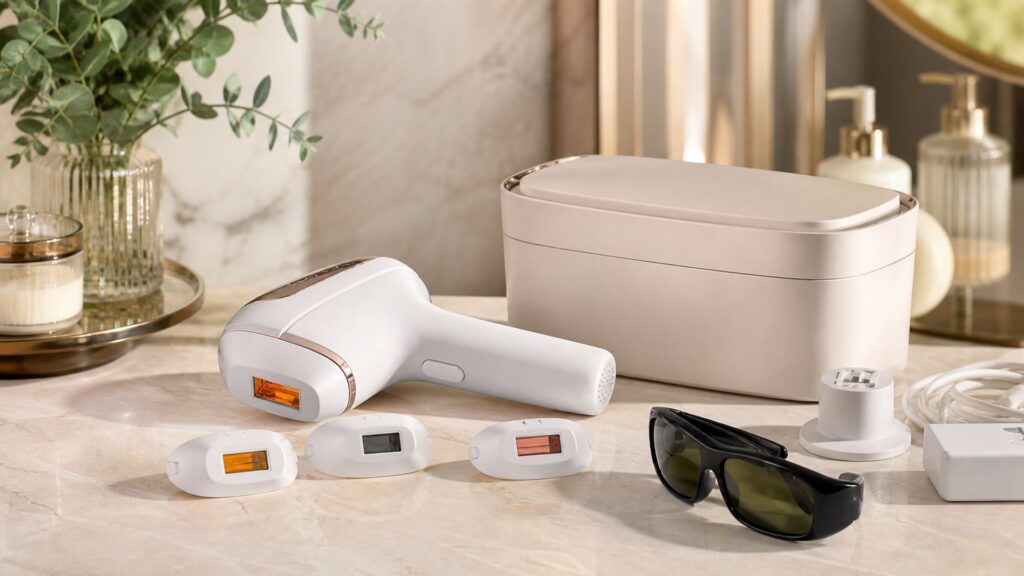
Buying framework
Define the skin sensitivity levels routine before comparing products
Use the setting, frequency, and skin priorities to narrow ipl hair removal devices logically.
Start with the use case: Identify baseline sensitivity, pigment history, tanning, skin disease, and relevant products or medications.
Rank the practical tradeoffs: Confirm the model includes the current untanned skin tone and treatment zone.
Check instructions early: Patch-test one small area and wait the entire labeled observation period.
Use profiles
Match ipl hair removal devices to the person and pace
Three shopper profiles expose different priorities for skin sensitivity levels.
Routine-focused buyer: A pigment-change-prone user needs conservative energy and careful sun management.
Performance-focused buyer: A redness-prone user should monitor beyond the immediate normal transient response.
Occasional or flexible user: A photosensitizing-medication user needs professional guidance before considering IPL.
Specifications
Read the specifications through a skin sensitivity levels lens
Translate technical language into visible routine benefits.
Handling lens
Inspect the patch under consistent light through the full waiting period.
Ownership lens
Separate normal transient warmth from worsening delayed reaction.
Skin-Tone Compatibility: Skin-tone sensing reduces but does not eliminate pigment-response risk.
Energy Settings: Cooling changes comfort without preventing excess energy absorption.
Treatment Window: Small windows improve precision around eligible zones and marks.
Flash Speed: Automatic modes may still require manual avoidance of tattoos and dark lesions.
Safety Sensors: Repeated overlap increases local dose even when each flash uses a low level.
Common mistakes
Avoid shortcuts that undermine skin sensitivity levels
A good purchase can still disappoint when selection or use is based on the wrong assumption.
Buying from one metric: Do not patch-test on tanned, sunburned, irritated, or recently treated skin.
Skipping compatibility checks: Avoid using pain absence to justify a higher level.
Ignoring post-use care: Do not flash over tattoos, dark marks, wounds, or prohibited sensitive areas.
Decision guidance
Choose the simplest option that covers the real need
Use these decision rules to finish a shortlist for skin sensitivity levels.
Choose the basic format when: Choose no IPL when tone, pigment, medication, or skin condition is incompatible.
Choose the flexible format when: Use the lowest labeled effective setting after a fully tolerated patch test.
Pause before upgrading when: Seek care for blistering, burns, marked swelling, severe pain, or pigment change.
Ownership & compatibility
Plan for clean, repeatable ownership
The best value remains convenient after the first few uses.
Consumables and replacements: Log patch location, level, date, sun history, and delayed response.
Cleaning and storage: Use familiar compatible aftercare and follow sun guidance.
Routine compatibility: Retest or stop after meaningful skin-tone, medication, or health changes.
FAQ
IPL Hair Removal Devices Buying Guide for Skin Sensitivity Levels FAQ
Practical answers about choosing and owning ipl hair removal devices for skin sensitivity levels.
What matters most when choosing ipl hair removal devices for skin sensitivity levels?
Is the most expensive option better for skin sensitivity levels?
How should I compare two similar ipl hair removal devices options?
Bottom line
Buy for repeatable skin sensitivity levels results
A focused shortlist is easier to own and use well.
Prioritize fit: Let pigment and medication risk determine whether home IPL belongs.
Verify the limits: Use full-interval patch testing instead of pain as the safety signal.
Count ownership costs: Treat cooling as comfort, not compatibility.
Reading Shortcuts
Jump to the key ipl hair removal devices decisions.
Decision Reminders
Keep these checks beside your shortlist.
- Check skin-tone compatibility: Check skin-tone, hair-color, medication, and body-area restrictions before use.
- Check energy settings: Patch test exactly as directed before broader treatment.
- Check treatment window: Never flash toward the eyes and follow all eye-safety directions.
Glossary Snippets
Plain-language ipl hair removal devices terms.
When to Use a Top 10 Review
Use a ranked list to identify a manageable set of strong candidates.
- You are still exploring: A ranked list can reveal the main formats and price tiers.
- You want a shortlist: Start broad, then confirm fit with this buying guide.
Have finalists? Use a Comparison.
When to Use a Comparison
Use a direct comparison when only a few candidates remain.
- Features are close: Side-by-side details clarify meaningful differences.
- Prices overlap: Compare ownership value, not only purchase price.
Still exploring? See the Top 10.