
LED Handheld Devices Buying Guide for Device Features and Attachments
Useful LED handheld features solve a specific placement, control, power, hygiene, or storage problem. Attachments deserve the same scrutiny: each should have a documented purpose, compatible protocol, safe cleaning method, and geometry that improves access without creating uncertain distance or overlap.
Separate treatment-critical features from convenience and decoration. A timer, reachable shutdown, stable spacer, protective cap, and dependable power may support consistent use; extra heads, stands, cases, colors, or apps matter only when they improve the intended routine.
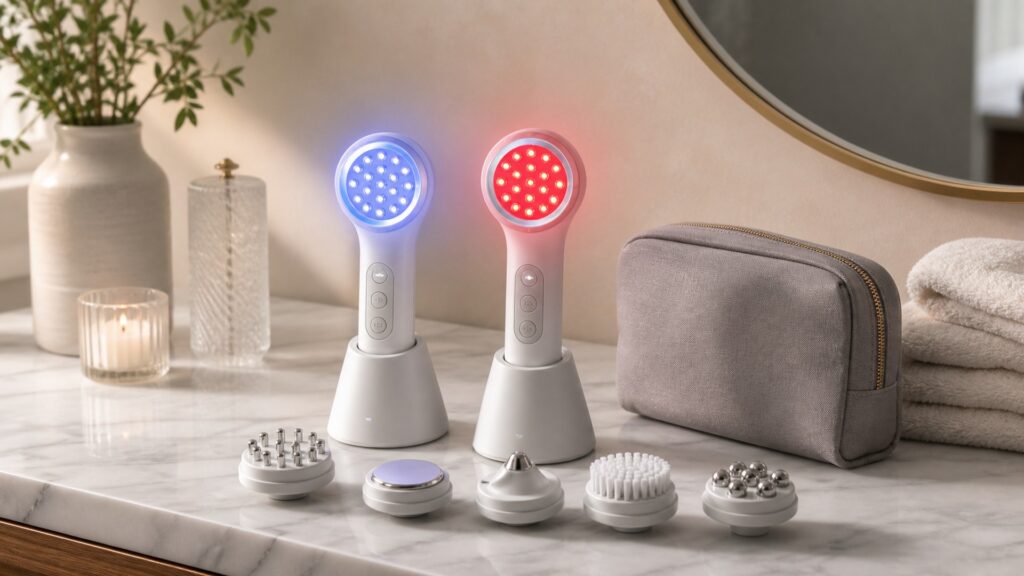
Buying framework
Define the device features and attachments routine before comparing products
Use the setting, frequency, and skin priorities to narrow led handheld devices logically.
Start with the use case: List the practical obstacle each feature or attachment is meant to solve.
Rank the practical tradeoffs: Verify that its instructions define mode, placement, timing, cleaning, and safety.
Check instructions early: Test the complete accessory workflow inactive, including changeover and storage.
Use profiles
Match led handheld devices to the person and pace
Three shopper profiles expose different priorities for device features and attachments.
Routine-focused buyer: A precision user may need a narrow attachment for small curved areas.
Performance-focused buyer: A shared-device household needs clear hygiene boundaries and replaceable personal parts.
Occasional or flexible user: A travel user benefits from protected optics and compatible charging more than a bulky stand.
Specifications
Read the specifications through a device features and attachments lens
Translate technical language into visible routine benefits.
Handling lens
Count attachment changes and cleaning steps across one real session.
Ownership lens
Confirm replacements, charging accessories, and support before valuing the bundle.
Wavelength Labeling: A spacer can standardize distance if it remains stable on the target contour.
Treatment Window: Interchangeable heads need unmistakable protocol and cleaning labels.
Session Timer: A protective cap helps keep emitters and sensors free from abrasion.
Grip And Controls: A stand is valuable only when it preserves the instructed treatment angle.
Charging Runtime: Essential timers and shutdown should remain available without an app subscription.
Common mistakes
Avoid shortcuts that undermine device features and attachments
A good purchase can still disappoint when selection or use is based on the wrong assumption.
Buying from one metric: Do not use an attachment on an area absent from its directions.
Skipping compatibility checks: Avoid paying for colors whose wavelength and protocol are undisclosed.
Ignoring post-use care: Do not share contact pieces without an approved hygiene process.
Decision guidance
Choose the simplest option that covers the real need
Use these decision rules to finish a shortlist for device features and attachments.
Choose the basic format when: Choose features that reduce a measured source of inconsistency or effort.
Choose the flexible format when: Reject accessories that obscure dose, distance, cleaning, or intended area.
Pause before upgrading when: Favor durable essentials and available replacements over a large novelty bundle.
Ownership & compatibility
Plan for clean, repeatable ownership
The best value remains convenient after the first few uses.
Consumables and replacements: Inventory heads, caps, chargers, eye protection, and cleaning supplies.
Cleaning and storage: Inspect attachment locks, lenses, spacers, and cables before each course segment.
Routine compatibility: Store cleaned pieces separately so the next setup begins predictably.
FAQ
LED Handheld Devices Buying Guide for Device Features and Attachments FAQ
Practical answers about choosing and owning led handheld devices for device features and attachments.
What matters most when choosing led handheld devices for device features and attachments?
Is the most expensive option better for device features and attachments?
How should I compare two similar led handheld devices options?
Bottom line
Buy for repeatable device features and attachments results
A focused shortlist is easier to own and use well.
Prioritize fit: Buy attachments for defined access or consistency needs.
Verify the limits: Keep essential timing and shutdown independent of optional software.
Count ownership costs: Value cleanable, replaceable essentials above bundle size.
Reading Shortcuts
Jump to the key led handheld devices decisions.
Decision Reminders
Keep these checks beside your shortlist.
- Check wavelength labeling: Follow labeled session times and eye-safety directions.
- Check treatment window: Check photosensitizing medication and condition warnings before use.
- Check session timer: Keep the device positioned exactly as its instructions specify.
Glossary Snippets
Plain-language led handheld devices terms.
When to Use a Top 10 Review
Use a ranked list to identify a manageable set of strong candidates.
- You are still exploring: A ranked list can reveal the main formats and price tiers.
- You want a shortlist: Start broad, then confirm fit with this buying guide.
Have finalists? Use a Comparison.
When to Use a Comparison
Use a direct comparison when only a few candidates remain.
- Features are close: Side-by-side details clarify meaningful differences.
- Prices overlap: Compare ownership value, not only purchase price.
Still exploring? See the Top 10.