
LED Handheld Devices Buying Guide: How to Choose the Right One
Choosing an LED handheld begins with the treatment footprint, because a small head trades coverage speed for placement control. The right format must deliver a documented light protocol consistently while remaining comfortable to hold and easy to position without staring at the emitters.
Define the target area, required eye protection, session duration, charging method, grip angle, and number of placements before comparing colors or accessories. A device that tires the wrist or makes overlap uncertain can turn a short protocol into an inconsistent routine.
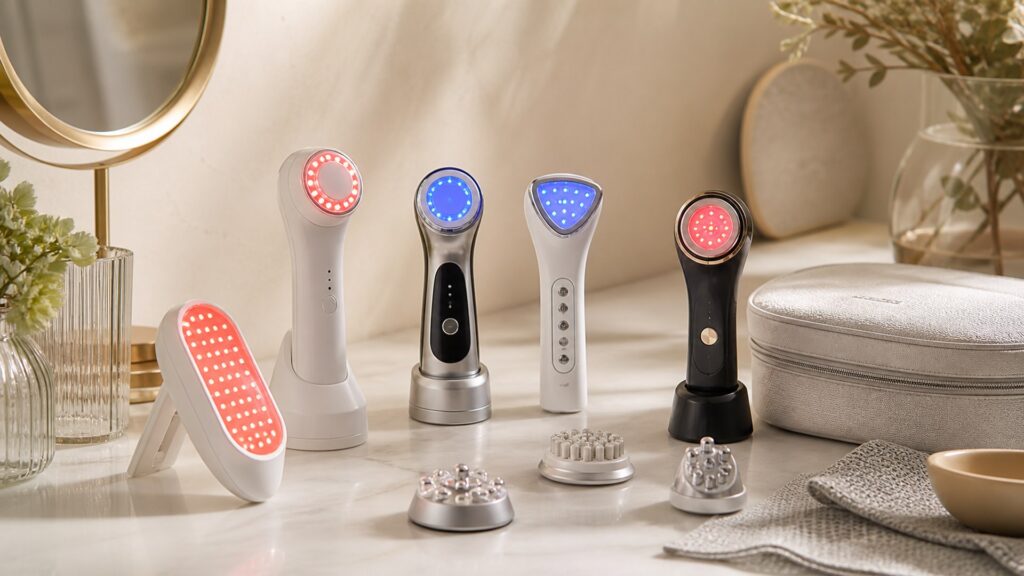
Buying framework
Define the right one routine before comparing products
Use the setting, frequency, and skin priorities to narrow led handheld devices logically.
Start with the use case: Map the intended treatment area and estimate placements per complete session.
Rank the practical tradeoffs: Verify wavelengths, exposure instructions, contraindications, eye precautions, and device status.
Check instructions early: Test inactive handling, control reach, charging stability, cleaning, and storage.
Use profiles
Match led handheld devices to the person and pace
Three shopper profiles expose different priorities for right one.
Routine-focused buyer: A spot-treatment user benefits from a compact head with clear placement boundaries.
Performance-focused buyer: A larger-area user needs fast repeatable indexing more than a tiny precision tip.
Occasional or flexible user: A mobility-limited user should prioritize low weight and controls reachable without regripping.
Specifications
Read the specifications through a right one lens
Translate technical language into visible routine benefits.
Handling lens
Perform the planned placement sequence inactive and count every reposition.
Ownership lens
Compare complete-session effort, not the comfort of holding the device briefly.
Wavelength Labeling: Head dimensions determine coverage per placement and total repositioning.
Treatment Window: A visible rim or spacer can make overlap easier to judge.
Session Timer: Timer behavior should match the manufacturer-defined exposure for each location.
Grip And Controls: Button placement matters when eye protection limits visual confirmation.
Charging Runtime: Cord length and battery endurance must support the entire mapped session.
Common mistakes
Avoid shortcuts that undermine right one
A good purchase can still disappoint when selection or use is based on the wrong assumption.
Buying from one metric: Do not assume more colors make an undocumented protocol useful.
Skipping compatibility checks: Avoid freehand sweeping when directions require fixed placement.
Ignoring post-use care: Do not choose a tiny head for broad coverage without timing the full routine.
Decision guidance
Choose the simplest option that covers the real need
Use these decision rules to finish a shortlist for right one.
Choose the basic format when: Choose a format that covers the real area within a sustainable session.
Choose the flexible format when: Reject devices that omit wavelength, exposure, contraindication, or eye guidance.
Pause before upgrading when: Prefer controls and placement cues that remain usable with required eye protection.
Ownership & compatibility
Plan for clean, repeatable ownership
The best value remains convenient after the first few uses.
Consumables and replacements: Record placements, mode, time, products, comfort, and delayed response.
Cleaning and storage: Clean the treatment head only by the stated powered-off method.
Routine compatibility: Store the device where the lens, cable, and battery avoid damage.
FAQ
LED Handheld Devices Buying Guide: How to Choose the Right One FAQ
Practical answers about choosing and owning led handheld devices for right one.
What matters most when choosing led handheld devices for right one?
Is the most expensive option better for right one?
How should I compare two similar led handheld devices options?
Bottom line
Buy for repeatable right one results
A focused shortlist is easier to own and use well.
Prioritize fit: Match the treatment head to the actual surface area.
Verify the limits: Time the whole placement sequence before committing.
Count ownership costs: Require documented light and safety instructions ahead of extra modes.
Reading Shortcuts
Jump to the key led handheld devices decisions.
Decision Reminders
Keep these checks beside your shortlist.
- Check wavelength labeling: Follow labeled session times and eye-safety directions.
- Check treatment window: Check photosensitizing medication and condition warnings before use.
- Check session timer: Keep the device positioned exactly as its instructions specify.
Glossary Snippets
Plain-language led handheld devices terms.
When to Use a Top 10 Review
Use a ranked list to identify a manageable set of strong candidates.
- You are still exploring: A ranked list can reveal the main formats and price tiers.
- You want a shortlist: Start broad, then confirm fit with this buying guide.
Have finalists? Use a Comparison.
When to Use a Comparison
Use a direct comparison when only a few candidates remain.
- Features are close: Side-by-side details clarify meaningful differences.
- Prices overlap: Compare ownership value, not only purchase price.
Still exploring? See the Top 10.