
Lighting & Visibility Buying Guide for Night Driving Visibility
Night visibility is a distance-and-time problem. The driver needs enough controlled illumination to recognize a pedestrian, animal, curve, or stopped vehicle while there is still room to respond. A dazzling patch directly ahead can feel impressive while hiding weak reach farther down the road.
Start by separating deterioration from design limitation. Clean the windshield and lenses, inspect moisture and mounting damage, confirm source type and voltage, and check aim using the vehicle procedure. Then compare complete beam performance on straight and curved approaches, including glare. High beams, automatic controls, and fog lamps serve different conditions; none repairs a scattered or incorrectly aimed low beam.
Buying framework
Build night visibility from detection distance backward
Choose around the hazard distance, road geometry, and beam mode the driver can actually use—not the apparent brightness of a source.
Define the dark-road task: Separate straight rural roads, curves, divided highways, urban lighting, and adverse weather because each exposes a different beam weakness.
Restore the optical path: Clean both sides of the windshield where accessible, clear lenses, address haze or moisture, verify voltage, and replace damaged optical components before upgrading.
Read low and high beams separately: Low beams must control glare in traffic; upper beams are distance tools for clear roads without nearby road users.
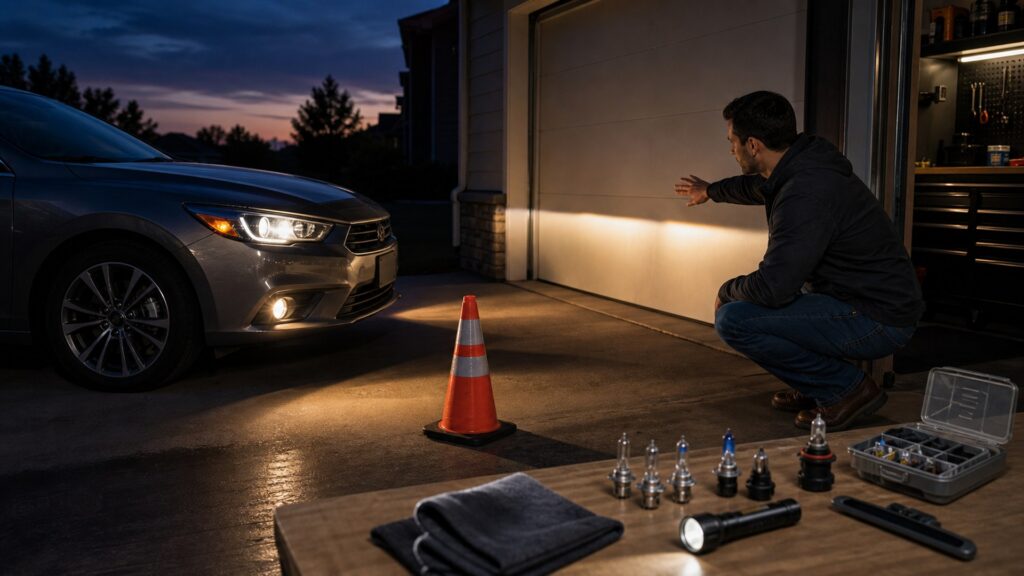
Validate aim under normal load: Set tire pressure and representative vehicle load, stabilize the suspension, and follow the specified aiming procedure after lamp, suspension, or collision work.
Who this is for
Match the solution to the nighttime route
The best intervention changes with traffic density, curves, weather, speed, and whether the existing system is degraded or simply limited.
Rural commuters: Prioritize usable high-beam reach, reliable dimming, wildlife-edge visibility, and low-beam performance when oncoming traffic prevents upper-beam use.
Curving-road drivers: Look closely at left and right curve illumination, aim, and curve-adaptive performance rather than relying on straightaway beam claims.
Urban night drivers: Control windshield scatter, reflections, lens haze, and glare while preserving conspicuity and signal clarity among streetlights and illuminated signs.
Older or glare-sensitive drivers: Favor clean optics, accurate aim, controlled beam distribution, and reduced interior reflections; an extremely cool or intense source is not automatically easier to use.
What to pay attention to
Night-driving evidence that predicts what reaches the road
Complete beam distribution and optical condition matter more than a component's peak output.
Road Performance
Low- and high-beam visibility on straight and curved approaches, plus glare at relevant eye heights.
Optical Integrity
Aim, lens transmittance, reflector condition, source geometry, voltage, and windshield cleanliness.
Measured illumination distance: Prefer road or laboratory data showing where a useful illuminance threshold is sustained rather than one peak candela or lumen number.
Curve coverage: Examine gradual and sharp curves in both directions; a beam that performs on a straight road can leave the inside of a bend underlit.
Glare performance: Useful reach should not be purchased by sending excessive low-beam light toward oncoming or preceding drivers.
Source and optic match: Filament or emitter location, shield, reflector, projector, lens, and control module create the pattern together.
Aim and leveling behavior: Manual adjusters, automatic leveling, ride height, trailer load, and cargo can change where the cutoff lands during real use.
Avoid these traps
Night-lighting changes that reduce usable vision
Common upgrades optimize appearance or near-field intensity while ignoring detection distance and visual adaptation.
Buying by color temperature: Whiter appearance does not establish greater reach, better curve coverage, legal compatibility, or lower glare.
Flooding the foreground: Excess light near the bumper can make pupils adapt to the bright foreground while hazards beyond it remain difficult to recognize.
Skipping aim after installation: A correctly shaped beam can still perform badly when a bulb is misseated, an assembly is loose, or the vehicle is loaded differently.
Overtrusting automatic high beams: Camera controls have limits around curves, weather, dirty glass, dim road users, and changing ambient light; the driver remains responsible for beam selection.
Decision guidance
Choose the smallest repair that restores seeing distance
Diagnose degradation first, then escalate only when the complete headlamp design remains the limiting factor.
If one side is weak: Compare voltage, ground, source seating, lens, reflector, moisture, and aim side to side before replacing both assemblies.
If both beams look dull: Clean the optical path, inspect aging sources and voltage drop, and evaluate lens restoration only when the coating and plastic condition make it appropriate.
If reach remains inadequate: Use complete-system evidence for the exact vehicle trim; replacement assemblies may require modules, coding, leveling, and calibration.
If weather is the complaint: Preserve correct low beams and add only a properly aimed, permitted fog function; reduce speed because backscatter and wet-road contrast remain limiting.
Ownership & compatibility
Keep the night-driving baseline measurable
Performance drifts as lenses weather, mounts move, sources age, and glass accumulates film. Inspect before the next dark-season commute.
Clean without damaging coatings: Use compatible products on lamp lenses and windshield surfaces; abrasive polishing can remove protective coating and accelerate renewed haze.
Recheck after vehicle changes: Aim and function deserve review after suspension work, tire-size changes, collision repair, heavy accessory installation, or persistent cargo loading.
Track symptoms, not impressions: Record flicker, color shift, condensation, warning messages, dark zones, and repeated driver flashes so service can isolate optical or electrical causes.
FAQ
Night-driving visibility questions
These answers distinguish real beam performance from brightness impressions.
Do brighter bulbs always increase seeing distance?
Why can very bright foreground light be a problem?
Should I use high beams whenever the road is dark?
Can lens restoration return factory performance?
Does a cooler color temperature improve night vision?
How do I know whether my headlamps are aimed correctly?
Are automatic high beams a replacement for driver judgment?
Why is my night vision worse in rain despite bright lamps?
When is a complete headlamp assembly justified?
Bottom line
Measure night lighting by the hazards it reveals
The winning system provides controlled distance and curve illumination under the beam modes the driver can use, while keeping glare and optical deterioration in check.
Restore first: Clean, inspect, power-check, and aim the existing system before buying an upgrade.
Judge the whole beam: Use straight, curve, low-beam, high-beam, and glare evidence for the exact vehicle.
Maintain the baseline: Watch lens condition, windshield scatter, mount stability, and aim as the vehicle changes.
Reading Shortcuts
Move from the night-driving lighting problem to a vehicle-compatible plan that can be installed and verified.
Decision Reminders
Keep the complete night-driving lighting system in view while comparing parts.
- Route: Straight, curved, urban, or rural.
- Distance: Look beyond foreground brightness.
- Glare: Preserve other drivers' vision.
- Aim: Check under representative load.
- Optics: Clean lens, reflector, and glass.
- Controls: Use upper beams responsibly.
Glossary Snippets
Terms that separate useful performance from apparent compatibility.
When to Use a Top 10 Review
Use a night-driving lighting roundup only after the required function, vehicle interface, and operating limits are known.
- Problem defined: The visibility or mobility failure is specific.
- Vehicle mapped: Interfaces and limits are documented.
- Format chosen: The correct product family is settled.
- Evidence available: Finalists can be compared on relevant tests.
Have finalists already? Open a Comparison for a closer tradeoff.
When to Use a Comparison
Compare night-driving lighting finalists that solve the same defined problem on the same vehicle configuration.
- Application: Both match the exact vehicle and function.
- Performance: Evidence addresses the operating problem.
- Integration: Mounting and system effects are understood.
- Ownership: Inspection and service demands are acceptable.
Need a broader field? Use a Top 10 to form a shortlist.