
Lighting & Visibility Buying Guide for Weather and Road Conditions
Bad weather changes both the air and the surfaces that light must cross. Fog, falling snow, rain, and dust return some light toward the driver. Wet pavement lowers contrast and redirects reflections. Salt and spray attack connectors, coatings, vents, and mounting hardware.
Name the limiting condition before adding a lamp. A low, wide fog distribution may help with close road-edge guidance in appropriate fog, but it cannot replace low beams or overcome unsafe speed. Lens heat may address icing yet demand more current. A sealed-looking housing still needs pressure and vapor management. Choose the beam, clearing method, and environmental construction as one system, then confirm road-use requirements and aim.
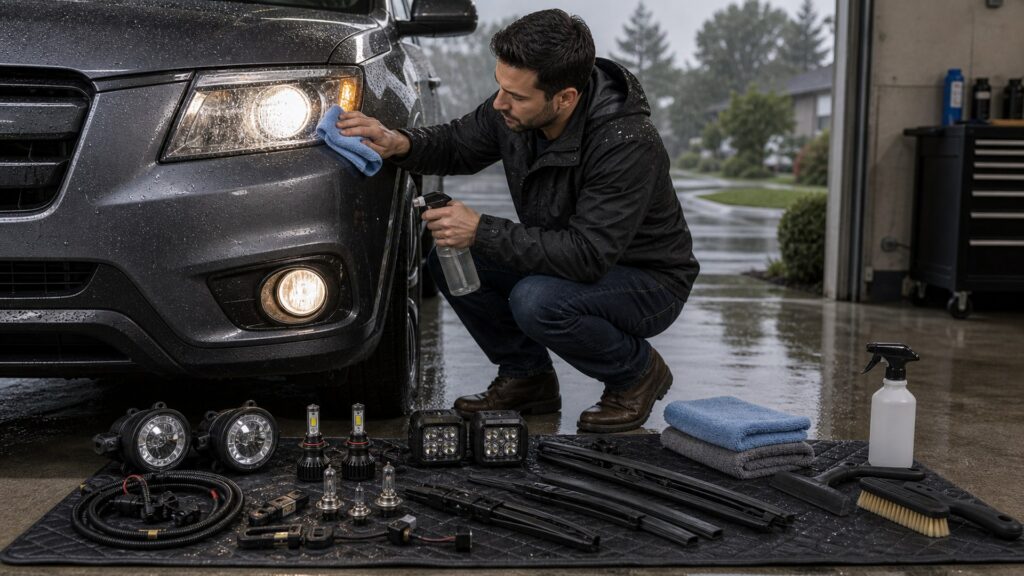
Buying framework
Treat weather visibility as air, surface, and hardware
Separate scattering in the atmosphere, lost contrast on the road, and contamination or damage at the lamp.
Identify the medium: Fog droplets, rain, snow, dust, and road spray have different density, motion, and persistence; record the condition that actually defeats visibility.
Preserve the primary low beam: Restore lens clarity and aim first. A fog lamp is a specialized supplement, not permission to drive without required headlamps.
Control where light goes: Favor a defined distribution that limits upward stray light and excessive foreground intensity; raw output can amplify backscatter.
Engineer for exposure: Match seals, vents, connectors, coatings, drains, heaters, and fasteners to water, salt, dust, temperature cycles, and cleaning methods.
Who this is for
Choose by the recurring weather failure
The right equipment differs for coastal rain, mountain snow, desert dust, winter salt, and occasional valley fog.
Frequent fog drivers: Prioritize correct low-beam aim, clean glass, and a low controlled fog pattern with permitted color, mounting, and switching.
Snow and ice users: Consider lens icing, snow packing, heater current, salt corrosion, and whether a recessed or flat lens remains serviceable during a storm.
Heavy-rain commuters: Focus on windshield and lens cleanliness, wet-road beam performance, drainage, connector sealing, and reduced glare from scattered or reflected light.
Dust and washboard users: Look for ingress-tested assemblies, protected vents, sealed terminations, stiff mounts, and surfaces that can be cleaned without scratching optical coatings.
What to pay attention to
Weather specifications that matter after the first storm
Environmental labels are useful only when they cover the assembled lamp, connector, vent, and installation orientation.
Optical Control
Cutoff, vertical spread, foreground balance, color, road-edge coverage, and reflection management.
Environmental Survival
Ingress, condensation, thermal cycles, salt corrosion, lens clearing, connector seals, and coating durability.
Fog-beam distribution: Look for a wide, controlled pattern intended for low mounting; color does not compensate for a flood or driving-beam optic.
Ingress and vent design: Understand the test standard, depth or spray condition, duration, assembly boundaries, and whether installation preserves the rated orientation.
Lens clearing strategy: Evaluate heat from the source, dedicated heaters, washer access, lens angle, and manual cleaning rather than assuming LEDs will melt snow.
Corrosion system: Coatings, stainless or plated hardware, isolated metals, sealed terminals, and drain paths must work together after stone chips and service.
Operating temperature and current: Heaters and drivers need cold-start behavior, thermal protection, fused supply, and charging-system margin in the conditions where they are most needed.
Avoid these traps
Weather-lighting fixes that add glare or trap moisture
The most tempting shortcuts confuse color with beam control and airtightness with moisture management.
Choosing yellow by appearance alone: Selective-yellow color may change visual impression, but useful fog performance still depends on controlled distribution, aim, mounting, output, and the driver's speed.
Sealing every vent: Blocking a designed vent can trap vapor and pressure. Diagnose caps, membranes, cracks, drains, and assembly guidance before applying sealant.
Assuming an ingress code covers the install: A lamp rating may not cover a spliced connector, upward-facing relay, cable entry, damaged membrane, or orientation that collects water.
Using high beams in dense fog or snow: More upward and distant light can return as a bright veil. Use appropriate lower beams, reduce speed, and select supplemental fog lighting only for its intended condition.
Decision guidance
Match each weather symptom to one intervention
Fix the condition at the optical surface or enclosure before adding another beam.
If the lens repeatedly ices: Compare heated assemblies or approved heater solutions with current demand, thermal control, lens material, wiring, and clearing coverage.
If droplets persist inside: Inspect caps, seals, cracks, vents, drains, prior repairs, and pressure paths; replace damaged components instead of permanently closing designed ventilation.
If fog creates a white wall: Confirm low-beam aim, clean glass, slow down, and evaluate a compliant low-mounted fog pattern rather than a higher-output driving beam.
If salt causes intermittent lamps: Repair corroded terminals and grounds, restore sealing and strain relief, protect dissimilar metals, and relocate vulnerable connections when the design allows.
Ownership & compatibility
Service weather lighting before exposure becomes failure
Seasonal inspection is more effective than discovering a failed heater, blocked vent, or green connector during a storm.
Clean with coating-safe methods: Rinse abrasive grit before wiping, use compatible cleaners, clear snow without sharp tools, and avoid products that haze plastics or obstruct vents.
Inspect after each harsh season: Check mounting tabs, fasteners, coating chips, cable chafe, seals, caps, membranes, drains, connector pins, grounds, and heater function.
Interpret moisture by pattern: A temporary light film after a temperature swing differs from standing water, repeated droplets, staining, or corrosion; follow the manufacturer criteria and repair guidance.
FAQ
Weather and road-condition lighting questions
These answers explain backscatter, color, sealing, icing, and corrosion.
Do yellow fog lights always work better in fog?
Why can high beams make snowfall harder to see through?
Are LED lamps less likely to clear snow from their lenses?
Does an IP rating guarantee the lamp will never leak?
Is temporary condensation inside a lamp always a defect?
Can I coat headlamp lenses to repel rain and dirt?
Where should fog lamps be aimed?
Why do road-salt conditions cause intermittent lighting faults?
Should auxiliary lamps remain covered on public roads?
Bottom line
Weather lighting succeeds by controlling reflection and exposure
Choose a distribution that supports the condition, then keep its lens, enclosure, wiring, and mount functioning through contamination and thermal cycles.
Name the failure: Separate backscatter, wet-road contrast, lens blockage, moisture entry, and corrosion.
Control the beam: Keep required low beams restored and add only the specialized function the condition warrants.
Maintain the enclosure: Protect vents, seals, connectors, coatings, heaters, and aim through each harsh season.
Reading Shortcuts
Move from the adverse-weather lighting problem to a vehicle-compatible plan that can be installed and verified.
Decision Reminders
Keep the complete adverse-weather lighting system in view while comparing parts.
- Atmosphere: Fog, rain, snow, or dust.
- Surface: Wet roads change contrast.
- Pattern: Control upward stray light.
- Lens: Plan cleaning and ice removal.
- Housing: Vent without admitting water.
- Salt: Protect terminals and mixed metals.
Glossary Snippets
Terms that separate useful performance from apparent compatibility.
When to Use a Top 10 Review
Use a adverse-weather lighting roundup only after the required function, vehicle interface, and operating limits are known.
- Problem defined: The visibility or mobility failure is specific.
- Vehicle mapped: Interfaces and limits are documented.
- Format chosen: The correct product family is settled.
- Evidence available: Finalists can be compared on relevant tests.
Have finalists already? Open a Comparison for a closer tradeoff.
When to Use a Comparison
Compare adverse-weather lighting finalists that solve the same defined problem on the same vehicle configuration.
- Application: Both match the exact vehicle and function.
- Performance: Evidence addresses the operating problem.
- Integration: Mounting and system effects are understood.
- Ownership: Inspection and service demands are acceptable.
Need a broader field? Use a Top 10 to form a shortlist.