
Lighting & Visibility Buying Guide: How to Choose the Right One
Vehicle lighting has two jobs: help the driver see and help other road users understand where the vehicle is and what it is doing. Those jobs depend on beam shape, aim, color, location, and timing—not simply on how bright a lamp appears when viewed up close.
Identify the required function before choosing a bulb or assembly. Match the source to the reflector or projector, confirm the application and electrical system, and evaluate beam distribution and glare after installation. Auxiliary lamps also need appropriate mounting, switching, and road-use status. A technically impressive light is a poor upgrade if it scatters light, overheats, leaks, triggers faults, or hides signals from other drivers.
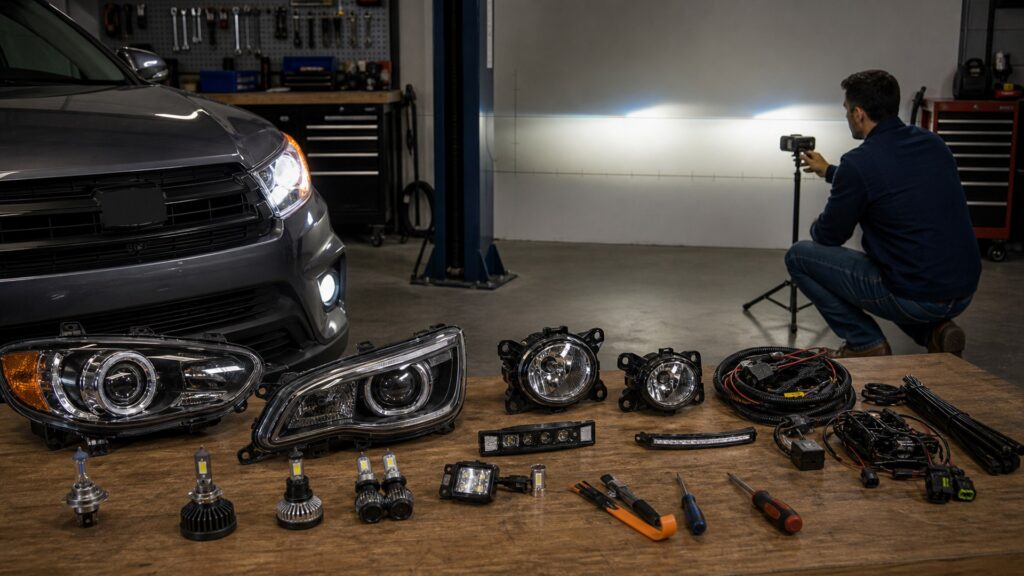
Buying framework
Choose the road function before the light source
Seeing, signaling, and adverse-weather lighting require different distributions. Begin with the complete lamp system, not a bulb technology.
Name the function: Separate low beam, high beam, fog, signal, marker, reverse, and off-road work lighting before comparing products.
Preserve the optic: Use a source and assembly documented for each other; reflector, projector, shield, lens, and source geometry create the beam together.
Evaluate the road pattern: Look for useful distance and curve coverage with controlled glare, not a bright foreground patch or a large lumen claim.
Plan installation and aim: Confirm mounting height, orientation, load condition, electrical supply, sealing, and the correct aiming or calibration procedure.
Who this is for
Match lighting to the driving problem
The route and visibility failure should drive the upgrade. Different users need different functions, not one brighter bulb.
Night highway drivers: Low-beam reach, high-beam performance, beam aim, and high-beam assist matter. Excess foreground light can feel bright without improving distant detection.
Rural and curving-road drivers: Curve illumination and appropriate high-beam use become important. Complete vehicle headlamp performance may matter more than source type.
Fog, rain, or snow users: A controlled low, wide fog pattern can reduce backscatter in appropriate conditions, but it does not replace correctly aimed low beams.
Work and off-road users: Scene and driving lights need dedicated wiring, mounting, and switching. Treat them as off-road equipment unless their exact road function and use are permitted.
What to pay attention to
Lighting characteristics the road reveals
Bench brightness does not show beam quality. The assembly must deliver controlled illumination and remain stable in heat and weather.
Optics & Visibility
Beam distribution, cutoff, glare, aim, curve coverage, high-beam reach, and signal recognition.
Integration & Durability
Application, electrical load, drivers, fuses, thermal control, venting, seals, connectors, and coding.
Application and source geometry: Bulb base, focal position, emitter size, orientation, and shield geometry must match the optic; physical insertion is only one fit check.
Measured beam performance: Prefer complete-vehicle or lamp photometric evidence that addresses visibility and glare on straight and curved approaches.
Aim range: The mount should allow the specified horizontal or vertical adjustment without loose hardware. Vehicle load and ride-height changes can alter aim.
Electrical design: Use appropriate current capacity, fuse, relay, driver or ballast, grounds, sealed connectors, and compatibility with lamp-out monitoring.
Thermal and moisture control: Heat sinks, fans, vent membranes, housing seals, and condensation management must work within the available space and engine-bay environment.
Avoid these traps
Lighting upgrades that look bright but see poorly
Most failures come from treating the source independently of the optic and road pattern. Glare is not evidence of useful reach.
Buying by lumens alone: Source output does not describe where light lands. Beam distribution, aim, optic compatibility, and glare determine useful visibility.
Installing a mismatched source: An LED or HID source in an optic designed around another geometry can scatter light or distort cutoff even when the base fits.
Aiming by garage-wall appearance only: A wall can support the specified procedure, but an improvised visual guess may leave beams high, low, or uneven. Follow vehicle service guidance.
Using work lights on public roads: A wide scene lamp may lack the beam control, color, mounting, or approval required for road use. Wire and switch it for its intended environment.
Decision guidance
Choose the smallest change that fixes the visibility problem
Restore condition and aim before replacing an entire system. Escalate when evidence shows the original design is the limitation.
If output has declined: Inspect lens haze, moisture, voltage, grounds, bulb age, reflector damage, and aim. Restoration or correct replacement may recover performance.
If replacing a bulb: Use the exact approved type for the housing and verify beam pattern and aim afterward; do not assume a different technology is compatible.
If replacing an assembly: Match trim, adaptive functions, leveling, connectors, modules, coding, and photometric application. Calibration may be required.
If adding auxiliary lamps: Choose the exact fog, driving, or work function, then design legal mounting, beam control, fused wiring, switching, and aim around that function.
Ownership & compatibility
Keep lenses, aim, and seals in the inspection routine
Lighting performance changes with contamination, impacts, ride height, moisture, and connector condition. Compare both sides and the road pattern.
Clean and inspect: Remove film and dirt from lenses, check cracks, mounting tabs, condensation, vents, connectors, and wiring abrasion.
Recheck aim: Inspect after suspension changes, collision repair, lamp replacement, heavy loading changes, or any impact that moves the housing.
Replace by condition and function: Address dimming, flicker, color mismatch, failed segments, overheating, or recurring moisture before nighttime visibility becomes unreliable.
FAQ
Lighting and visibility questions
These answers clarify beam quality, compatibility, and road use.
Are LED replacement bulbs always brighter than halogen bulbs?
What is more important, lumens or beam pattern?
Can yellow fog lamps improve visibility in fog?
Why do new headlamps need aiming?
What causes condensation inside a lamp housing?
Will higher color temperature help me see farther?
Do auxiliary lights need a relay and fuse?
Can headlight upgrades interfere with vehicle electronics?
When should I replace a complete headlamp assembly?
Bottom line
Useful light is controlled light
The right system supports the intended road function without excessive glare or electrical compromise. Judge what the driver and other road users receive, not how the source looks on a bench.
Name the function: Separate seeing, signaling, fog, and off-road work-light needs.
Keep source and optic matched: Verify the complete application, beam pattern, aim, electrical system, and road-use status.
Maintain the system: Clean lenses, protect seals and wiring, and recheck aim after changes or damage.
Reading Shortcuts
Move from lighting function and beam performance priorities to a usable configuration.
Decision Reminders
Check the vehicle system, not one product claim.
- Function: Low, high, fog, signal, or work.
- Optic: Match source geometry and housing.
- Pattern: Prioritize reach and glare control.
- Aim: Follow the specified procedure.
- Electrical: Fuse, wire, ground, and monitor.
- Road use: Confirm application and jurisdiction.
Glossary Snippets
Terms that clarify the important tradeoffs.
When to Use a Top 10 Review
Shortlist lighting function and beam performance products only after the governing vehicle limits and useful format are settled.
- Need defined: The recurring task is specific.
- Vehicle checked: Limits and interfaces are known.
- Format chosen: The product family is settled.
- Need options: Several valid designs remain.
Have finalists already? Open a Comparison for a closer tradeoff.
When to Use a Comparison
For lighting function and beam performance, rank competing designs against one defined vehicle and operating task.
- Fit: Both match the application.
- Duty: Both support the same load.
- Tradeoff: Convenience and protection differ.
- Upkeep: Inspection needs differ.
Need a broader field? Use a Top 10 to form a shortlist.